
12x More Vitamin C Than Oranges. All 4 Omegas. Why Can't You Buy It?
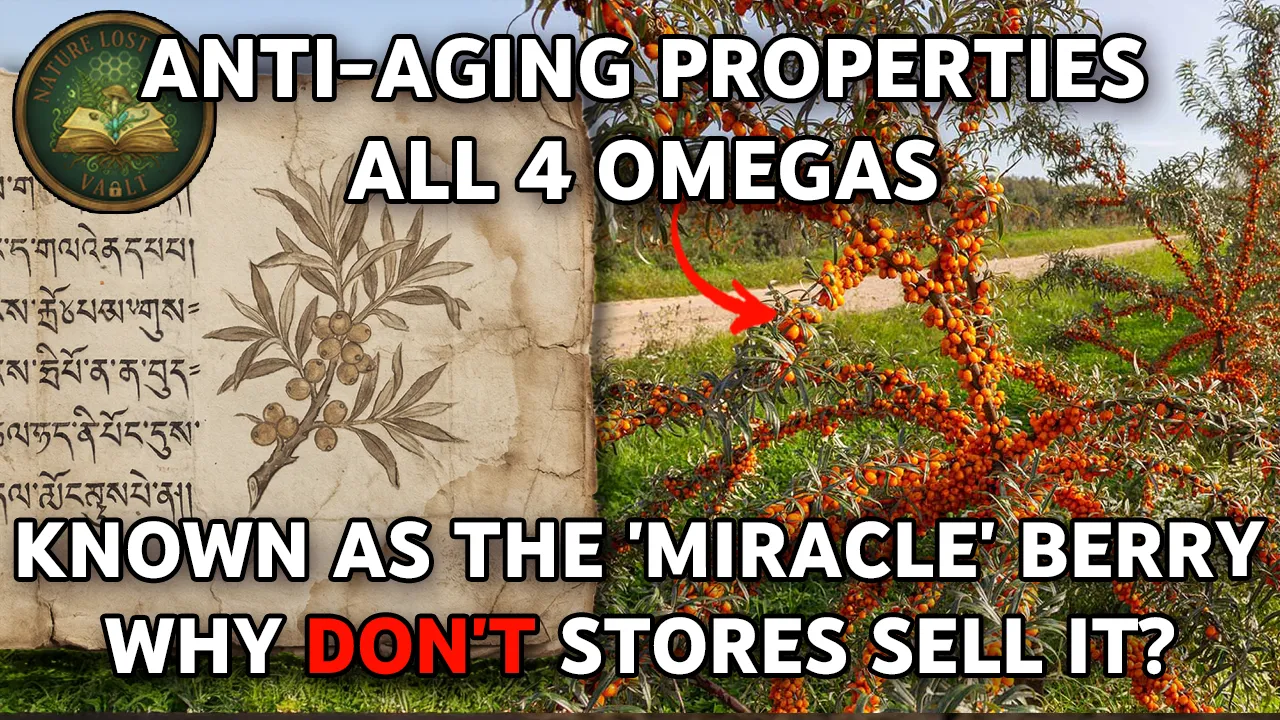
Table of Contents
Recommended Product: Sea Buckthorn Seeds
View Sea Buckthorn OptionsAffiliate link - supports our channel
What is Sea Buckthorn?
There is a berry growing in the harshest conditions on Earth.
From the frozen Himalayas at 15,000 feet where oxygen is scarce, to windswept coastal cliffs where salt spray kills everything else, to the Gobi Desert where summer heat exceeds 104°F and winter cold drops below -40°F.
It is bright orange. It tastes like sour pineapple mixed with citrus.
And it contains the biochemical profile that the supplement industry has been trying to synthesize for decades.
Here is what they are not telling you.
It is the only plant on Earth that contains all four omega fatty acids simultaneously: Omega-3, Omega-6, Omega-9, and Omega-7.
That last one, Omega-7, is so rare in the plant kingdom that macadamia nuts only have trace amounts. This plant has up to 40%.
While they sell you fish oil capsules extracted from industrial trolling operations scraping ocean floors clean, this plant has been growing wild in mountains and coastlines for 70 million years.
| Metric | Value |
|---|---|
| Botanical name | Hippophae rhamnoides ("shining horse") |
| Family | Elaeagnaceae (oleaster family) |
| Common names | Sea buckthorn, seaberry, Siberian pineapple, holy fruit of the Himalayas |
| Form | Deciduous dioecious shrub (separate male and female plants) |
| Mature height | 6–20 feet (2–6 m), thorns up to 6 inches |
| Evolutionary age | ~70 million years growing wild |
| Native range | Himalayas (to 15,000 ft), Eurasian steppe, coastal Europe, Gobi Desert |
| Temperature range | Survives -40°F winters and 104°F+ summers |
| Earliest documented use | 8th century AD Tibetan rGyud Bzhi (Four Medical Tantras, 156 chapters) |
| Linnaean classification | 1753 (Greek name retained for documented animal-health link) |
| Vitamin C content | ~12× that of oranges (up to 600 mg per 100 g berries) |
| Vitamin E content | Equal to or exceeds wheat germ |
| Omega fatty acids | Only plant on Earth with all four (omega-3, 6, 7, 9) in one fruit |
| Omega-7 (palmitoleic acid) | Up to 40% of berry oil (macadamia tops out near 20%) |
| Bioactive compounds | 190+ identified (carotenoids, flavonoids, phytosterols, tocopherols) |
| 2014 Maturitas RCT | 116 post-menopausal women: vaginal mucosa integrity restored without estrogen |
| Soil ecology | Symbiosis with Frankia bacteria fixes atmospheric nitrogen (zero fertilizer) |
| Loess Plateau restoration | Millions of acres planted in China since the 1990s to halt desertification |
| Commercial harvest method | Cut branches, flash-freeze at -40°F, shake berries off frozen |
1,200 Years of Documented Medicine
The Name: Shining Horse
Its scientific name is Hippophae rhamnoides, which translates from ancient Greek as "shining horse."
That is not poetry. That is observation.
The ancient Greeks documented that horses fed on these berries developed glossy coats and recovered from wounds faster.
When Linnaeus classified this plant in 1753, he kept the Greek name because the connection to animal health was already established across multiple cultures.
Tibetan Medicine - The Holy Fruit of the Himalayas
For 12 centuries, this plant has been one of the most revered medicinal species in Tibetan, Chinese, and Mongolian traditional medicine.
In the 8th century AD, Tibetan physicians compiled the rGyud Bzhi (The Four Medical Tantras), a 156-chapter medical treatise that became the foundation of Tibetan medicine.
Sea Buckthorn appears throughout these texts, used to treat:
- Digestive disorders
- Respiratory conditions
- Cardiovascular disease
- Skin injuries
The Tibetans called it the "holy fruit of the Himalayas" - not as supplemental medicine, but as primary treatment.
For 12 centuries, Tibetan physicians have prescribed Sea Buckthorn while Western medicine was still practicing bloodletting.
The Only Plant with All 4 Omegas
Unprecedented Nutrient Profile
This is not just ancient medicine. This is biochemistry that threatens multiple industries.
The nutrient profile is not just impressive - it is unprecedented:
- Vitamin C: 12x higher than oranges. A single Sea Buckthorn berry contains more vitamin C than an entire citrus fruit.
- Vitamin E: Levels equal or exceed wheat germ, the supplement industry standard.
- Lipid oils: The plant contains oils that allow your body to actually absorb fat-soluble vitamins.
Nature's Delivery System
Most plants give you vitamins. Sea Buckthorn gives you the delivery system.
Without fat, your body cannot use Vitamin E, Vitamin A, or Vitamin K. This plant solved that problem 70 million years ago.
It packages the vitamins with the oils in the same berry. That is biological engineering beyond anything industrial agriculture has achieved.
The Omega-7 Advantage
Now let us talk about what the supplement industry really does not want you to know: Omega-7 (palmitoleic acid).
This fatty acid is incredibly rare in the plant kingdom.
- Sea Buckthorn berry oil contains up to 40% Omega-7
- Macadamia nuts have maybe 20%
- Nothing else in the plant world comes close
Why does that matter? Because Omega-7 specifically targets mucous membranes - the internal lining of your body: your gut, your eyes, your mouth, your urogenital tract.
These tissues are under constant attack from inflammation, dryness, and cellular damage. Omega-7 repairs them from the inside.
Modern Science Validates Ancient Knowledge
Clinical Evidence
A 2014 study published in the journal Maturitas involved 116 post-menopausal women experiencing vaginal atrophy - a condition where tissue deteriorates due to declining estrogen.
Conventional treatment? Hormone replacement therapy.
This study used Sea Buckthorn oil. No estrogen. Just the oil.
The results showed significant improvement in the integrity of the tissue. A non-hormonal alternative that works.
One Plant, Multiple Solutions
Think about what this means. This single plant addresses needs currently filled by separate industries:
- Moisturizer
- Eye drops
- Gut health supplements
- Cardiovascular medication
- Hormone therapy
All from one species that grows wild.
Is this why it is not on every shelf? Is this why you have never heard of it?
Yes. And the reason is even more calculated than you think.
Healing Humans & Ecosystems
Nitrogen-Fixing Superpower
Sea Buckthorn does not just heal humans - it heals ecosystems.
The roots have a symbiotic relationship with Frankia bacteria. These bacteria pull nitrogen directly from the air and fix it into the soil.
That means Sea Buckthorn requires zero fertilizers. It feeds itself.
Ecological Restoration
The root system is extensive and aggressive. It prevents soil erosion. It stabilizes hillsides. It grows in soil so poor that nothing else survives.
The Chinese government launched massive ecological restoration projects starting in the 1990s. They have planted Sea Buckthorn across millions of acres in the Loess Plateau specifically to stop desertification.
Not as a food crop. As restoration.
Research from the Chinese Academy of Sciences documents this: The plant that heals human tissue also heals the skin of the Earth itself - the topsoil.
While industrial agriculture depletes soil and requires constant chemical inputs, Sea Buckthorn regenerates soil naturally.
It is the opposite of everything modern agriculture stands for.
How to Find & Identify Sea Buckthorn
Identification
Look for these characteristics:
- Leaves: Willow-like, silver-green leaves
- Thorns: Vicious thorns (you cannot miss them)
- Berries: Bright orange clusters that hug the branch so tightly they look painted on
Where It Grows
It grows wild across:
- Coastal Europe
- Throughout Asia
- Canadian prairies
- Parts of the United States
It loves salt spray. It thrives in poor soil. And it laughs at drought.
You can find it where nothing else grows.
Growing Sea Buckthorn
You can grow Sea Buckthorn from seeds or nursery plants. It requires:
- Full sun
- Well-drained soil (even poor soil)
- Male and female plants for berry production
- Minimal water once established
The plant is incredibly hardy and requires almost no maintenance once established.
The Thesis They Don't Want You to Understand
We do not need new synthetic drugs. We do not need laboratory supplements. We do not need pharmaceutical interventions for conditions that have plant-based solutions.
We need to look at what traditional medicine systems revered.
- The Tibetan monks knew
- The ancient Greeks documented it
- Modern science has validated it
They used plants that industrial systems have either forgotten or deliberately ignored.
Why You've Never Heard of It
Sea Buckthorn is not a superfood trend. It is:
- 1,200 years of documented medical use
- Nitrogen-fixing ecological restoration at a planetary scale
- The only plant on Earth with all four omega fatty acids in one package
Better than salmon caught from collapsing ocean ecosystems.
Better than avocado shipped thousands of miles.
Better than any isolated supplement they are selling you.
The Real Reason
So why have you never heard of it?
- Because you cannot patent 12 centuries of knowledge
- Because it does not fit the industrial agriculture model
- Because one plant that replaces six different product categories is bad for business
The Plant Doesn't Care
But the plant does not care about their business model.
It keeps growing in the Himalayas at 15,000 feet. It keeps producing on windswept coastal cliffs. It keeps offering the same nutrition that sustained civilizations.
The only question is: Will you start using it?
Sea Buckthorn FAQ
What plant has all 4 omegas?
Sea buckthorn (Hippophae rhamnoides) is the only plant on Earth that contains all four omega fatty acids simultaneously: omega-3, omega-6, omega-9, and the rare omega-7 (palmitoleic acid). Macadamia nuts contain only trace amounts of omega-7, while sea buckthorn has up to 40%. This berry has been growing wild for 70 million years.
What are the health benefits of sea buckthorn?
Sea buckthorn contains 12x more vitamin C than oranges, vitamin E equal to wheat germ, all 4 omega fatty acids, and over 190 bioactive compounds. Tibetan physicians have used it for 1,200 years to treat digestive disorders, respiratory conditions, cardiovascular disease, and skin injuries. Its unique lipid oils allow your body to absorb fat-soluble vitamins directly from the berry.
Why is omega-7 in sea buckthorn important?
Omega-7 (palmitoleic acid) is extremely rare in the plant kingdom. Sea buckthorn contains up to 40% omega-7, making it the richest plant source known. Research has linked omega-7 to supporting mucous membrane health, skin regeneration, and cardiovascular function. The supplement industry sells omega-7 capsules extracted from sea buckthorn at premium prices, but the whole berry delivers it alongside all other nutrients.
How much vitamin C does sea buckthorn have compared to oranges?
Sea buckthorn contains approximately 12 times more vitamin C than oranges. A single sea buckthorn berry contains more vitamin C than an entire citrus fruit. Combined with its vitamin E, lipid oils, and omega fatty acids, sea buckthorn is one of the most nutrient-dense berries ever analyzed.
Why is sea buckthorn so hard to harvest commercially?
Sea buckthorn is protected by dense thorns up to 6 inches long that puncture leather gloves, and the berries attach directly to the wood with no natural breaking point. Hand-picking causes the thin-skinned fruit to burst. The only commercial method that works is to cut entire branches, flash freeze them at -40°F, and shake the berries off while frozen solid. This is incompatible with the fast-commodity model of industrial agriculture, which is why corn and soy dominate while sea buckthorn remains uncommercialized in most countries.
Explore More Medicinal Plants
Discover ancient healing plants backed by centuries of traditional use and modern science.
Browse Medicinal Plants Collection →