The Infinite Fertilizer: The Plant That Threatened a $230 Billion Industry
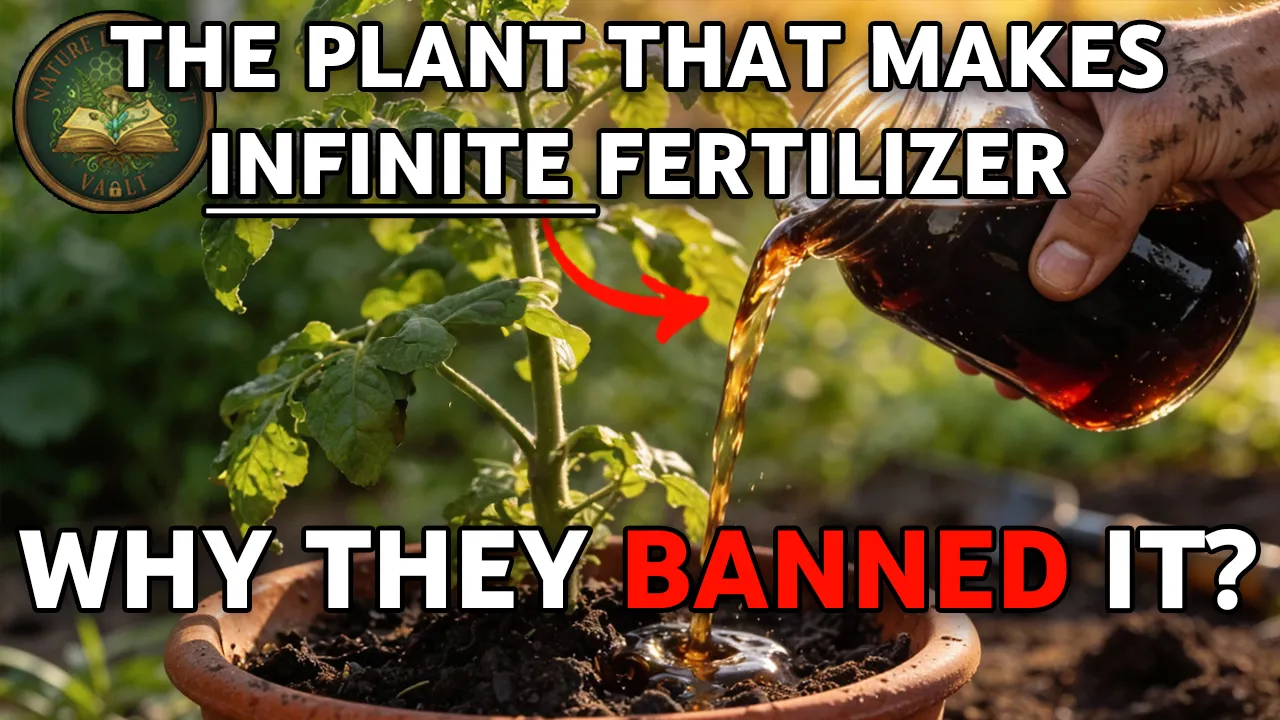
Table of Contents
Recommended Product: Comfrey root cuttings and growing supplies
View Comfrey OptionsAffiliate link - supports our channel
What is Comfrey?
In the 1960s, British agricultural trials documented yields that should not be biologically possible, 100 tons per acre, year after year, on soil so poor other crops failed. The same plant was cut five times in a single season, regrowing to full size in just 4 weeks. It required no fertilizer input, no irrigation, and no replanting for 20 years. Laboratory analysis confirmed decomposition rates that defied every known green manure.
While other crops take weeks to break down and release nutrients, this plant melts into the soil in 48 hours. Victorian England cultivated it as insurance against starvation. By 1954, one man systematically bred 21 varieties searching for perfection. Yet by 2001, it had vanished from every garden center in America.
Today, the global fertilizer industry generates $230 billion annually, consuming vast amounts of natural gas and producing massive carbon emissions to sell farmers something this plant produces for free. This is comfrey (*Symphytum officinale*). The war to erase it reveals what happens when nature offers something corporations cannot control. Welcome to Nature's Lost Vault.
The story begins in 90 AD when the Greek physician Dioscorides documented a plant with sticky roots in Demateria Medika, the text that remained Europe's primary medical reference for 1500 years. He prescribed it for broken bones. The Greek name symphfetum literally means to make grow together. The Romans proved it.
Plenny the Elder boiled the roots into a paste and used it to stick pieces of meat together. The adhesive held. For 2,000 years, Europeans called it knit bone. But in 1845, one man discovered its true potential.
It had nothing to do with medicine. Henry Double Day was a poor Quaker in Essex when the Irish potato famine struck. 1 million people starved to death while he watched helpless. He had tried manufacturing starch, then producing glue for postage stamps.
Both businesses failed, but the images of mass starvation never left him. In the 1850s, while searching for a new glue source, he wrote to the head gardener at the Royal Palace in St. Petersburg, requesting a specific Russian variety of comfrey. But fate intervened.
| Metric | Value |
|---|---|
| Botanical name | Symphytum officinale, Symphytum × uplandicum (Bocking 14) |
| Family | Boraginaceae (borage family) |
| Earliest documented use | ~90 AD (Dioscorides, De Materia Medica) |
| Traditional name | "Knitbone" (2,000+ years) |
| Key cultivar | Bocking 14 (sterile, bred 1950s by Lawrence Hills) |
| Yield | Up to 100 tons fresh biomass / acre / year |
| Potassium content (fresh leaf) | ~7% (higher than manure) |
| Decomposition time | ~48 hours |
| Productive lifespan | 20+ years from single planting |
| Root depth | Up to 10 feet (3 m) |
| Active compounds | Allantoin, rosmarinic acid, pyrrolizidine alkaloids |
| FDA ruling (2001) | Internal supplement use banned; topical & fertilizer use legal |
| Distribution | Temperate Europe, North America, cultivated worldwide |
Historical Context & Discovery
The plants he received were not pure Russian comfrey. They were an accidental cross, an F1 hybrid exhibiting genetic vigor. Neither parent possessed. Double Day had stumbled onto something unprecedented.
The hybrid plants produced yields no one had seen before. 100 tons per acre. Doublede abandoned the glue business. The Irish famine had shown him what mattered.
This plant could prevent future starvation. He spent the next 30 years meticulously researching confrey's potential as a food and forage crop. He died at 92, still poor, still devoted to the plant he believed could feed a hungry world. And then tragedy struck.
His family burned all his notes. 30 years of yield data, cultivation techniques, and nutritional analyses were gone. The full extent of his work vanished into ash. For decades, comfrey cultivation declined as the industrial revolution shifted agriculture toward mechanization and chemical inputs.
Farmers forgot the Quaker, who had achieved 100 tons per acre with nothing but a spade. In 1948, a young horiculturist named Lawrence Hills discovered Double Day's forgotten story and decided to finish what the Quaker had started. Hills founded the Henry Double Day Research Association, gathering comfrey strains from across Britain and growing 21 varieties side by side. He recorded every measurement, testing every claim, documenting what the fire had destroyed.
By the early 1960s, one strain dominated every metric. Bocking 14. It was sterile, producing no invasive seeds. It resisted disease and it delivered the highest nutrient content of any comfrey tested.
Then Hills did something the fertilizer industry could not comprehend. He refused to patent it and instead he mailed root cutings for free to anyone who requested them. Gardeners in England, farmers in Africa, and experimenters in America. By the time Hills retired, Bocking 14 was growing on six continents.
Laboratory analysis reveals why this terrified the chemical industry. Fresh comfrey leaves contain higher levels of potassium than farmyard manure. While manure rarely exceeds 1.5%, Bocking 14 delivers over 7%. But the decomposition rate is the real revolution.
Most green manurs, alalfa, clover, and grass sit in compost heaps for weeks before releasing nutrients. But comfry's low fiber content means microbes devour the leaves in 48 hours. Toss fresh comfrey onto a stalled compost pile, and within hours, the temperature spikes. The material transforms into black, nutrient-rich humus, while other crops are still intact.
The secret lies deep underground. Comfrey roots penetrate 10 ft into the soil far beyond where vegetables and grains can reach. Those roots function as living mining drills pulling up potassium, calcium, and phosphorus from the deep subs soil and concentrating them in the leaves. When you cut the plant, you are bringing deep earth minerals to the surface.
It is a biological nutrient pump. By the early 1900s, the world faced a crisis. Natural fertilizer sources like guano were running out and scientists warned of famine. Then German chemists invented the Hera Bosch process to synthesize ammonia from nitrogen in the air.
It saved the world from starvation, but it addicted agriculture to fossil fuels. Today, the harbor Bosch process feeds half the world's population, but it consumes vast amounts of natural gas and generates massive carbon emissions. The global fertilizer market is worth over $200 billion, and it depends on farmers buying bags of nitrogen, phosphorus, and potassium every single year. Comfrey threatens that entire model.
You plant comfrey once and it produces for 20 years. You need no fertilizer input because the plant is fertilizer. You need no irrigation after establishment because the 10-ft tap routt accesses deep water tables. You need no pesticides because nothing bothers it.
And you need no annual purchase. If every farmer in Britain had followed Henry Double Day, the synthetic fertilizer industry would have lost its foothold. If every gardener in the 1950s had planted Bocking 14, commercial sales would have collapsed, and the industry knew it, which is why what happened in 2001 was so perfectly timed. On July 6th, 2001, the FDA issued a warning.
Scientific Research & Nutritional Benefits
Manufacturers were advised to remove comfrey dietary supplements from the market. The reason was sound. Comfrey roots contain pyizodine alkaloids, compounds that can cause liver damage if ingested in large quantities over long periods. The FDA banned supplements for internal use, pills, teas, and capsules.
But the headlines did not make that distinction. Garden centers saw the word toxic and stopped stocking comfrey entirely. Nurseries refused to carry it. The public heard liver damage and assumed the plant was dangerous to touch or grow.
No one explained that using comfrey as fertilizer poses zero risk to humans. No one explained that soil microbes break down the alkoids rapidly. The result was surgical. Comfrey vanished from mainstream gardening within 5 years.
The plant that Lawrence Hills spent 40 years promoting disappeared. The timing is worth noting. In 2001, natural gas prices were rising. The fertilizer industry was consolidating into massive conglomerates, companies whose entire business model depends on farmers remaining dependent.
And suddenly the one plant that offered permanent independence was declared too dangerous to sell. Meanwhile, Comfrey's performance has not changed. Bocking 14 still produces 100 tons per acre. It still decomposes in 48 hours.
It still delivers 7% potassium. Established comfrey survives temperatures down to -30°. It tolerates drought, thrives on marginal land, and because Bocking 14 is sterile, it never invades. It stays exactly where you plant it.
Controlled abundance waiting for harvest. Cut the plant when it reaches 2 ft tall, and within 4 weeks, it regrows. Five harvests per season, 20 tons per harvest, 100 tons annually, for two decades. Use the leaves as mulch around tomatoes.
Make free liquid fertilizer that outperforms commercial feeds or charge your compost piles. Comfrey solves fertility without purchasing anything ever. From 1845 to 2001, three forces tried to erase comfrey. Time erased Henry Double Day's notes.
Industrial agriculture erased the need for perennials and regulatory confusion erased it from garden centers. But none of those erasers changed the math. The fertilizer industry generates billions by selling products you must buy every year. Natural gas companies profit when agriculture depends on synthesis plants.
That entire system relies on you forgetting that fertility can be grown, not bought. Comfrey cannot be patented. It cannot be genetically modified to force annual purchases and it cannot be controlled because it grows from a single root fragment. Lawrence Hills understood this.
How to Identify, Grow & Use Comfrey
That is why he gave it away for free. He knew that for Comfrey to survive, it had to be decentralized and impossible to monopolize. Walk through any permaculture garden today and you will find it. The people who grow it understand that 100 tons per acre costs nothing if the plant lives 20 years.
They understand that fertility does not come in bags. It comes from deep roots. Comfrey is not extinct. It is underground literally and metaphorically.
Bocking 14 still exists. Root cutings pass between gardeners like contraband. The plant Henry Double Day found after the famine persists exactly as he predicted. Unckillable, unstoppable, waiting for the moment when dependence becomes too expensive.
It is not a weed. It is freedom from the supply chain. It is fertilizer that costs nothing forever. And the fact that a $230 billion industry spent 150 years trying to make you forget it exists tells you exactly how valuable it is.
Comfrey is waiting. The only question is whether you will plant it. If this vault opened something for you, subscribe to Nature's Lost Vault and hit the bell. Every like and share preserves what they tried to erase.
Frequently Asked Questions
How much does comfrey yield per acre?
Comfrey (specifically the Bocking 14 cultivar) produces up to 100 tons of fresh biomass per acre per year with zero external fertilizer inputs, sustained for 20 or more years from a single planting. It decomposes in just 48 hours, releasing approximately 7% potassium, along with nitrogen and phosphorus, making nutrients immediately available to surrounding plants. A mature plant can be cut 4 to 5 times per season, regrowing to full size in about 4 weeks each time.
How do you use comfrey as fertilizer?
Three main methods:
- Mulch: cut comfrey leaves and lay them directly around tomatoes, potatoes, squash and fruit trees. They melt into the soil in 48 hours.
- Liquid feed: pack a bucket with leaves, cover with water and steep 2 to 4 weeks. The resulting black liquid is diluted 10 to 15 parts water to 1 part concentrate and watered onto plants.
- Compost activator: toss fresh comfrey onto a stalled compost pile. The low-fiber leaves heat the pile within hours and accelerate decomposition of everything else.
What is Bocking 14 comfrey and where does it come from?
Bocking 14 is a sterile cultivar of Russian comfrey (Symphytum × uplandicum) selected by British horticulturist Lawrence Hills in the 1950s at his trial ground in Bocking, Essex. Out of 21 varieties tested, Bocking 14 gave the highest yield, the highest potassium content (over 7%), and best disease resistance. Because it is sterile, it produces no seed and cannot spread invasively. Hills refused to patent it and mailed root cuttings free to gardeners worldwide. It still propagates today only by root division, passed between gardeners.
Why did the FDA ban comfrey?
On July 6, 2001, the FDA advised manufacturers to remove comfrey dietary supplements from the US market due to pyrrolizidine alkaloids (PAs), compounds in the plant that can cause liver damage when taken internally in concentrated doses over long periods. The ban applied specifically to oral supplements (pills, teas, capsules). External use on skin and use as garden fertilizer were never banned and remain fully legal. The plant had been used medicinally for over 2,000 years under the name knitbone before the ruling.
Is comfrey safe to use on the skin?
Yes. Topical comfrey preparations (salves, poultices and creams made from the leaves or root) are considered safe when applied to unbroken skin for short periods. The European Medicines Agency has approved certain standardized topical comfrey products for use on sprains, bruises and joint pain. Comfrey contains allantoin, which accelerates cell proliferation and is the traditional reason the plant was known for 2,000 years as knitbone. Do not apply to open wounds or broken skin, and do not use continuously for more than 4 to 6 weeks.
Explore More Medicinal Plants
Discover ancient healing plants backed by centuries of traditional use and modern science.
Browse Medicinal Plants Collection →