The Battlefield Medicine They Turned Into a Weed. Why Is It Forgotten?
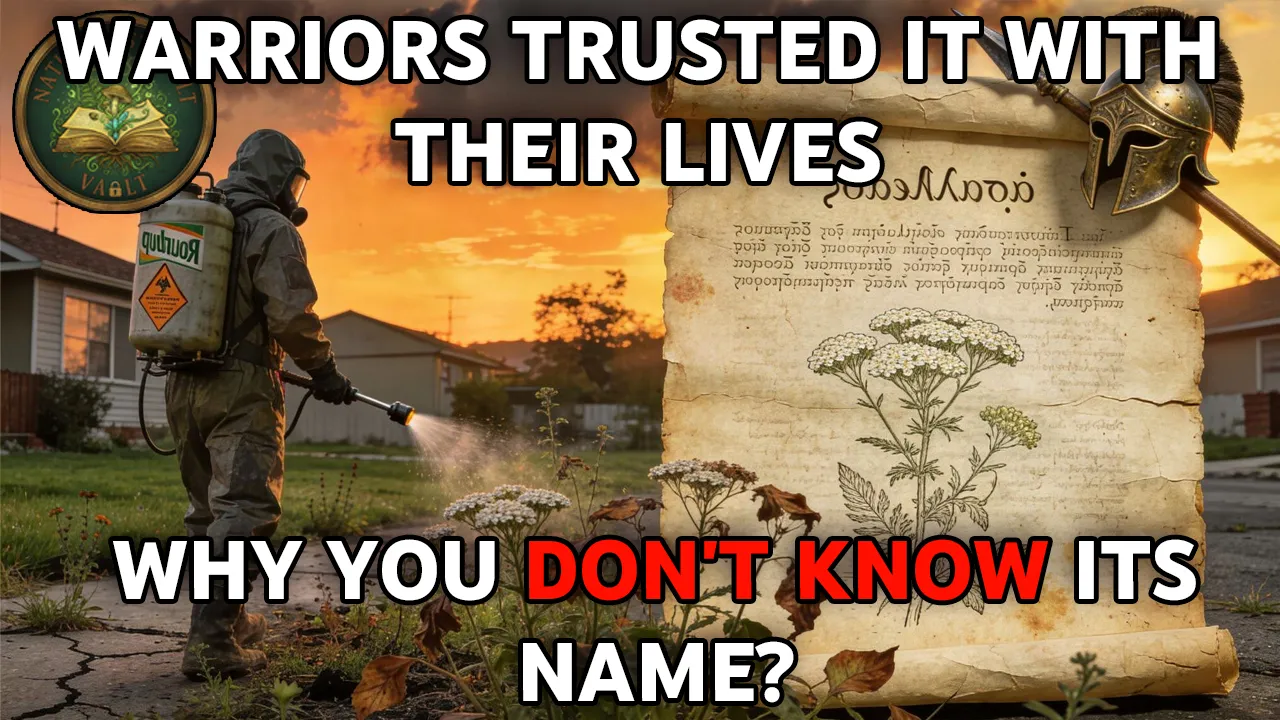
Table of Contents
Recommended Product: Yarrow seeds and growing supplies
View Yarrow OptionsAffiliate link - supports our channel
What is Yarrow?
There is a plant growing in your lawn right now that people have pressed into wounds to stop bleeding for two thousand years.
A plant whose pollen was found beside a Neanderthal burial in the mountains of Iraq.
A plant named after a Greek warrior who, legend says, used it to heal wounds.
And today, it is called a weed.
They sell you chemicals to spray it. They publish bulletins on how to eradicate it. They have created an entire industry teaching you to poison it out of existence.
This plant has been used as battlefield medicine for two thousand years. It contains compounds that modern pharmaceuticals are still trying to replicate. It grows for free in every climate where humans live.
And that is precisely why they had to make you forget it.
This is the story of Yarrow. The plant that healed warriors and terrifies a ten-billion-dollar industry.
60,000 Years of Medicine - From Neanderthals to Troy
The Shanidar Cave Discovery
The archive opens in 1960. American anthropologist Ralph Solecki and his team were excavating Shanidar Cave in the Zagros Mountains of northern Iraq. They were looking for bones. They found something that would become one of the most famous images in prehistory.
Ten Neanderthal skeletons. Dating back sixty thousand years.
But it was not the bones that shocked the scientific community. It was the soil around them.
One skeleton, known as Shanidar Four, was different. When palynologist Arlette Leroi-Gourhan analyzed the soil samples, she found concentrated clumps of pollen. She published the finding in Science in 1975.
She argued this was not pollen blown in by the wind, but flowers placed in the grave.
She identified Grape Hyacinth. Bachelor's Button. Groundsel. And among them, one small white herb with feathery leaves: Yarrow.
In 2023, archaeologist Chris Hunt and his team reexamined the evidence. Their verdict: the pollen clumps were most likely carried underground by burrowing rodents. So the cave does not prove that Neanderthals used Yarrow as medicine.
Everything after the cave does. For two thousand years of written history, this was the herb people pressed into wounds.
Identifying Yarrow
The plant they chose is unmistakable:
- Feathery leaves so finely divided they look like tiny ferns
- White flowers that bloom in flat-topped clusters
- A smell that hits you instantly—sharp, herbaceous, like pine needles crushed between your fingers
Botanists call it Achillea millefolium. The Thousand Leaves. Named for what happened next.
Achilles and the Battlefields of Troy
Homer never mentions Yarrow. The story comes later. In the first century AD, Pliny the Elder recorded that Achilles, the great warrior of the Trojan War, found a plant to heal wounds.
According to Pliny, Achilles used it on Telephus, a king he had wounded with his spear.
Dioscorides, the army physician whose De Materia Medica ruled European medicine for fifteen centuries, prescribed it for bleeding wounds. The instruction never changed: crush the leaf, pack the wound, stop the blood.
The Greeks named the plant Achilleios. Later Latin herbals called it Herba Militaris, the military herb.
Because on the battlefields of the ancient world, Yarrow meant the difference between bleeding out in the mud or surviving to fight another day.
And this is not just folklore. In 1954, chemists F. M. Miller and Lee Ming Chow isolated achilleine, an alkaloid from Yarrow, and reported in the Journal of the American Chemical Society that about 0.5 milligrams per kilogram, injected into rabbits, cut blood clotting time by roughly 32%.
A third faster. That is the arithmetic of a wound closing.
Through the Ages
Its folk names read like a field surgeon's notebook: soldier's woundwort, knight's milfoil, staunchweed, nosebleed. By the First World War, wound care had moved to antiseptics: in 1915 Alexis Carrel and Henry Dakin introduced a hypochlorite solution for irrigating infected wounds.
For two thousand years of written history, Yarrow was the herb pressed into wounds. And then it disappeared.
Indigenous Wisdom Across Continents
But the story is not just about time. It is about geography.
When European settlers arrived in North America, they found something that defied explanation. Indigenous peoples across the continent, separated from the Greeks by an ocean and five thousand years, were using the exact same plant for the exact same purpose.
- The Navajo valued it as a "life medicine"
- The Cherokee drank it to break fevers
The Zuni took it a step further. In 1915, anthropologist Matilda Coxe Stevenson recorded that people chewed the blossoms and roots and rubbed the cooling juice on their skin before the fire ordeal, when dancers handled burning embers.
Think about that. Greeks and Romans around the Mediterranean. The Navajo in Arizona. How did cultures separated by thousands of miles and thousands of years independently discover the exact same medical application?
Because Yarrow actually works.
The Science & Why Big Pharma Erased It
Modern Scientific Validation
Modern research has confirmed what the ancients knew instinctively. A 2024 study published in Hepatology Forum applied topical Yarrow to standardized incisions in 12 rats. Bleeding time fell by 36% in one group and 32% in the other. An animal study, but a measured one.
Chemical Powerhouse
The plant is a chemical powerhouse:
- Tannins that constrict blood vessels, physically closing the wound
- Azulene, a compound that turns blue when distilled, which reduces inflammation and triggers tissue regeneration
- Salicylic Acid, the precursor to aspirin, for pain
- Flavonoids like apigenin that calm inflammation
In laboratory tests, the essential oil of Yarrow inhibits Staphylococcus aureus, E. coli, and Candida.
In wound healing studies, Yarrow-treated injuries closed faster, developed healthier tissue, and showed less scarring than the control groups. A double-blind trial of 140 first-time mothers (published online in 2017, in print in 2018) found that yarrow ointment on episiotomy wounds meant less pain, redness, swelling and bruising.
Pliny would not have been surprised.
Why Is It Not in Every First-Aid Kit?
So if Yarrow is this effective, if it stops bleeding, kills bacteria, and relieves pain, why is it not in every first-aid kit in America? Why are we spraying it with poison instead of harvesting it?
You simply have to follow the money.
The Aspirin Story
The turning point was 1897. A chemist at Bayer named Felix Hoffmann synthesized acetylsalicylic acid. We know it as Aspirin.
Its chemistry came from willow bark and meadowsweet, not from Yarrow, which contains only minor amounts of salicylic acid. But there was a problem with the plants.
You cannot patent a leaf. You cannot patent a root. But you can patent a synthetic extraction process.
Aspirin became one of the most profitable drugs in human history. Forty thousand tons are consumed annually. A ten-billion-dollar market.
But there is a hidden cost. A widely cited 1999 estimate put deaths from gastrointestinal bleeding linked to NSAIDs as a whole, not aspirin alone, at about 16,500 a year in the US.
Not a Natural Aspirin
Yarrow does contain some salicylic acid, but only in minor amounts. There is no good evidence that the whole plant works as a gentler aspirin or that its tannins buffer the stomach. Its documented uses are different: wounds, digestion, appetite and cramps.
When you isolate a compound, you strip away the safety mechanisms evolved over millions of years.
But isolated compounds are patentable. Profitable. Controllable. Whole plants are not.
The Systematic Demotion
In the 1880s, Yarrow was dropped from the United States Pharmacopeia, where it had been listed for hemorrhage and fever. Through the 20th century, as the pharmaceutical industry consolidated power, medical schools stopped teaching it. Doctors dismissed it as folklore.
Yarrow went from Herba Militaris, the savior of soldiers, to a noxious weed.
The definition of a weed is simply a plant that the industry has not figured out how to monopolize yet.
They classified it as a nuisance because they could not commodify it. They created chemicals to kill it because they could not patent it. They convinced you it was worthless because its value undermines their business model.
How to Grow & Use Yarrow
Yarrow Refuses to Die
But here is what they cannot control. Yarrow refuses to die.
- It grows in all fifty states. Every Canadian province. Every continent except Antarctica
- It thrives in poor soil
- It tolerates drought
- It survives being walked on
- It requires zero fertilizer
Once established, it spreads through underground rhizomes, coming back year after year. It is the ultimate survivalist.
Growing Yarrow - An Act of Resistance
Bringing it back to your garden is an act of resistance.
Starting from Seed: The seeds need light to sprout. Sprinkle them on the surface of the soil. Do not bury them.
Root Division: Or simply find a wild patch and take a root division.
Planting: Plant it in full sun. Give it terrible soil. Ignore it. It will thrive.
By the end of the first year, a small planting will fill a 3 by 4 foot bed.
Harvesting & Preparation
When to Harvest: Harvest it when the flowers are fully open, typically midsummer to early fall. Cut the top third of the plant—flowers, leaves, and stems. Do it in the morning, after the dew has evaporated but before the sun gets hot. That is when the volatile oils are at their peak.
Drying: Tie the stems in small bundles and hang them upside down in a dark, airy place. Or use a dehydrator on low heat. When the leaves crumble like crackers, they are ready.
Storage: Store them in a glass jar. They will keep their potency for years.
How to Use Yarrow
For Wounds: Crush the fresh leaves into a green paste and apply it directly to the cut. The bleeding stops. The pain fades.
For Fever: Steep a teaspoon of dried flowers in boiling water. It opens the pores and breaks the fever naturally.
Important Safety Note
A quick note of caution. Yarrow is powerful. If you are allergic to ragweed or daisies, test a small amount first. And if you are pregnant or on blood thinners, consult a professional.
But for the vast majority of human history, for the vast majority of people, Yarrow was the first line of defense.
Breaking the Lock
This is what they do not want you to understand. Every empire in history has controlled its population through three things: Food, Medicine, and Information.
When you cannot grow your own food, you depend on the system. When you cannot heal your own wounds, you depend on the system. When you do not know there is an alternative, you are trapped in the system.
Yarrow breaks the lock.
It grows like a weed. It works in minutes. It costs nothing. It has been tested by two thousand years of recorded human use, a clinical trial vastly longer than any drug on the market today.
The Earth Provides
The healers who pressed it into wounds for two thousand years knew something we have been taught to forget. He knew that the earth provides. He knew that health is not something you buy. It is something you grow.
Yarrow proves it.
Once you learn to identify those feathery leaves and flat white flowers, you will see them everywhere. In parks. Along highways. In the cracks of the sidewalk. Growing wild in the margins of the very system that tried to erase it.
They buried the knowledge. But the plant survived. Just like it has for sixty thousand years.
The white flowers are blooming right now. Each one contains more healing power than a bottle of pills manufactured in a sterile factory.
Dioscorides knew it. The Navajo knew it. And now, you know it.
Frequently Asked Questions
How does yarrow stop bleeding?
Yarrow (Achillea millefolium) contains tannins that tighten tissue and achilleine, an alkaloid that shortened clotting time by about 32% when injected into rabbits in a 1954 study. Traditionally, a crushed fresh leaf is pressed on a minor cut for a few minutes, a use recorded from Dioscorides onward.
What are the medicinal uses of yarrow?
Yarrow stops bleeding, lowers fever, fights infection, and promotes wound healing. It is named after Achilles, who according to Pliny the Elder healed wounds with it. Yarrow-type pollen found at a Neanderthal burial in Shanidar Cave was once read as evidence of prehistoric medicine, but a 2023 study attributes it to burrowing rodents.
Is yarrow safe to use?
Yarrow has been used medicinally for thousands of years and is generally considered safe for external wound treatment. It grows wild across most temperate regions. As with any medicinal plant, consult a healthcare provider before internal use, especially during pregnancy.
Explore More Medicinal Plants
Discover ancient healing plants backed by centuries of traditional use and modern science.
Browse Medicinal Plants Collection →