
Grow Unlimited Omega-3 in a Bucket. Plant just ONCE in 5 Mins. Why Don't You Know About It?
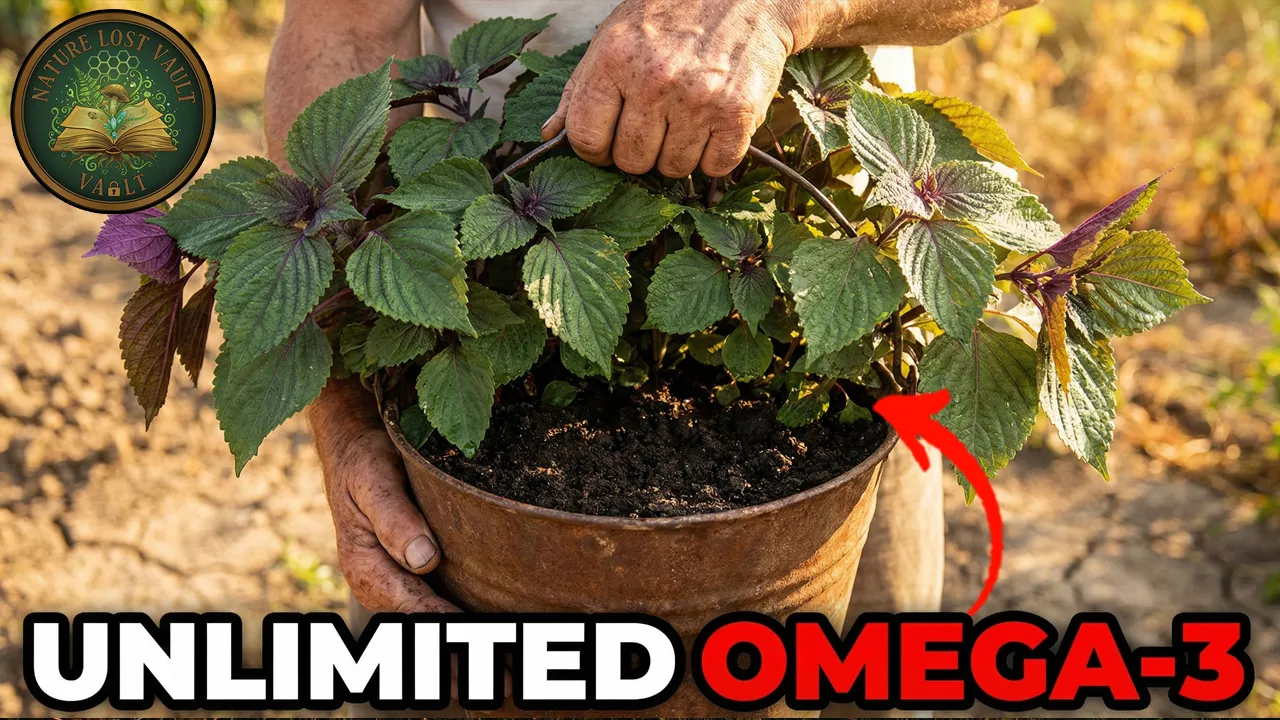
Table of Contents
- The Richest Omega-3 Source on Earth
- The Ancient Archive: 1,500 Years of Cultivation
- The Science They Buried in Foreign Journals
- The Fish Oil Machine
- Executive Order 9066: How America Lost the Knowledge
- The Corporate Lobby Behind the Evacuation
- Reclassified as a Weed
- The Nutritional Profile They Ignored
- How to Grow a Permanent Omega-3 Supply
- The Seeds They Could Not Incarcerate
The Richest Omega-3 Source on Earth
The richest source of omega-3 fatty acids on Earth is not salmon. It is not fish oil. It is not flaxseed or chia or any supplement on a pharmacy shelf.
It is a plant that produces 64% omega-3 by seed weight. A plant that self-seeds so aggressively that one planting feeds a family for generations. A plant that half a billion people eat every single week across Asia, used as food, medicine, and lamp oil for centuries.
In America, it gets sprayed with herbicide and classified as a weed.
That classification is not an accident. On February 19, 1942, President Franklin Roosevelt signed Executive Order 9066. Within six days, 120,000 people received notices. They had less than a week to pack a life into what they could carry. Farms worth $72 million were sold for cents on the dollar or simply abandoned. The crops still in the ground were seized by strangers at harvest time.
Among those farms were the gardens of Japanese-American families who had cultivated this plant for thirty years on American soil. When the families came home after the war, shattered and starting over, they did not replant it. The market was gone. The buyers did not know what it was. The knowledge had been incarcerated with the people who held it.
Today, Americans spend $7.68 billion every year on omega-3 supplements. Most of that money buys fish oil. Meanwhile, this plant grows freely in almost every climate zone, asks nothing in return, and outperforms every product in that multi-billion-dollar industry.
The Ancient Archive: 1,500 Years of Cultivation
The archive opens in the mountains of southern China, sometime around 500 CE. A physician named Tao Hongjing is compiling the Supplementary Records of Renowned Physicians, the most comprehensive Chinese pharmacopeia of its age. Among the herbs he documents is one called zi su, or purple reviver. He records it as a treatment for respiratory ailments, noting that it clears the blood and calms the stomach.
This plant had been cultivated across China for at least 400 years before he wrote his first line. It had already crossed the sea to Japan in the 8th century, where during the Edo period (1603 to 1868), farmers grew it on 90% of all cultivated land. They used the leaves for medicine. They pressed the seeds into oil to light their homes before electricity existed. Japanese fish sellers tucked its leaves beneath raw fish, not as decoration, but because the antibacterial compounds prevented spoilage. Chefs understood this centuries before science confirmed it.
In Japan, the word for this plant is shiso. In China, zi su. In Korea, kkaennip. In India, perilla. Four names for the exact same plant.
The Science They Buried in Foreign Journals
In 1991, researchers at the National Institute of Nutrition in India analyzed perilla seed oil. The findings went quietly into a scientific journal and almost nowhere else. Alpha-linolenic acid concentration: 54 to 64%. The highest concentration of omega-3 fatty acids ever recorded in any plant species. Higher than flaxseed. Higher than chia. Higher than any fish oil product on a pharmacy shelf.
Perilla seed oil also carries the highest ratio of omega-3 to omega-6 fatty acids of any known seed oil, at 6 to 1. The modern Western diet runs closer to 15 to 1 in the wrong direction, heavy in omega-6 and light in omega-3. Researchers at Harvard Medical School have linked this dangerous imbalance to increased inflammation and cardiovascular disease.
The plant also contains rosmarinic acid. Perilla carries more of it than rosemary does. More than basil. More than oregano. In a 2004 clinical trial published in the Annals of Allergy, Asthma, and Immunology, Japanese researchers gave perilla extract to patients with seasonal allergies. The treatment group reported 50% fewer symptoms. Not from a pharmaceutical. From a plant.
By 2017, Korean researchers documented that the omega-3 from perilla oil crossed the blood-brain barrier, protecting neurons from oxidative stress. In 2024, a team studying Parkinson's disease found that cold-pressed perilla oil increased beneficial gut microbiota through the gut-brain axis, one of the most promising frontiers in modern neuroscience. The plant had been doing this quietly for a millennium while Western medicine looked elsewhere.
These studies came from Asian government research centers and medical hospitals. They sat in journals published in languages that major Western databases systematically underindexed until the early 2000s. An entire archive of clinical knowledge, effectively invisible to the physicians prescribing fish oil capsules every morning.
The Fish Oil Machine
In 1971, a study of Inuit populations in Greenland showed that communities eating enormous quantities of fat had dramatically lower rates of cardiovascular disease. Researchers identified omega-3 as the protective mechanism. Fish consumption was the explanation. Fish oil was the answer. By 1980, an industry was born.
Today, fish oil commands 61% of the global omega-3 market share. Processing, extraction, encapsulation, cold-chain shipping. Every step creates a barrier to entry. Every barrier protects a profit margin.
PubMed lists more than 15,000 studies on fish oil and omega-3. Search for perilla oil and you find 400. Not because fish oil works better, but because fish oil has funding. Perilla cannot be patented. Its seeds cannot be made sterile. Its oil cannot be extracted with proprietary technology that generates licensing revenue. A family can press perilla seeds with a hand tool purchased for under $100 and produce a year's supply of omega-3 oil in a single afternoon.
That arithmetic is the reason the research does not exist.
Executive Order 9066: How America Lost the Knowledge
By the 1930s, Japanese-American farming families across California's Central Valley had quietly become the most productive agricultural force on the West Coast. They grew 40% of California's commercial vegetable crop. Per acre, their farms were worth $279, against a state average of $37. They transformed marginal land into the most productive farms in America.
Among those farms were kitchen gardens where perilla grew. The seeds were saved each autumn. The oil was pressed in winter. The leaves were eaten fresh through summer. This was ancestral practice, maintained quietly in a new country.
Then Pearl Harbor happened. Hours after the attack, Austin Anson, managing secretary of the Salinas Vegetable Grower-Shipper Association, boarded a train to Washington. He had been lobbying for the removal of Japanese-American farmers since the 1920s. He now had a receptive audience. He told the Saturday Evening Post in May 1942 that the real question was whether white farmers would live on the Pacific Coast or Japanese ones.
Decades of organized corporate lobbying had finally found its political moment.
The Corporate Lobby Behind the Evacuation
When Executive Order 9066 was signed, the War Relocation Authority oversaw the removal of 120,000 people into concentration camps. By year's end, the managing secretary of the Western Growers Protective Association reported that the removal had resulted in considerable profits for white growers. The farms that had been lobbied away were acquired by the exact same organizations that had demanded the evacuation.
By 1960, the number of Japanese-American farmers had dropped to a quarter of their prewar presence. The knowledge they carried did not return with them. Rebuilding the agricultural practice of a generation was not possible. Many moved to cities. The perilla gardens did not come back.
Reclassified as a Weed
The plant kept growing. It escaped cultivation and spread into roadsides and disturbed ground across the eastern United States. It now appears in agricultural extension bulletins as an invasive weed pest. In America's backyard, an ancient food and medicine tradition was reclassified as a nuisance. Herbicide companies now sell products specifically formulated to kill it.
Yet half a billion people still eat perilla every week across Asia. They wrap it around grilled meat. They pickle it in garlic and soy. They press the seeds for oil. They have not forgotten.
The Nutritional Profile They Ignored
A 100-gram serving of fresh perilla leaves delivers 3.9 grams of protein, more than spinach or kale. Calcium at 230 mg. Iron at 1.7 mg. Vitamin A at 5,520 international units. And the seeds are the real infrastructure: 35 to 45% oil by weight, with 54 to 64% of that oil being the exact omega-3 fatty acid the supplement industry sells back to you in gelatin capsules for $20 a bottle.
How to Grow a Permanent Omega-3 Supply
The plant grows in USDA zones 2 through 11, covering virtually the entire continental United States. It thrives in poor soil. It tolerates drought. And it self-seeds with a ferocity that is closer to infrastructure than gardening. A single plant produces 1,000 to 4,000 seeds. 85% of those seeds germinate. They remain viable in the soil for five years or longer. Korean farming villages have documented the same perilla patches growing on the same ground for 10 generations without replanting.
To grow it now: soak the seeds in water for 24 hours before planting. Surface-sow them directly into the ground or any container with basic potting soil. They need light to germinate, so do not bury them. Seedlings emerge in 7 to 21 days. After the first month, the plant adapts to local rainfall and needs almost no further attention.
Harvest leaves all summer. Eat them raw. Wrap them around grilled meat the way half a billion people across Korea and Japan do every week. Add them to soups. Dry them for winter tea. At the end of the season, let some plants flower. The seed heads will shatter and sow themselves. What you will have is not a garden plant. You will have a permanent food system that returns every spring without asking.
For the oil: let seed heads fully mature in autumn. Dry them completely, then cold press using any manual hand press. The golden oil stores for up to 12 months in a dark glass container. The leftover seed cake feeds chickens or goes into compost. Nothing is wasted.
The Seeds They Could Not Incarcerate
The Japanese-American families who kept perilla alive in California did not lose it because the plant failed. They lost it because they were taken from their land by an executive order, lobbied into existence by corporate interests who wanted their farms. The corporate associations got the land. America lost the knowledge.
But they could not incarcerate the seeds. The plant escaped into the roadside ditches and spread across 20 states, waiting to be recognized. It has been recognized by half the world's population for 1,500 years.
The knowledge is not lost. It is growing in your driveway. It is in every packet of shiso seeds at any Asian grocery store. It is in every community that held onto what was taken.
Explore More Perennial Foods
Discover self-sustaining plants that feed families for generations from a single planting.
Browse Perennial Foods Collection →