More Omega-3 Than Salmon Per Leaf. Why Is the World's Most Nutritious Plant Classified as a Weed?
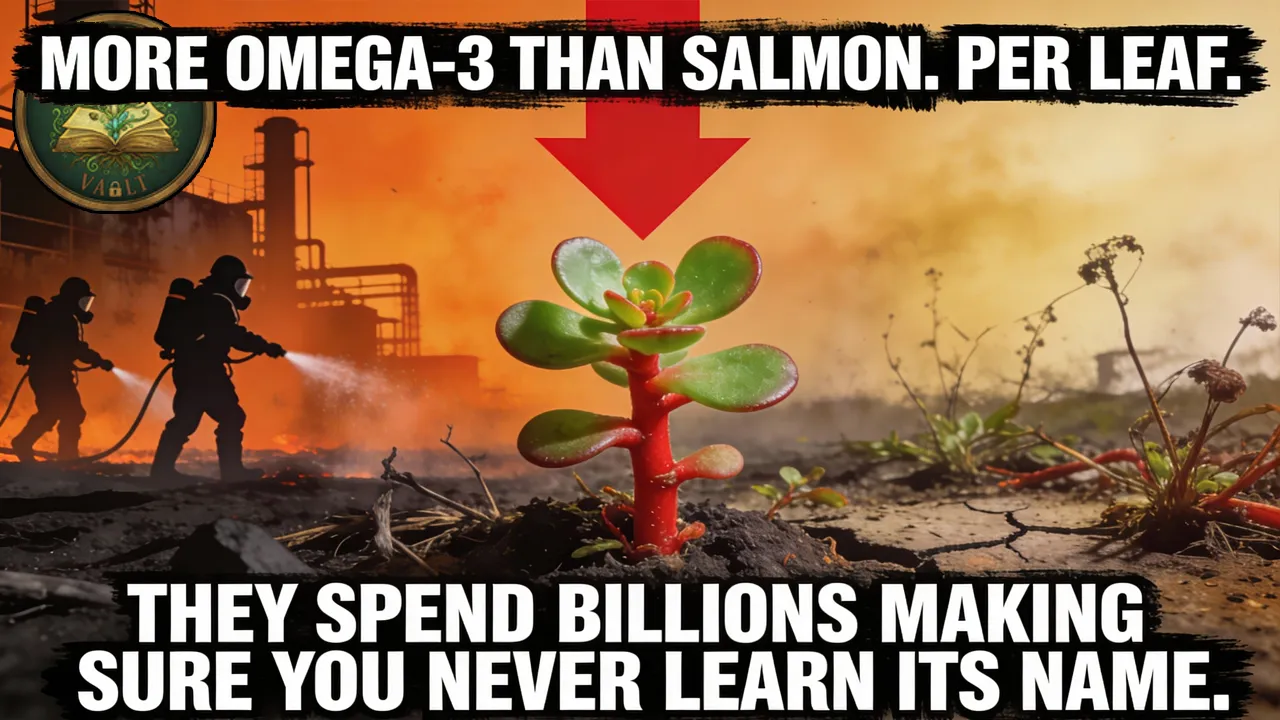
Table of Contents
Recommended Product: Purslane seeds and growing supplies
View Purslane OptionsAffiliate link - supports our channel
What is Purslane?
There is a plant with red stems crawling through the cracks in your driveway right now that contains more omega-3 fatty acids than salmon—not per pound, per leaf. It has been feeding humans for 4,000 years, survived the fall of empires, and in 2022, scientists at Yale discovered it does something no other plant on Earth can do: something they called a "biological impossibility." This is Purslane (Portulaca oleracea), the plant that solved a problem scientists didn't know existed, and the one we've been taught to destroy.Purslane Omega-3 Content & Nutritional Data
Purslane (Portulaca oleracea) is the richest vegetable source of omega-3 fatty acids ever measured. Below is a quick-reference summary compiled from peer-reviewed research.
| Nutrient | Per 100g Fresh Leaves | Comparison |
|---|---|---|
| Omega-3 (ALA) | 300-400 mg | 5-7x more than spinach, 15x more than lettuce |
| EPA (marine omega-3) | Present (trace) | Only land plant known to produce EPA |
| Vitamin E | 12.2 mg | 7x more than spinach |
| Beta-carotene | 1,320 µg | 6x more than carrots |
| Melatonin | Highest of any plant tested | Natural sleep and antioxidant compound |
| Glutathione | Present | Master antioxidant, rare in plants |
| Water requirement | 6 inches annual rainfall | 1/5th of what corn needs (20-30 in.) |
Source: Dr. Artemis Simopoulos, 1992; Yale University (Edwards et al.), Science Advances, 2022.
Historical Context
Ancient Origins
In 1050 BC, someone in northern Greece stored Purslane seeds in a clay vessel. When archaeologists opened it 3,000 years later, they found thousands of tiny black seeds—the same plant still growing between the stones outside.
- 7th century BC: Seeds appear in the Samian Heraion, one of the most important sanctuaries in ancient Greece
- 4th century BC: Theophrastus writes cultivation instructions, telling farmers to sow it in April alongside essential crops
- Roman Empire: Cultivated across three continents as a staple food
- 1288 AD: Bonvesan Deariva's list of everything Milan consumed includes Purslane—not as a curiosity, but as a staple
Americas: The Double Discovery
European settlers documented Purslane in Massachusetts in 1672. But archaeologists later discovered it had already been here for 2,500 years:
- Seeds found in Ontario date to 1350 AD
- Seeds found in Kentucky date to 800 BC
- Native Americans cultivated it alongside sunflowers, squash, and chenopods in the eastern agricultural complex
Two populations separated by an ocean both decided this plant was essential. What did they know that we've forgotten?
Scientific Discoveries & Nutritional Power
The Cretan Paradox
In 1960, physiologist Ancel Keys launched the Seven Countries Study, tracking 12,763 men across seven countries for 50 years. The results broke every assumption:
The farmers of Crete consumed some of the highest fat diets in the world—more than 35% of calories from fat. According to every nutritional theory of the time, they should have been dying from heart attacks. Instead, they had the lowest cardiovascular mortality rate Keys had ever measured. Lower than Japan. Lower than Finland. Lower than anywhere.
For 20 years, scientists credited olive oil. Then in the 1980s, they analyzed frozen blood samples from the original study. The Cretans had three times the omega-3 levels of the Dutch—but they weren't eating three times more fish. They were eating Purslane every single day: in salads, in stews, sautéed with olive oil, and fed to their chickens and goats.
The Impossible Nutritional Profile
Dr. Artemis Simopoulos analyzed Purslane in 1992. The numbers seemed impossible:
- Omega-3 Fatty Acids: 300-400mg per 100g of fresh leaves—5-7 times more than spinach, 15 times more than iceberg lettuce. The richest vegetable source of omega-3 ever measured
- EPA (Eicosapentaenoic Acid): Land plants don't make EPA—that's a marine omega-3 from fish and algae. Purslane makes EPA. When Simopoulos published this, other scientists questioned if samples were contaminated. They weren't.
- Vitamin E: 7 times more than spinach
- Beta-carotene: 6 times more than carrots
- Also contains: Melatonin, glutathione, potassium, magnesium, and calcium in concentrations that make it one of the most nutrient-dense plants ever analyzed
The Lyon Diet Heart Study
605 patients recovering from heart attacks were split into two groups. Half got the standard low-fat cardiac diet. Half got a Mediterranean diet rich in Purslane, walnuts, and omega-3 fatty acids.
After 5 years: The Purslane group had 70% fewer deaths. Not 70% fewer heart attacks—70% fewer deaths from all causes. The study was stopped early because keeping the control group on the standard diet became unethical.
Yale's 2022 Discovery: The Biological Impossibility
Dr. Erica Edwards and her team at Yale published findings in Science Advances that rewrote what we thought possible in photosynthesis.
Most plants use C3 photosynthesis (works with plenty of water). Corn and sugarcane evolved C4 photosynthesis (handles high temperatures). Desert plants like cacti use CAM photosynthesis (opens pores at night to collect CO₂, seals them during day to prevent water loss—but grows incredibly slowly).
Scientists knew Purslane could do both C4 and CAM. They assumed it used them separately. When Yale mapped gene expression, they discovered both systems operating in the same cells at the same time:
- C4 activity during the day for fast growth
- CAM activity at night for drought survival
- The products of CAM reactions feed directly into the C4 pathway
"This is a very rare combination of traits and has created a kind of super plant," Edwards said. No other species on Earth does this.
The result: Purslane survives on 1/5th the water corn needs, grows in soil so salty most crops would die in days, and produces 200,000 seeds per plant that remain viable for up to 40 years.
How to Identify, Grow & Use Purslane
Identification
Purslane has distinct features that make it easy to identify:
- Stems: Thick, red, smooth (never hairy), and succulent
- Leaves: Paddle-shaped, succulent, growing flat along the ground
- Interior: When you break a stem, it's juicy and almost translucent inside
- Flowers: Tiny and yellow, usually tucked between the leaves
- Growth pattern: Spreads horizontally along the ground
Growing Conditions
Purslane is nearly indestructible:
- Thrives in extreme drought
- Grows in soil so salty most crops die
- Completes its life cycle on just 6 inches of annual rainfall (corn needs 20-30 inches)
- Accelerates photosynthesis above 95°F (when soybeans shut down)
- Every stem fragment that touches ground roots into a new plant
- One plant produces 200,000 seeds that stay viable for 40 years
Harvesting
- Best time: First 6 weeks when leaves are tender
- Method: Cut stems above ground level (they'll regrow)
- Continuous harvest: Plant keeps producing all summer
- Seed saving: Let a few plants go to seed in late summer—collect hundreds of thousands for next year
Culinary Uses
Raw: Add to salads for a lemony, slightly salty crunch with crisp texture
Cooked: Sauté like spinach, add to soups and stews, or stir-fry
Preserved: Pickle it, dry it for winter use
Smoothies: Blend fresh leaves for omega-3 boost
Traditional Names & Global Use
- India: Kulfa (still widely eaten)
- Greece: Glistrida
- Mexico: Verdolagas (sautéed with garlic and chile)
- China: Ma chi xian (continuously cultivated for thousands of years)
- Middle East: Appears in mezze spreads and summer salads across Turkey, Iran, and the region
Half the world never forgot Purslane. The other half was taught to poison it.
Why is Purslane Called a "Weed"?
The global herbicide market hit $40 billion in 2024. Bayer, Syngenta, and Corteva sell products specifically formulated to kill Purslane in lawns, gardens, and agricultural fields. Homeowners associations prohibit it. Agricultural extension offices publish eradication guides.
Why the war on Purslane?
- You cannot patent Purslane
- You cannot genetically modify it to make sterile seeds
- You cannot create hybrid varieties farmers must buy new every year
- It reproduces freely and cannot be controlled
Every other omega-3 source is a controlled market: Wild fish populations are collapsing. Farmed salmon requires massive infrastructure. Flax seed oil goes rancid. Fish oil supplements cost $20 a bottle.
Purslane grows for free in every climate zone where humans live. It produces more omega-3 per acre than any cultivated crop, and it asks for nothing but sunlight and occasional rain.
Purslane Omega-3 FAQ
Does purslane have more omega-3 than salmon?
Yes. Purslane (Portulaca oleracea) contains 300-400mg of omega-3 fatty acids per 100g of fresh leaves, which is more omega-3 per leaf than salmon on a gram-for-gram basis. It is the richest vegetable source of omega-3 (ALA) ever measured, with 5-7 times more than spinach and 15 times more than iceberg lettuce.
What is the omega-3 content of purslane per 100g?
Purslane contains 300-400mg of alpha-linolenic acid (ALA) omega-3 per 100g of fresh leaves, according to research by Dr. Artemis Simopoulos published in 1992. Purslane also uniquely contains EPA (eicosapentaenoic acid), a marine omega-3 normally found only in fish and algae. No other land plant produces EPA.
What plant has more omega-3 than salmon or fish?
Purslane (Portulaca oleracea) has more omega-3 per leaf than salmon. It is the only land plant known to produce EPA, a marine-type omega-3 fatty acid. The Cretan population that ate purslane daily had three times the omega-3 blood levels of the Dutch in the Seven Countries Study, with the lowest cardiovascular mortality ever measured.
What is the full nutritional profile of purslane?
Per 100g of fresh leaves, purslane contains: 300-400mg omega-3 fatty acids (ALA + EPA), 7x more vitamin E than spinach, 6x more beta-carotene than carrots, plus melatonin, glutathione, potassium, magnesium, and calcium. It is one of the most nutrient-dense plants ever analyzed. Yale researchers in 2022 discovered it uses a unique dual C4+CAM photosynthesis system, making it a biological impossibility that survives on 1/5th the water of corn.
How does purslane omega-3 compare to fish oil?
Purslane provides omega-3 fatty acids naturally, including both ALA and EPA. In the Lyon Diet Heart Study, 605 heart attack survivors eating a Mediterranean diet rich in purslane and omega-3 had 70% fewer deaths than the control group. The study was stopped early because keeping the control group on the standard diet was deemed unethical. Unlike fish oil supplements, purslane grows for free in every climate zone.
Explore More Medicinal Plants
Discover ancient healing plants backed by centuries of traditional use and modern science.
Browse Medicinal Plants Collection →