Lamb's Quarters (Chenopodium album): The 8,500-Year Wild Green With 15× More Calcium Than Spinach
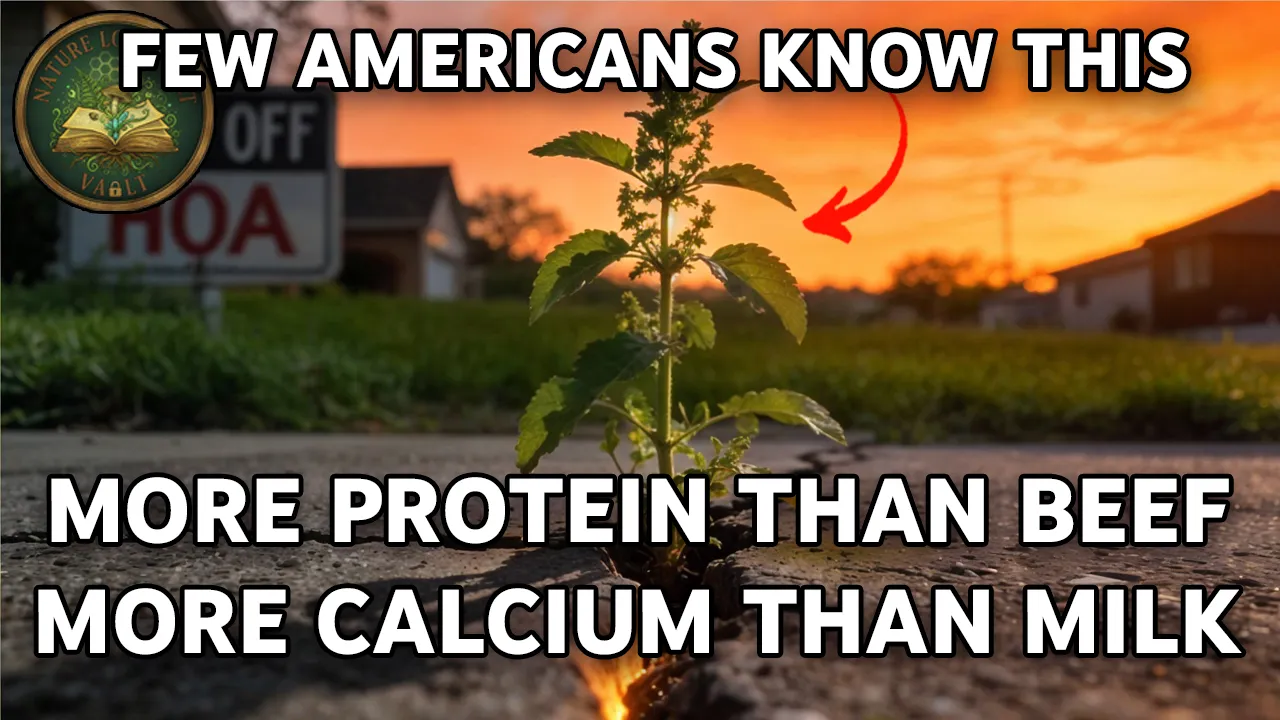
Table of Contents
Recommended Product: Lamb's quarters seeds and growing supplies
View Lamb's Quarters OptionsAffiliate link - supports our channel
What is Lamb's Quarters?
There is a plant growing in the cracks of your driveway right now that contains 15 times more calcium than spinach, eight times more vitamin C than oranges, and more protein per ounce than beef. For 8,500 years, it sustained entire civilizations from the Great Lakes to the Mediterranean. People did not just gather it. They bred it like wheat, selected its seeds generation after generation, stored them in clay jars for winter, and ground them into flour that lasted through famines.
Then we made it disappear. We created a $74 billion industry dedicated to poisoning it out of existence. We convinced millions that this plant, which offers more nutrition than almost anything in the grocery store, is their enemy. We erased its name so completely that most Americans under 40 have never heard it, even though they have been looking at it their entire lives.
This is the story of the most nutritious weed in America and the system that cannot afford to let you remember what it is.
| Metric | Value |
|---|---|
| Botanical name (Old World) | Chenopodium album |
| Botanical name (Americas) | Chenopodium berlandieri |
| Family | Amaranthaceae (formerly Chenopodiaceae) |
| Earliest archaeological record | ~6,500 BCE (Eastern Kentucky rock shelters) |
| Full domestication | ~1,700 BCE (Eastern Agricultural Complex) |
| Domesticated seed coat | ~20 microns (vs. 60 microns wild) |
| Calcium per cup (cooked) | 464 mg (vs. ~30 mg cooked spinach) |
| Vitamin C per cup | 66 mg (vs. ~8 mg cooked spinach) |
| Vitamin K per cup | 741% of daily requirement |
| Protein content | Complete amino acid profile |
| Seeds per plant | ~75,000 (viable up to 40 years in soil) |
| Closest cultivated relative | Quinoa (Chenopodium quinoa) |
| Common names | Fat hen, goosefoot, pigweed, bathua, quelite |
| Global herbicide market | $74 billion (lamb's quarters is target #1) |
| 2,4-D introduction (lawn use) | 1947 (Scotts Company mass marketing) |
8,500 Years of Cultivation
1987: The Eastern Kentucky Rock Shelters
The archive opens in 1987. Deep in the Cumberland Plateau of eastern Kentucky, archaeologists were excavating ancient rock shelters sealed for thousands of years. Inside one shelter, they found storage pits carefully constructed and deliberately placed. Carbon dating returned a result of 6,500 BCE, more than 8,000 years old. What stopped everyone was not the age. It was what was inside.
Thousands of carbonized seeds, preserved alongside squash and sunflower, in a way that could only mean one thing. This was food storage. This was deliberate agriculture. The seeds were identified as Chenopodium berlandieri, the Native American species of lamb's quarters.
It was fully domesticated by 1,700 BCE as part of the Eastern Agricultural Complex, a sophisticated system of native cultivated crops that supported populations across eastern North America for over 3,000 years, long before maize arrived from the south.
The Microscopic Proof of Plant Breeding
When scientists examined the domesticated seeds under microscopes, they found something that revealed how intentional this cultivation was. The seed coats measured 20 microns thick. Wild Chenopodium seeds were 60 microns, three times thicker. Thin seed coats mean faster germination and quicker growth, which translates to more crops per season.
Someone had been selecting these seeds year after year, generation after generation. They were breeding this plant the same way teosinte was bred into corn and wild grasses were bred into wheat. This was agricultural science happening in North America thousands of years before Columbus. The Ohio River Basin, Kentucky rock shelters, Tennessee caves: everywhere archaeologists looked, they found Chenopodium seeds stored alongside other grains, treated with the same care as any staple crop.
The European Cousin: Iron Age Bog Bodies
And then in 2014, European researchers started finding the same thing. Viking-age sites in Denmark. Roman settlements across central Europe. Iron Age storage pits in Germany and France. All contained Chenopodium album seeds, the European cousin, stored in clay jars with wheat and barley.
Then came the discovery that made headlines. Danish bog bodies: Iron Age people preserved in peat for 2,000 years had Chenopodium seeds in their stomachs, their last meals. This was not famine food. This was not desperation. This was regular food eaten by regular people across 8,500 years of human history.
The Zuni cooked the young greens. The Iroquois harvested it every summer. In India it is called bathua, sold in markets today as a premium winter vegetable. In northern China the related species is still cultivated. The knowledge was global. The cultivation was deliberate. The nutrition was understood long before laboratories could measure it.
The Collapse and the Survivors
By 1,150 CE, maize had arrived in eastern North America, spreading north from Mesoamerica. It was calorie-dense, easier to store, and it fit the model that European colonizers would later bring. The Eastern Agricultural Complex collapsed within generations. Lamb's quarters, marshelder, little barley and knotweed, the crops that sustained civilizations for 3,000 years, faded into obscurity. The native domesticated variety, carefully bred for three millennia, went extinct. Gone forever.
European settlers brought their own Chenopodium album across the Atlantic. They knew it as fat hen, pigweed, goosefoot. Peasants ate it during famines, fed it to livestock, used it as medicine. But by then, agriculture meant wheat, corn, cash crops: things you could tax, things you could sell, things you could control. The plant survived anyway, growing in ditches and disturbed soil. It did not need permission. That was always its strength.
Nutrition: 15× More Calcium Than Spinach
The Numbers Are Stunning
One cup of cooked lamb's quarters contains 464 mg of calcium. Spinach, the vegetable we are told to eat for strong bones, contains about 30 mg cooked. That is 15 times more. Vitamin C: 66 mg per cup, compared to spinach at roughly 8 mg. More iron, more protein, more B vitamins than spinach or cabbage. One cup delivers 741% of the daily vitamin K requirement, the same vitamin sold in supplements for $20 a bottle.
Michael Pollan, in The Omnivore's Dilemma, called lamb's quarters and purslane two of the most nutritious plants in the world. Not vegetables. Plants, period. Indigenous farmers cultivated it for thousands of years without laboratories. European peasants knew chickens grew fat on it. People have always known this plant was extraordinary.
What You Cannot Do With It
Here is what you cannot do with lamb's quarters:
- You cannot patent it.
- You cannot genetically modify it to depend on specific fertilizers.
- You cannot control its seeds. Each plant drops 75,000 seeds that remain viable for 40 years.
- Cut it into pieces and every fragment roots.
- It heals depleted soil, grows without irrigation, and tolerates extremes.
It asks for nothing. In a food system built on scarcity and control, a plant like that is more dangerous than any pest.
What It Threatens
Lamb's quarters threatens the $95 billion leafy greens industry: spinach, kale, lettuce trucked from California's Central Valley, irrigated with increasingly scarce water, packaged in plastic, shipped thousands of miles. It threatens the calcium supplement market, the multivitamin industry, and the herbicide industry that sells products to kill it. More fundamentally, it threatens the logic of modern agriculture: the idea that food must be difficult, must require inputs, must be controlled by corporations selling seeds every year, fertilizers every season, pesticides to kill everything that grows without permission.
Lamb's quarters grows without permission. It heals soil instead of depleting it. It feeds people without asking anything in return. That kind of abundance, free, uncontrollable, available to anyone, cannot exist in a system built on scarcity.
Why It Was Buried as a "Weed"
1947: The Suburban Lawn and 2,4-D
Then came 1950 and everything changed. Postwar America, the GI Bill financed millions of new homes, suburbs exploded, and with them came a new ideology: the perfect lawn. Grass, uniform and green, with absolutely no weeds. Construction created disturbed soil everywhere, perfect conditions for lamb's quarters, which colonizes bare ground faster than almost anything. Suddenly every suburban yard had it growing, and homeowners panicked.
Chemical companies saw opportunity. In 1947, the Scotts Company began mass-marketing herbicides to American homeowners. The active ingredient was 2,4-D, originally developed during World War II as part of biological warfare research. After the war, chemical companies needed new markets for these weapons, and American lawns became the battlefield. By the 1960s, homeowners' associations wrote bylaws prohibiting "noxious weeds," listing lamb's quarters by name. You could be fined for allowing food to grow on property you owned.
A $74 Billion Industry to Erase a Free Food
Agriculture followed the same pattern. Lamb's quarters competes with soybeans and corn, the most heavily subsidized crops in America. The herbicide industry exploded into a $40 billion global market. Add weed control services and the figure climbs past $74 billion annually. We are spending $74 billion every year to destroy plants, with lamb's quarters as target number one. Meanwhile, an industrial leafy greens market grew into a $95 billion industry selling the same nutrition that grows free in every crack in the pavement.
Erased by Language
The plant was erased not with fire or war, but with language. We called it a weed, a pest, a problem. We created an entire vocabulary around its destruction and convinced three generations that this plant is their enemy. Most Americans under 40 have seen it their entire lives, but have no name for it. When you erase the name, you erase the knowledge. When you erase the knowledge, you erase the power.
But here is what the chemical industry could not erase: the plant itself. While Americans forgot, the rest of the world kept eating. In India, bathua is sold in every winter market, not famine food but premium food, eaten in bathua paratha, saag, and raita. In northern China, the related li (藜) is still cultivated. In Mexico, quelites, the wild greens including lamb's quarters, never left the diet. Grandmothers still teach children which plants to harvest and how to cook them. What happened in America was a cultural erasure, but it was incomplete. Immigrant families brought the knowledge with them. Italian grandmothers remembered fat hen. Mexican families knew quelites. Indigenous communities never stopped gathering traditional foods. The knowledge survived in fragments, waiting for the moment when people would need it again. That moment is now.
How to Identify, Harvest & Cook Lamb's Quarters
Identification: The Powdery Coating Test
Lamb's quarters has diamond or goosefoot-shaped leaves with toothed edges, alternating along an upright branching stem that ranges from one to five feet tall. The most diagnostic feature is the fine white powdery coating on the youngest leaves and growing tips. It looks like a dusting of flour and rubs off between your fingers. The undersides of young leaves often appear silvery. The stem is grooved, often with red or purple streaks at the base or leaf joints. Tiny green flower clusters form at the tips in summer.
Lookalikes (None Are Dangerous)
Lamb's quarters is in the same family as several other edible "pigweeds" (genus Amaranthus) and other Chenopodium species, including its closest cultivated relative quinoa (Chenopodium quinoa). The powdery coating and goosefoot-shaped leaf are the combination that separates lamb's quarters from amaranth, which has spinier leaves and reddish flower spikes. There is no common toxic lookalike for the powdery-coated goosefoot leaf in temperate North America or Europe. Always confirm identification with a regional field guide before eating any wild plant.
Where and When to Harvest
Lamb's quarters thrives on disturbed soil: garden edges, vegetable beds, construction sites, abandoned lots, sidewalk cracks, and freshly turned fields. It is summer-active in temperate climates and the most tender greens are harvested from late spring through midsummer, before flowering. Cut the top few inches: tender stem tips and young leaves. The plant responds to harvest by branching, producing more leaves the more you pick. Avoid sites that are sprayed with lawn herbicides, sit beside busy roads, or are downstream from industrial runoff.
Cooking: Treat It Like Spinach
Once cooked, eat as much as you want. Heat breaks down the naturally occurring oxalic acid (the same compound found in spinach, beet greens and chard). A few cooking ideas:
- Sauté: 3-4 minutes in olive oil with garlic and salt. Substitute one-for-one anywhere a recipe calls for spinach.
- Bathua paratha: chopped greens kneaded into wheat dough with cumin, ginger and salt; rolled and pan-fried.
- Saag: simmered with onion, ginger, garlic, green chili and a touch of cream or yogurt.
- Soups and stews: wilt into the pot in the last 5 minutes.
- Seeds (pseudocereal): the mature seeds are edible. Rinse to remove saponins (as you would quinoa) and cook 1:2 with water for ~15 minutes.
Saving Seeds & Letting It Heal Your Soil
Stop poisoning it. Let it grow and let it heal your soil while it feeds you. Each plant produces about 75,000 seeds that last 40 years in the soil. Collect mature seed heads in late summer or fall by stripping them into a paper bag, then sift to remove chaff. Share seeds. Teach children. Reclaim the name that was taken.
Safety
Lamb's quarters contains oxalic acid and absorbs nitrates from soil. Cooking reduces oxalates significantly and is recommended for any large serving. Caution is warranted for people with active kidney stone disease, gout, or a history of calcium oxalate stones. Pregnant women should cook the leaves rather than eat them raw in quantity. Always harvest from clean soil. As with any wild plant, never eat what you cannot identify with certainty.
Frequently Asked Questions
Is lamb's quarters more nutritious than spinach?
Yes. One cup of cooked lamb's quarters (Chenopodium album) contains 464 mg of calcium versus about 30 mg in cooked spinach, roughly 15 times more. It delivers 66 mg of vitamin C (8x more than an orange), more iron and protein per ounce than spinach, and 741% of the daily requirement of vitamin K. It was bred and cultivated as a staple grain for 8,500 years before the herbicide industry rebranded it a weed.
Can you eat lamb's quarters and how do you cook it?
Yes. Lamb's quarters is entirely edible. Young leaves and tender stem tips can be eaten raw in salads, but cooking is preferable for larger quantities because heat breaks down naturally occurring oxalic acid. Treat it like spinach: sauté with olive oil and garlic, add to soups and curries (Indian bathua paratha and saag are classic dishes), or steam for 3-4 minutes. The seeds are an edible pseudocereal that can be cooked like quinoa, the closely related domesticated species.
How do you identify lamb's quarters?
Lamb's quarters has alternate, diamond or goosefoot-shaped leaves with toothed edges, an upright branching stem (often 1-5 feet tall), and a distinctive white powdery coating on the youngest leaves and growing tips that looks like fine flour and rubs off between your fingers. The undersides of young leaves often appear silvery. The stem is grooved and frequently develops red or purple streaks at the base or leaf joints. Tiny green flower clusters form at stem tips in summer. The powdery coating and goosefoot leaf shape together are diagnostic and not shared by any common toxic lookalike.
Why is lamb's quarters considered a weed?
Lamb's quarters was reclassified as a weed when post-WWII chemical companies began marketing herbicides to American homeowners and to industrial monoculture agriculture. 2,4-D, originally developed during World War II as part of biological warfare research, was repurposed for civilian lawn and farm use in 1947. The global herbicide market is now worth $74 billion, and lamb's quarters is one of its primary commercial targets because it competes with subsidized soybean and corn fields. The plant grows freely without planting, watering, or fertilizing, which makes it incompatible with the economics of patented seeds and chemical inputs.
Are there any side effects or precautions for eating lamb's quarters?
Lamb's quarters contains oxalic acid (similar to spinach, beet greens, and chard) and nitrates absorbed from soil. Cooking reduces oxalates significantly. People with active kidney stone disease, gout, or a history of calcium oxalate stones should limit intake or consult their physician. Pregnant women should cook the leaves rather than eat them raw in large quantities. Always harvest from soil free of pesticides, lawn herbicides, and roadside contamination. Identification is straightforward thanks to the white powdery coating and goosefoot leaves, but never eat any wild plant you cannot identify with certainty.
Explore More Wild Edibles
Discover the forgotten foods that fed civilizations for millennia, free in cracks and ditches everywhere.
Browse Survival Foods Collection →