More Protein Than Beef, Doubles Every 48 Hours (But It's Called Pond Scum)
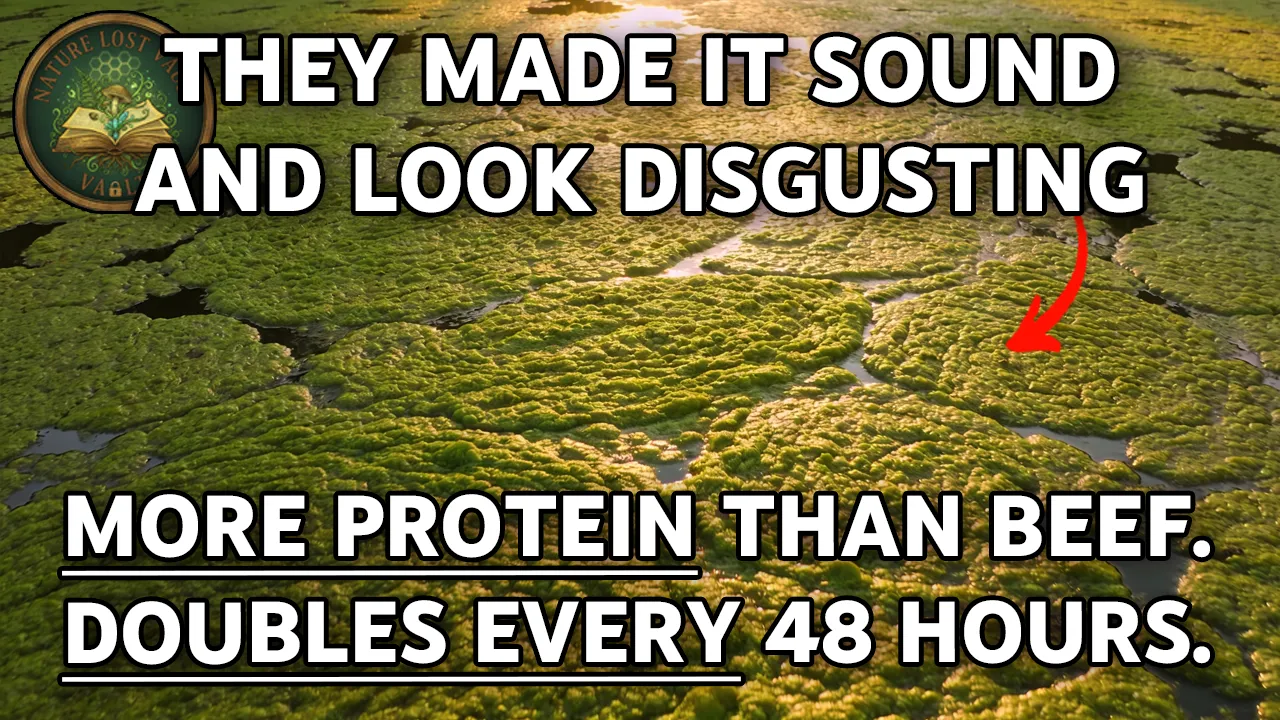
Table of Contents
Recommended Products:
Affiliate links - support our channel
What is Duckweed?
Picture a still pond at dawn. The surface is green, completely green, blanketed by something so small you would miss it if you were not looking. This is duckweed (*Lemna* spp.), the tiniest flowering plant on Earth. Now picture that same pond 48 hours later. The green has doubled.
Every single speck has become two. Another 48 hours. It doubles again and again and again. This is not algae.
This is not pond scum. This is the fastest growing protein source on Earth. And the chemical fertilizer industry has spent 60 years making sure you never heard of it. In a laboratory at Bengurion University in 2018, researchers ran a clinical trial comparing three protein sources: soft cheese, green peas, and a plant most participants had never seen before.
They fed 36 men identical portions, 30 g of protein each, then drew their blood every hour for 3 hours. The plant outperformed the cheese. Blood concentrations of essential amino acids spiked higher. Vitamin B12 levels increased more than either the cheese or the peas.
The digestibility score hit 89%, rivaling animal protein. The plant they were testing weighs less than a grain of sand. It is called wulia globosa. In Thailand they call it ka nam which means eggs of the water.
In the west if anyone knows it at all they call it duckweed. And it is about to make you question everything you thought you knew about feeding the world. Welcome to nature's lost vault. Let's start with what this plant actually is.
Wolfia globosa is the smallest flowering plant on earth. Each individual measures less than a millimeter smaller than the head of a pin. It has no roots, no leaves in the traditional sense. It is a microscopic green oval floating on still water.
It reproduces every 29 to 48 hours by bdding off daughter plants. Under optimal conditions, wolfia contains up to 45% protein by dry weight. That is higher than soybeans at 36%, higher than quinoa at 14%, and higher than beef at 26%. But here is where it gets interesting.
Wolffia Globosa: Doubling Time, Protein Yield & Growth Data
Wolffia globosa is the smallest flowering plant on Earth and the fastest-growing protein source ever documented. Below is a quick-reference summary of its key growth and nutritional data, compiled from peer-reviewed research.
| Metric | Value | Source |
|---|---|---|
| Doubling time (Wolffia globosa) | 36 - 48 hours | Appenroth et al., 2017 |
| Doubling time (W. microscopica, fastest) | 29 hours | Ziegler et al., 2015 |
| Protein content (dry weight) | Up to 45% | Kaplan et al., Clinical Nutrition 2018 |
| Protein yield per hectare per year | ~100 tons (dry protein) | Estimated from continuous harvest models |
| Fresh wolffia for daily protein needs | ~600 g / day | NRC Italy, Scientific Reports 2024 |
| Protein quality score (PDCAAS) | 89 / 100 | Kaplan et al., Clinical Nutrition 2018 |
| Vitamin B12 content | ~2.5 µg / 100 g dry | Ben-Gurion University, 2020 |
| Optimal growth conditions | 25-30 °C, pH 5.0-7.5, 10-16 h light | Appenroth et al., 2017 |
At these growth rates, wolffia globosa protein yield per hectare is roughly 28 times faster than conventional crops, making it the most land-efficient protein source known to science.
Historical Context & Discovery
This is not an incomplete plant protein missing essential amino acids like most vegetables. According to research published in clinical nutrition in 2018, wolffia globosa contains all nine essential amino acids in quantities that meet world health organization recommendations. The protein quality score is 89 out of 100, putting it in the same category as eggs and milk. And that is not even the strangest part.
In 2020, researchers at Bengurian University published something that should not be possible. They found bioactive vitamin B12 in wolfia globosa. Real vitamin B12, not the inactive analoges that show up in some algae. They confirmed it with liquid chromatography and mass spectrometry, the gold standard for detecting vitamin B12.
Plants do not make vitamin B12. That is the rule. Only bacteria and archa synthesize vitamin B12, which is why vegans have to supplement. But wia globosa contains it anyway.
Approximately 2.5 micrograms per 100 g of dried plant. Inside the plant tissue live bacterial endoites. Wolffia has formed a natural symbiosis with bacteria that produce vitamin B12. When you eat the plant, you receive that B12.
So, let's review. This is a plant the size of a sand grain that doubles its biomass every 2 days, contains more protein than soybeans, has a complete amino acid profile rivaling animal products, and produces vitamin B12 through bacterial symbiosis. NASA noticed. In 2021, researchers at the National Research Council of Italy began testing Wolia Glossa under simulated microgravity conditions for space agriculture applications.
The results published in scientific reports in 2024 confirmed what NASA had suspected. Welfia Globosa maintains protein production even under altered gravity conditions. According to their calculations, just 600 g of fresh wolfia per day would meet an adult astronaut's complete daily protein requirements. Think about what that means.
On a theoretical Mars mission, you could grow complete protein in water tanks using only light, water, and recycled waste nutrients. No soil, no massive grow chambers, no 90-day growth cycles, just microscopic plants doubling every 48 hours, producing 45% protein forever. This isn't science fiction. Wolia globosa has been incorporated into NASA's bioreenerative life support system research specifically because of its unprecedented growth rate and protein density.
But here is the question nobody is asking. If this plant is so perfect, why isn't it feeding earth? The answer, as always, comes down to money. In 1909, German chemist Fritz Harour invented a process to synthesize ammonia from nitrogen and hydrogen.
By 1913, his colleague Carl Bosch had scaled it to industrial production. The habosh process could create nitrogen fertilizer from thin air. Prior to 1913, the world relied on natural nitrogen sources, manure, crop rotation, and nitrogen fixing plants. Farmers understood that soil needed to rest, needed legumes, needed diversity.
The harbor Bosch process changed everything. Suddenly, you could dump synthetic nitrogen on monoulture fields forever. The soil could be dead, depleted, lifeless, and crops would still grow as long as you kept adding chemicals. By 1950, synthetic fertilizer use had exploded worldwide.
By 2000, humans were fixing more nitrogen synthetically than all natural terrestrial processes combined. The chemical fertilizer industry had become a $200 billion per year empire. And Wolffia Glossa threatened all of it. Here is why.
Wolffia does not need soil. It grows in water. It does not need fertilizer, at least not the synthetic kind. It absorbs nutrients directly from water, including nitrogen and phosphorus, from sources the chemical industry would consider waste, agricultural runoff, waste water, even polluted ponds.
Studies have shown wolffia can remove up to 99% of nitrogen and 88% of phosphorus from contaminated water while simultaneously producing edible protein. It turns pollution into food. But there is a deeper problem for them. Walia reproduces through simple cell division.
You do not need seeds. You do not need to buy anything from a seed company every spring. You do not need patented genetics. You just need one microscopic plant and a bucket of water.
And 48 hours later, you have two plants. 4 days later, you have four. A week later, you have eight. The doubling time for the fastest WIA species, WIA microscopica, is just 29 hours, making it the fastest growing flowering plant ever documented.
Starting with a single plant under optimal conditions, the exponential growth curve is terrifying for anyone trying to control food production. One becomes two, two becomes four, four becomes eight. By day 30, you would have over a billion plants. by day 60, more than the number of stars in the Milky Way.
This is not a plant you can control. This is not a plant you can patent. This is not a plant that requires annual purchases of seeds, fertilizers, pesticides, or proprietary growing systems. This is a plant that could be growing in buckets on rooftops in Lagos, in ponds in rural India, in water tanks, in refugee camps, completely decentralized, completely outside the industrial agriculture system.
Scientific Research & Nutritional Benefits
And that is exactly why it had to be buried. The suppression was not direct. Nobody banned duckweed. Nobody passed laws against it.
The chemical industry simply made sure that all the infrastructure, all the research funding, all the agricultural extension services, all the crop subsidy programs pointed in one direction, chemically dependent monoculture. When farmers asked about alternative protein sources, extension agents recommended soybeans, which need fertilizer. When governments funded agricultural re research, the money went to institutions with deep ties to chemical companies. When universities developed new crop varieties, they focused on plants that fit the existing industrial system.
Duckweed did not fit. It never would. In Thailand, Laos, and Myanmar, people have been eating wulia globosa for centuries. They call it kynam, water eggs.
They harvest it from ponds, toss it into stir fries, and add it to soups. It is unremarkable. It is food. But in the west, duckweed remained pond scum in the public imagination.
It was something that covered stagnant water. It was something you would never eat. The cultural conditioning was subtle, but effective. Americans learned that protein comes from meat, dairy, or maybe soybeans.
Never from pond water. Never from something that grows wild without human intervention. Never from something free. In the 1960s, NASA briefly experimented with Lemna duckweed for space missions.
But they abandoned it because Lemnner species produce oxylic acid which can cause kidney stones. The research stopped. The public narrative became, "NASA tried duckweed and it didn't work." Nobody mentioned that wolfia species don't produce oxylic acid. Nobody mentioned that NASA had simply tested the wrong genus.
Decades passed. Then in 2018, an Israeli company called Hinoman began cultivating a strain of wia globosa they branded as mankai. They published peer-reviewed research showing the protein content, the amino acid profile, the B12 content. They ran clinical trials proving bioavailability.
The science was undeniable. But getting duckweed into western diets still meant battling 60 years of cultural conditioning and an entire agricultural system built around chemical dependence. Here is what they do not want you to understand. The chemical fertilizer industry does not make money when you grow protein in a bucket of pond water.
Seed companies do not profit when plants reproduce for free. Agricultural conglomerates do not benefit when food production becomes truly decentralized. The entire industrialized food system is built on control, dependency, and recurring purchases. Wolia globosa breaks every rule.
It grows without soil, without seeds, without chemicals. It doubles every 48 hours. It produces complete protein with B12. It grows in waste water, in polluted water, in water that would cost millions to treat chemically.
This is a plant that could produce 100 tons of dry protein per hectare per year, 28 times faster than conventional crops while simultaneously cleaning polluted water. And for 60 years, the people who control what gets grown, what gets funded, and what gets labeled as food made sure you never heard about it. But something is changing. In 2021, the European Food Safety Authority approved Wolia Globosa as a novel food.
How to Identify, Grow & Use Duckweed
In 2024, scientific reports published research confirming its viability for space agriculture. Climate change is making traditional agriculture increasingly unstable. And suddenly, people are looking for alternatives that do not require arable land or chemical inputs. The plant that was too perfect to be allowed is starting to break through.
Anyway, you can buy Mankai online right now. You can order wolfia gloza cultures from aquarium suppliers and grow your own in a bucket on your balcony. You can start with one plant and in 60 days, if you wanted, you could theoretically have more protein than you could eat in a lifetime. This is what they never wanted you to know.
The most efficient protein source on Earth does not need them. It does not need their fertilizers. It does not need their seeds. It does not need their system.
It just needs water and light. And it has been growing in ponds since before humans figured out agriculture. The question is, now that you know, what are you going to do about it? Because every bucket of duckweed growing on a rooftop is a small act of rebellion against a system that profits from scarcity, dependency, and control.
And this plant, this microscopic floating speck smaller than a grain of sand, might just be the most revolutionary crop you have never heard of until now. If this vault opened something for you, subscribe to Nature's Lost Vault and hit the bell. Every like and every share helps preserve the knowledge they tried to bury. Some plants are too small to notice.
Some protein is too fast to catch. And some solutions have been floating right in front of us the whole time. The next vault opens soon.
How to Clean, Prepare & Cook Duckweed
Wolffia globosa is eaten daily across Thailand, Laos, and Myanmar, but almost nobody in the West has been taught how to handle it. Here is the practical workflow for turning a bucket of fresh duckweed into food on the plate, including which preparation method preserves the most vitamin B12.
Step 1: Sourcing Safely
Never harvest duckweed from unknown ponds, ditches, or agricultural runoff for human consumption. Wolffia bioaccumulates heavy metals, pesticides, and waterborne pathogens from the water it grows in. That is exactly why it filters pollution so effectively, and also why wild-harvested duckweed is not food safe. For eating, grow your own in clean rainwater or purified water, or buy a certified food-grade strain such as Mankai or culinary-grade Wolffia globosa powder from a reputable supplier.
Step 2: Cleaning Fresh Wolffia (3 Minutes)
- Skim the fresh Wolffia off the water with a fine mesh sieve.
- Rinse under cold running water for 30 seconds, working the mass gently with your fingers to dislodge debris and any insects.
- Soak for 2 minutes in cold salted water (1 teaspoon of salt per liter), then rinse one final time.
Drain thoroughly before using. 100 g of fresh Wolffia compresses to a few tablespoons of dense green pulp once strained.
Step 3: Raw vs Cooked (What Happens to the B12)
The bioactive vitamin B12 in Wolffia globosa is produced by bacterial endophytes living inside the plant tissue. Published research from Ben-Gurion University (2020) confirmed B12 remains detectable after light cooking. Practical guidance:
- Raw: preserves 100% of vitamin B12 and maximum protein digestibility. Best in smoothies, salads, and cold sauces.
- Light cooking (under 5 minutes, under 100 °C): blanching, steaming, or quick stir-frying retains most B12 and nearly all protein quality.
- Prolonged boiling or high-heat roasting: B12 begins to degrade after 10+ minutes at boiling temperature. The largest nutrient losses come from discarding the cooking water, not from the heat itself. If you boil it, use the broth.
Step 4: Four Ways to Actually Use It
- Green protein smoothie: 30 g fresh Wolffia + 1 banana + 1 handful spinach + 250 ml almond milk. Delivers roughly 13 g of complete protein, raw, with full B12 retention.
- Thai-style stir-fry (khai-nam pad): hot pan, 1 tbsp oil, garlic, chili, fish sauce or soy, add Wolffia last and flash-cook 90 seconds. The traditional northern Thai and Laotian preparation.
- Soup topper: stir 2 tablespoons of fresh rinsed Wolffia into any hot soup at the table, off the heat. Adds bioactive B12, color, and roughly 7 g of protein per serving without cooking it.
- Flatbread or pancake blend: replace 10 to 15% of the flour with dehydrated Wolffia powder in pancakes, tortillas, or pita for a naturally green, protein-rich flatbread.
Taste profile: mild, clean, vaguely grassy. Not fishy, not bitter, not pond-flavored. The closest comparison is young raw spinach with a slightly sweeter finish. It absorbs the flavor of whatever it is cooked with, which is why Southeast Asian cuisines pair it with strong aromatics like garlic, chili, and fish sauce.
Wolffia Globosa FAQ
What is the doubling time of Wolffia globosa?
Wolffia globosa doubles its biomass every 29 to 48 hours depending on species and conditions. The fastest species, Wolffia microscopica, has a minimum doubling time of just 29 hours. Under typical optimal conditions (25-30 °C water temperature, full-spectrum light, adequate nitrogen and phosphorus), most Wolffia globosa cultures double every 36 to 48 hours, making it the fastest-growing flowering plant ever documented.
What is the protein yield of Wolffia globosa in tons per hectare per year?
Wolffia globosa can produce approximately 100 tons of dry protein per hectare per year under continuous harvest. This is roughly 28 times faster than conventional protein crops like soybeans. At 45% protein by dry weight, this translates to around 220 tons of total dry biomass per hectare annually. No other known crop comes close to this protein yield per hectare.
How much fresh Wolffia globosa provides enough daily protein?
According to research by the National Research Council of Italy (published in Scientific Reports, 2024), approximately 600 grams of fresh Wolffia globosa per day meets an adult's complete daily protein requirements. This includes all nine essential amino acids at levels meeting WHO recommendations, plus bioactive vitamin B12.
What are the optimal conditions for Wolffia globosa growth?
For maximum doubling time and protein content, the optimal conditions for Wolffia globosa growth are: water temperature of 25-30 °C, pH between 5.0 and 7.5, full-spectrum or natural light with a 10-16 hour photoperiod, and adequate dissolved nitrogen and phosphorus. Wolffia absorbs nutrients directly from water and can thrive on agricultural runoff, simultaneously removing up to 99% of nitrogen and 88% of phosphorus from contaminated water.
How does Wolffia globosa growth rate compare to other protein crops?
Wolffia globosa produces protein 28 times faster per hectare than conventional crops. Soybeans yield one harvest per year at 36% protein. Wolffia globosa, at 45% protein by dry weight, can be harvested continuously with biomass doubling every 29-48 hours. This growth rate is why NASA has incorporated it into bioregenerative life support system research for potential Mars missions.
Is duckweed safe to eat raw?
Wolffia globosa is safe to eat raw when it is grown in clean water or sourced from a certified food-grade supplier such as Mankai. Wild duckweed is not recommended because it bioaccumulates heavy metals, pesticides, and pathogens from the water it filters. For raw use, rinse the fresh plant under cold water, soak it for 2 minutes in cold salted water (1 tsp salt per liter), and rinse again before eating. Eating Wolffia raw preserves 100% of its bioactive vitamin B12 and maximizes protein digestibility.
How do you clean duckweed before eating it?
Clean Wolffia globosa in three steps before eating. First, skim the fresh plant off the water with a fine mesh sieve. Second, rinse it under cold running water for 30 seconds, working the mass gently with your fingers to dislodge debris and insects. Third, soak it for 2 minutes in cold salted water (1 teaspoon of salt per liter), then rinse one final time. Drain well before using. This 3-minute process removes surface bacteria, debris, and any trapped insects.
Does cooking duckweed destroy its vitamin B12?
Light cooking preserves most of the bioactive vitamin B12 in Wolffia globosa. Research from Ben-Gurion University confirmed that B12 produced by bacterial endophytes inside the plant remains detectable after blanching, steaming, and brief stir-frying (under 5 minutes, under 100 °C). Prolonged boiling or high-heat roasting for more than 10 minutes does begin to degrade B12. The largest nutrient losses in cooked duckweed come from discarding the cooking water, not from the heat itself. For maximum B12 retention, eat Wolffia raw in smoothies or stir it into soups off the heat.
What does duckweed taste like and how do you use it in recipes?
Wolffia globosa has a mild, clean, vaguely grassy flavor closest to young raw spinach with a sweeter finish. It is not fishy or bitter. Traditional uses in Thailand, Laos, and Myanmar include stir-fries with garlic and chili (khai-nam pad), soup toppers, and fresh salads. Modern recipes include green smoothies (30 g fresh Wolffia + banana + almond milk delivers ~13 g complete protein), flatbread blends (replace 10-15% of flour with dehydrated Wolffia powder), and as a finishing garnish stirred into hot soup off the heat.
Explore More Survival Foods
Discover ancient plants that sustained civilizations through drought, famine, and extreme conditions.
Browse Survival Foods Collection →