More Sugar Than Maple. Free Feed for 100 Years. Zero Irrigation. Why Big Ag Erased It.
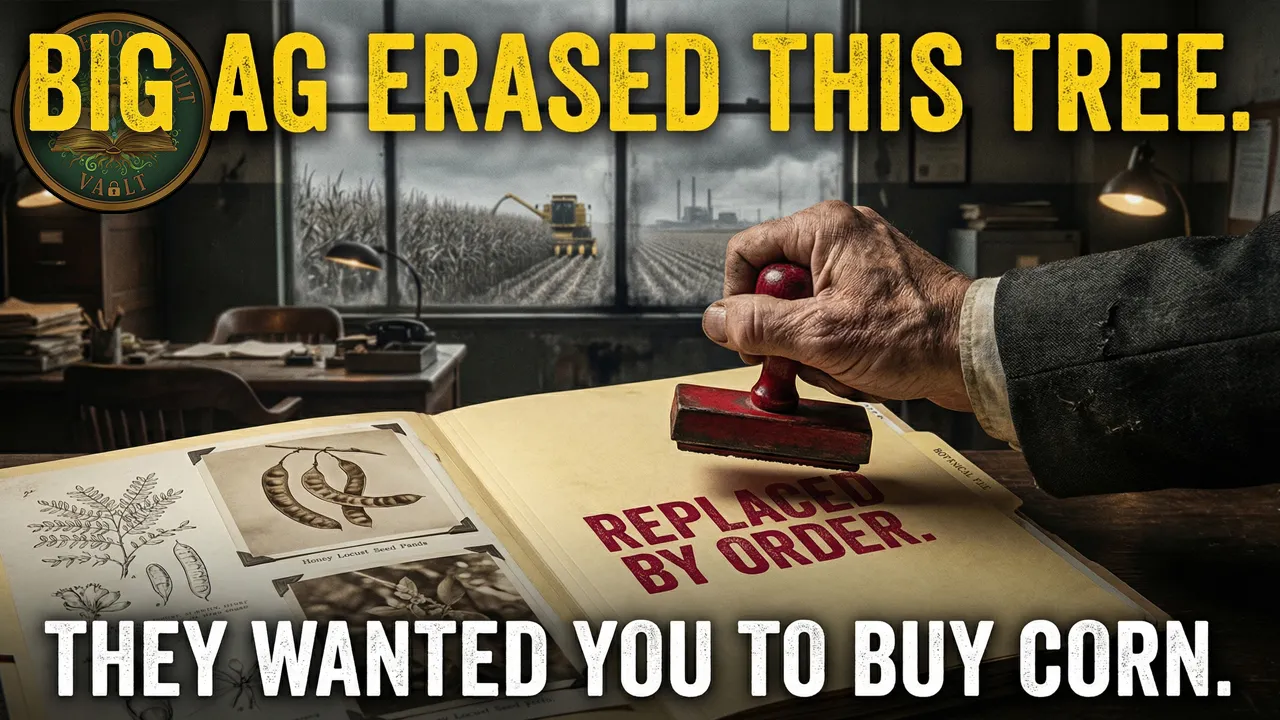
Table of Contents
Ghosts of Cultivation Past
In 2009, biologist Robert J. Warren was doing field surveys in former Cherokee territory in North Carolina. Every single time he found a wild honey locust tree, he was standing next to an ancient Cherokee archaeological site. Not occasionally. Every time. Warren published his findings in PLOS ONE in 2016. The Cherokee did not just use the honey locust. They cultivated it. There were three separate Cherokee settlements named Kulsetsiyi, "honey locust place," written down by English traders as Sugartown.
The Real Sugar Tree
In 1929, J. Russell Smith, a professor at Columbia University, published Tree Crops: A Permanent Agriculture. He devoted an entire chapter to the honey locust and called it the "bran tree" of the corn and cotton belts, imagining gullied hillsides held by its roots and "a ton or two of bran substitute per acre per year" falling from above, with no annual planting, no tilling, no purchased seed. He also recorded that the Secretary of Agriculture told him the department could not get funds to test it. Modern measurements show pod sugars above 30% in the best selections, while maple sap runs about 2 to 3%. One planting, 100 years of harvest.
The TVA Breeding Program
The Tennessee Valley Authority, created in 1933 to rebuild an eroded and impoverished region, launched a tree crops program. Smith's friend John W. Hershey, a nurseryman from Downingtown, Pennsylvania, ran contests asking farmers to send in their best wild trees. Out of those contests came the selections still sold today, 'Millwood' and 'Calhoun', with pods testing above 30% sugar. Hershey left the TVA in 1938, and the program did not outlive him as a national effort.
How World War II Killed the Honey Locust
When the soldiers came home, Washington's answer was industrial monoculture. The 1949 Agricultural Act and subsequent farm bills built a subsidy system around corn, soybeans, wheat, and cotton. Honey locust pods could not be handled by a combine harvester. But the real issue was more fundamental: you plant a honey locust once and it feeds you for a century. The entire federal agricultural architecture was built on the premise of annual purchases. Seed companies, fertilizer companies, chemical companies had no business model that worked if farmers could grow high-protein animal feed forever for free.
The Castrated Tree on Every Street
By the 1950s, American cities were planting honey locusts everywhere. But the form they selected was inermis: Latin for unarmed, meaning thornless. From it, nurseries cloned cultivars selected to bear few or no pods, often male trees that cannot fruit at all. No pods, no mess, no food. The same tree the Cherokee had called Sugar Town now lined the driveways of shopping malls, deliberately stripped of every function that ever mattered. Today, millions of honey locust trees grow in American cities. Most of them were chosen precisely because they bear few or no pods.
Anti-Inflammatory Power Equal to Aspirin
A 2015 study at Michigan State University isolated terpenoid compounds from honey locust flowers that, in laboratory assays, blocked the inflammatory enzymes COX-1 and COX-2, beating aspirin and matching ibuprofen and naproxen. That is a test-tube result; no human trials have followed. A 2013 Virginia Tech study found that ground seed was about 96% digestible in laboratory tests, seeds held more than 20% crude protein, and ground whole pods were comparable as feed to ground whole-ear corn or oat grain.
The Genetics Still Survive
The Hershey variety is available from specialty nurseries. Millwood and Calhoun, selected in the TVA contests of the 1930s, are still propagated. Some of Hershey's original trees still stand in Downingtown, Pennsylvania, in parking lots and on church grounds, dropping pods every autumn that no one knows to pick up. A researcher visiting in 2009 cracked one open and described the pulp as tasting like maple syrup. Those trees are now nearly a century old. Never fertilized, never irrigated, never replanted.
Plant Three Trees in Your Pasture
Plant three trees in your pasture today. In five years, they produce pods. By the time your grandchildren inherit your land, those trees are in full production. The only thing you will have ever done is let the animals harvest the food themselves.
A tree J. Russell Smith saw as a great crop possibility is growing in your parking lot right now, producing nothing, exactly as the industry intended. But the original trees are still out there. The genetics survive. The knowledge survives.
Explore More Survival Foods
Discover forgotten foods that sustained civilizations for millennia.
Browse Survival Foods Collection →