
The Free Bread Tree That Fed Millions of Americans. Why Were 4 Billion Destroyed in 40 Years?
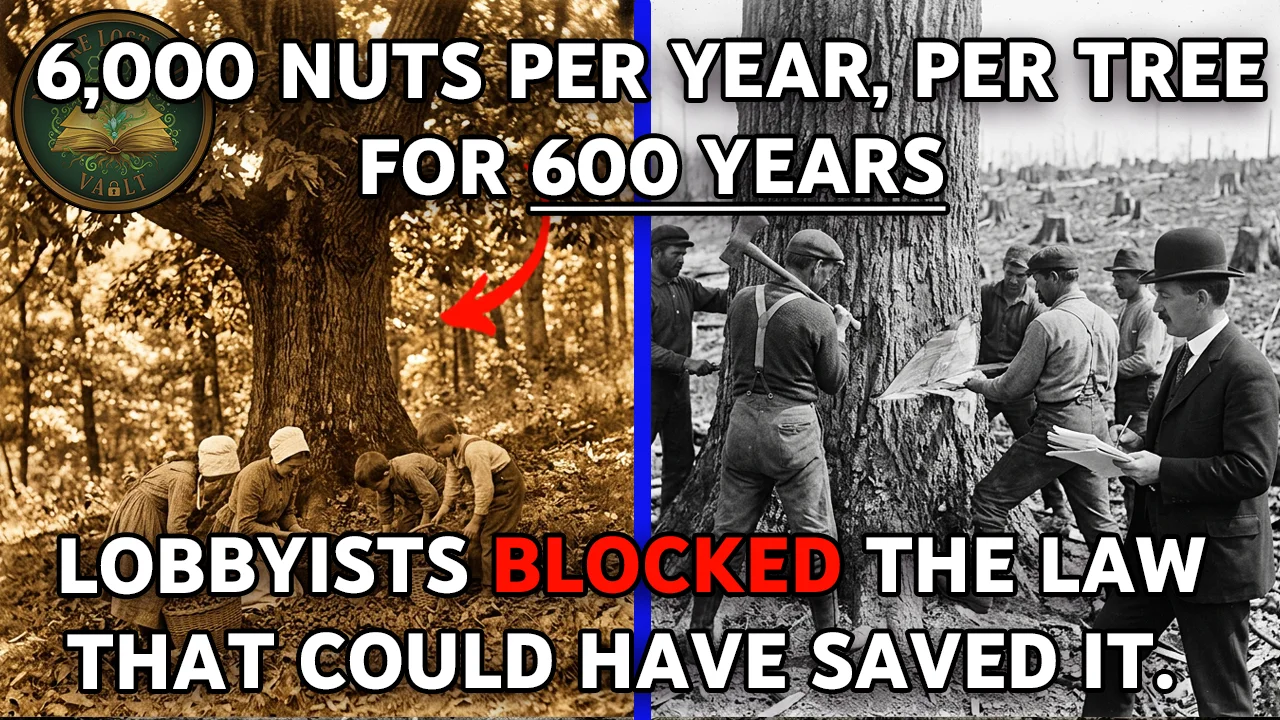
Table of Contents
Recommended: Hybrid Chestnut Tree Seedling
View Hybrid Chestnut Seedling OptionsNote: Pure American chestnut seedlings are rarely sold because they still succumb to blight. These are blight-resistant hybrid seedlings, carrying significant American chestnut genetics and suitable for planting today.
Affiliate link - supports our channel
What is the American Chestnut?
There was a tree that made poverty impossible. It grew without planting. It produced without farming. Every autumn, without asking anything of you, it dropped enough food to carry a family through winter.
For millennia, it was a fixture of the eastern forest. Then in 1876, a single shipment of ornamental trees arrived from Japan. Nobody inspected them. Nobody tested them. And the most catastrophic ecological disaster in American history began in silence.
By around 1950, it was over. About 4 billion trees gone.
We did not lose the American chestnut because it failed. We lost it because the government that should have protected it chose to ignore the scientists who predicted exactly what would happen.
The Bread Tree of the Mountains
A Family's Bank Account in the Trees
The archive opens in the Appalachian Mountains. The year is 1890. A mountain family in western North Carolina rises before dawn. They own no land. They have no cash. But in September, they walk into the forest and come home with bushels of chestnuts. The nuts are roasted on iron skillets. They are ground into flour for bread. They are boiled into porridge. They are fed to the hogs that will be sold at market. The harvest pays their winter taxes and fills their cellar.
This is Castanea dentata, the American chestnut. It was called the bread tree of the mountains, and the name was not poetic. It was literal. In a region where soil was thin, farms were small, and poverty was permanent, the chestnut was the difference between eating and not eating. Appalachian families called it their bank account in the trees. The nuts fell every autumn without fail, as reliable as the turning of leaves.
An Extraordinary Tree by Any Measure
The tree itself was remarkable. It grew to 100 feet tall, straight and fast, reaching full canopy in 20 years. Its wood was naturally rot-resistant. A fence post cut from chestnut lasted a century without chemical treatment. The tannin in its bark was the finest in the world for curing leather. Every part of the tree gave something.
The Cherokee made bread from crushed nuts, treated heart trouble with a tea from year-old leaves, and dressed wounds with infusions from young sprouts. Oral histories described the harvest as a massive community event. Entire families moved through the forest in October, filling wagons and baskets, singing under a canopy so dense that one in every four trees in the Appalachian Mountains was a chestnut. On some ridges, that number reached one in three.
A Grain That Grew on a Tree
The nutritional profile was what made it so essential. Unlike most nuts, the chestnut is not primarily fat. USDA data for the closely related European chestnut show 53 g of carbohydrate and just 2.2 g of fat per 100 g roasted, making it biologically closer to a grain than to a walnut or almond. The same 100 g carries 592 mg of potassium, far more than a banana (358 mg), along with vitamin C, folate, and copper. It was, in every measurable sense, a grain that grew on a tree without irrigation, without plowing, without purchasing seeds from anyone.
Because chestnuts flower in June and July, after the last frosts, a mature tree produced a heavy crop almost every autumn. Free food, year after year.
The hogs of Appalachia ate them and their fat marbled in ways corn-fed hogs could never match. The pork from chestnut-finished hogs was considered the finest in America. Country stores traded the nuts for coffee, cloth and shoes, and rail cars carried them to the street vendors of New York and Philadelphia. Street vendors in every major city built their livelihood around them. The smell of roasting chestnuts on a cold corner was the smell of the American winter.
Then it ended.
How One Shipment Ended a Species
The 1876 Import
In 1876, a nurseryman named S.B. Parsons imported Japanese chestnut trees to Long Island. A few years later, thousands more were brought in. By 1900, USDA plant explorer David Fairchild was importing Asian nursery stock from across the continent without any inspection protocol.
Inside the USDA, one man pushed back. Charles Marlatt, an entomologist and Fairchild's rival, warned publicly that unregulated imports were a biological gamble. He wrote that the greatest danger is often from something you do not know about. Marlatt was right.
Somewhere in those thousands of Japanese shipments, a fungus called Cryphonectria parasitica made the crossing. Asian chestnuts had co-evolved with this fungus for millions of years. They carried it silently, showing no symptoms. The American chestnut had never encountered it. It had zero defense.
The Pathogen Identified
In 1904, Herman Merkel, chief forester at the Bronx Zoological Park, noticed orange cankers spreading across the chestnuts on his grounds. He sent samples to mycologist William Murrill, who identified the unknown pathogen. Murrill's assessment was chilling and unambiguous: he warned his colleagues that this blight would kill every chestnut in America.
The fungus enters through any microscopic wound in the bark. It grows beneath the surface, killing the cambium in a ring around the trunk. Once girdled, the tree above the wound chokes and dies. It spread at 50 miles per year, carried on the wind, on the feet of birds, and by the exact same mail-order nursery trade that had brought it in.
Trade Interests Delayed the Response
Legislators tried to stop it. Marlatt drafted the Plant Quarantine Act, giving the USDA authority to inspect and halt dangerous imports. Nursery importers, whose business depended on cheap, uninspected stock, resisted controls, and inside the USDA, Marlatt's public feud with Fairchild over free plant imports dragged on.
By the time the Plant Quarantine Act finally passed in 1912, eight years after the first sighting, the blight had already crossed into Virginia, Maryland, Connecticut, New Jersey, and Pennsylvania. It was too late.
The Destruction Was Made Worse
Panic Cutting Erased the Survivors
What followed was a blind panic that made the loss exponentially worse. State governments organized massive cutting campaigns, hacking down blighted trees. In the rush to save the lumber before it spoiled, logging crews clear-cut millions of acres. In doing so, they inadvertently destroyed the rare trees that might have possessed natural genetic resistance.
Forests that held the biological key to recovery were leveled for quick timber value. The government had advised landowners to harvest before the trees were ruined, effectively eliminating the species' only chance at natural adaptation.
By around 1950, about 4 billion trees were dead and the American chestnut was functionally extinct across its range, in roughly half a century.
The Economic Collapse of Appalachia
The economic impact on Appalachia was absolute. Families who had relied on the autumn harvest to pay taxes and feed livestock lost the foundation of their survival at the exact moment the Great Depression arrived. The geographer J. Russell Smith, who had championed the chestnut as "a corn tree," wrote in Tree Crops (1929): "Every tree is dead on my twenty-five acres save one little Japanese tree."
The tanning industry collapsed. Communities built around the chestnut trade were left with nothing.
Government Programs That Were Abandoned
Federal support came in waves and left in waves. A federal breeding effort crossing American and Asian chestnuts ran for decades in the twentieth century, then wound down. Private citizens had to take over what the government would not sustain.
The Path Back
The Foundation and the Transgenic Detour
In 1983, the American Chestnut Foundation was established, launching a multi-decade backcross breeding program to cross American chestnuts with disease-resistant Chinese varieties. But then came the modern shortcut.
At the State University of New York College of Environmental Science and Forestry (SUNY ESF), William Powell and Charles Maynard developed a transgenic tree called Darling 58. By inserting a wheat gene for oxalate oxidase, an enzyme that breaks down the acid the blight produces, they believed they had solved the problem in a lab. In January 2020, they petitioned the USDA for deregulation, seeking permission to release these modified trees into wild forests.
In December 2023, the American Chestnut Foundation withdrew its support. Field trials showed inconsistent resistance, slower growth and lower survival. Then came the admission: because of a lab mix-up, the trees studied as Darling 58, possibly since 2016, were a different line entirely, Darling 54. Years of data, on the wrong tree. (In August 2026, USDA APHIS deregulated Darling 54; an EPA review is still pending. In February 2026, a Foundation-led team published in Science that blight resistance can be predicted from DNA, speeding the non-transgenic breeding path.)
The Roots Are Still Alive
But the chestnut does not need corporate approval to survive. Because the blight only kills the wood above ground, the ancient root systems are still alive. Across the Appalachian forest today, millions of native sprouts push up from century-old stumps, trying to reach the canopy before the blight finds them again.
And there are true survivors. Some of the most precious trees in the Foundation's program are large American chestnuts that endured in isolated places outside the main range. Volunteers track them, hand-pollinate them and plant their seed. Their genetics may hold what 120 years of programs could not manufacture.
What You Can Plant Today
If you want to plant this legacy today, Chinese chestnuts are available from nurseries across the country. They tolerate poor soil, require no irrigation, and produce large, highly nutritious nuts in just 3 to 5 years. They co-evolved with the blight and are nearly immune. One tree, properly sited, can feed your family for generations.
The American Chestnut Foundation also distributes hybrid backcross seeds carrying genetics that are 15/16 American chestnut, giving the species a genuine chance at natural recovery, without modification, without patents, without a corporate middleman.
Note: Pure American chestnut seedlings are rarely sold commercially because they still succumb to blight (the American Chestnut Foundation distributes pure American and hybrid seed to its members). The hybrid seedlings available today carry significant American chestnut genetics and are a meaningful step toward restoring this species.
The American chestnut did not fail. It was not replaced by a superior crop. It was destroyed by regulatory cowardice, protected too late, and abandoned by the institutions that caused the disaster. But the bread tree of the mountains is still here, stunted, waiting, trying to reach the light. It has not stopped trying in 80 years. Neither should we.
Explore More Perennial Foods
Discover food plants that produce for decades from a single planting with minimal maintenance.
Browse Perennial Foods Collection →