
Straw Bale Construction: Double the Insulation, Triple the Fire Resistance, $3 a Block
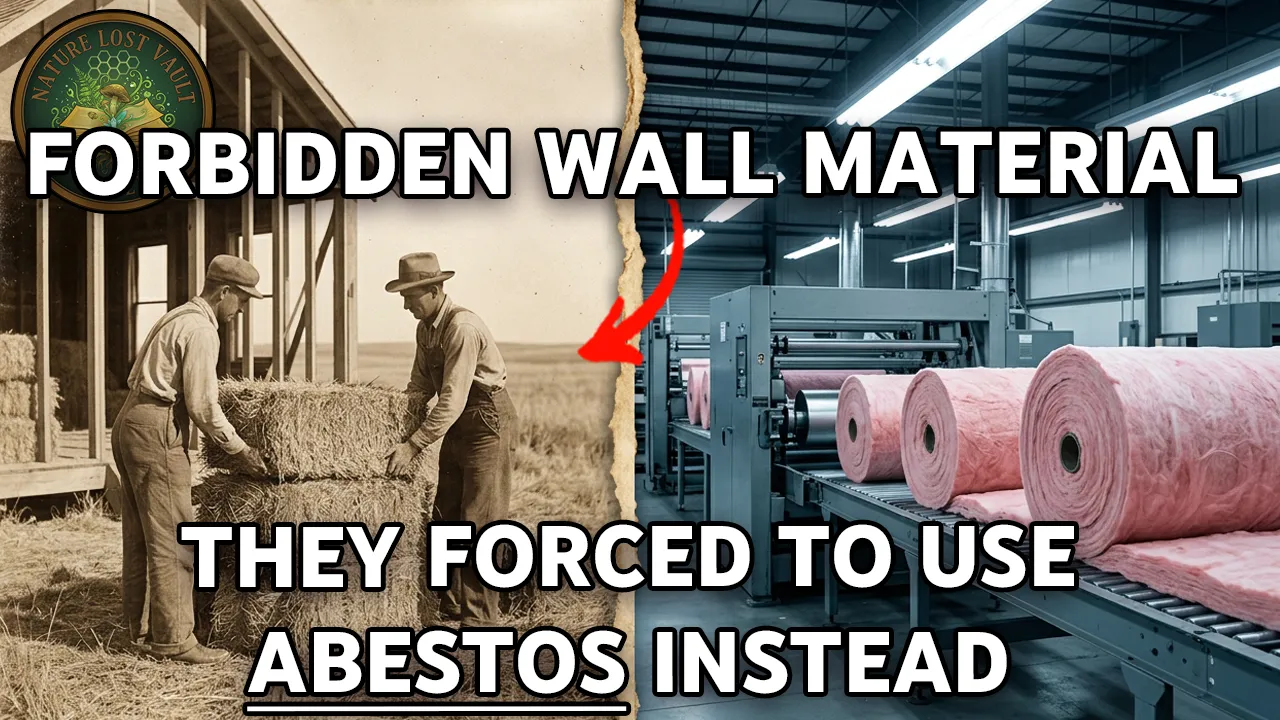
Table of Contents
Born on the Nebraska Sand Hills
In 1862, Congress passed the Homestead Act, offering settlers 160 acres of frontier land. Hundreds of thousands came. They found vast, punishing prairie with almost no timber. Then in the 1880s, the mechanical hay baler arrived. Farmers discovered you could compress the waste straw left behind after a grain harvest into dense, stackable bricks. Each bale weighed up to 80 pounds. Stack them like giant masonry blocks, pin them with wood rods, seal them with lime or clay plaster, and you had a wall that was stronger, quieter, and warmer than anything expensive lumber could produce. And it was essentially free.
The first documented straw bale building went up in 1897, a one-room schoolhouse on the Nebraska plains. The builders left the walls exposed. A report from a few years later noted the building had been eaten by cows. They learned from that. They sealed the next ones with lime, clay, and gumbo mud.
The 1928 Church Still Standing
In 1928, a congregation in Arthur, Nebraska built an entire church out of baled rye straw, hauled in by mules, stacked two feet thick, and sealed with black gumbo mud. Decades later, when restorers opened those walls during renovation, they found the straw inside completely intact. Not a trace of rot, not a trace of collapse. Ruth Jagela, the church caretaker, described standing beside that wall and looking at straw that had been sealed inside since 1928. Still pale, still dry, still holding.
That church is listed on the National Register of Historic Places. Tourists drive hours to see it. Foreign governments have sent formal delegations to Arthur, Nebraska to study it.
R-30: Double the Code Minimum
In 1998, researchers at Oak Ridge National Laboratory ran formal thermal testing. A standard wood-framed wall built to modern code registers R-19. A 23-inch straw bale wall registers R-30. That is more than double the insulation value of the wall in your house right now. The average American household spends over $2,000 a year on energy bills. Straw bale homes have recorded energy savings as high as 75% compared to conventional construction.
2 Hours at 1,800 Degrees
A plastered straw bale wall was blasted with open flame at temperatures above 1,800 degrees Fahrenheit. The wall held for more than two hours without structural failure. The dense compaction of the straw chokes off oxygen, making combustion nearly impossible. A wood-framed wall built to commercial standards burned through in 30 to 45 minutes. The material everyone assumed was a fire risk outlasted the material that replaced it by nearly three times.
Owens Corning and the Code of Silence
In 1938, Owens Corning patented fiberglass and within a decade embedded their product in the post-war housing boom as the default insulation. Then they did something more permanent. They got themselves written into the building code. Not a law that named straw bale and banned it. The code simply said nothing about straw bale at all. In building code logic, silence is the same as prohibition. No inspector can approve a material that does not exist in the code. No bank will finance it. No insurance company will cover it.
The material did not need to be banned. It just needed to be ignored. One of those generates perpetual revenue. The other does not.
The Asbestos Connection
Owens Corning manufactured more than fiberglass during those decades. For 40 years, the company produced insulation that contained asbestos, exposing factory workers and homeowners across the country. They knew the risks and did not disclose them. The liability eventually became so large the company collapsed into bankruptcy, establishing a trust of over $5 billion to pay its victims. Over 800,000 claims were filed. The company that defined the American insulation standard for half a century poisoned the people it was supposed to protect. Meanwhile, the 1928 church in Arthur, built from agricultural waste and lake mud, was still standing.
13 Years to Write a Code
David Eisenberg co-wrote the first load-bearing straw bale code in Arizona in 1995. California architect Martin Hammer spent 13 years drafting a national appendix entirely on volunteer time. Builders traveled to code hearings at their own expense, funded their own laboratory testing, and navigated a process built around materials with industrial lobbying behind them. When approval finally came, it landed as an optional appendix that individual states can still choose to ignore. Many have. 119 years after the first Nebraska schoolhouse, it is still optional.
Building With Straw Today
Check whether your state has adopted the straw bale appendix. If it has not, many owner-builders have succeeded through the alternate materials provision, which allows approval on a case-by-case basis with engineering documentation. Bales cost $3 to $12 each. Many grain farmers give them away. One-tenth of the residual straw North America produces from grain harvests each year could build over two million large homes.
Stack the bales, pin them with bamboo or wood rods, and seal both faces with lime or clay plaster. No fiberglass, no spray foam, no supply chain, no toxins.
They built that church in Arthur with mules, lake mud, and community labor. It has outlasted the billion-dollar industry that tried to replace it. The 1897 schoolhouse was eaten by cows because no one plastered the walls. Everything since then has been a lesson in finishing what you start. The walls are waiting. The straw is in the fields. Now you know what they spent more than a century trying to make sure you never found out.
Explore More Building & Construction
Discover forgotten techniques that built civilizations for millennia.
Browse Collection →