
Rammed Earth: The Wall That Heats and Cools Your Home for Free
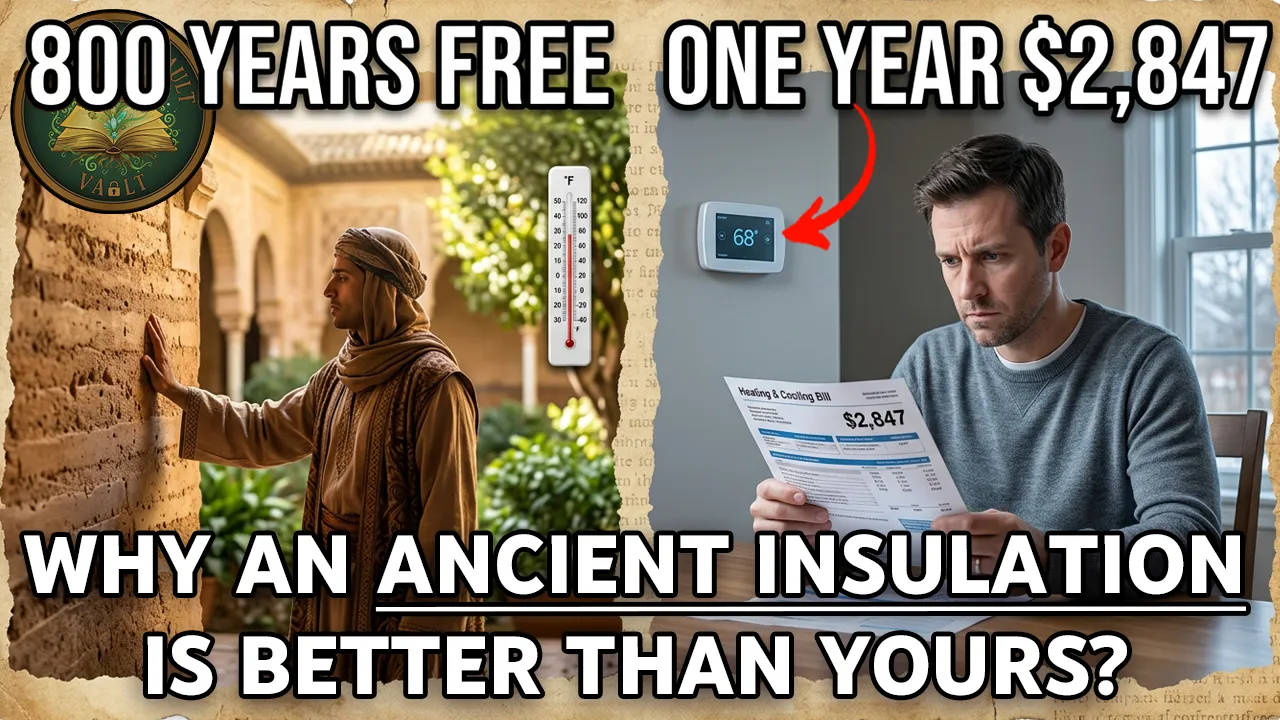

Table of Contents
9,500 Years of Thermal Engineering
At Catalhoyuk in south-central Turkey, archaeologists from Cambridge and Stanford excavated a fully developed urban center of 8,000 people dating back 9,500 years. The exterior temperature in that region swung more than 40 degrees Fahrenheit between day and night. Inside those thick earthen structures, that variation dropped to under 12 degrees. Earth and mass doing work no mechanical system had been invented to do, 7,500 years before Christ.
The Alhambra: 4 Degrees of Swing Inside, 63 Outside
Construction of the Alhambra Palace in Granada, Spain began in 1238. University of Granada researchers conducted systematic interior monitoring across multiple years. The exterior swings from freezing in winter to 95 degrees in summer. Inside, it holds between 68 and 72 degrees year-round. Sixty-three degrees of oscillation outside, four degrees inside. Your central air unit will need replacing in 15 years. That wall has not needed replacing in 800 years.
The Flywheel Effect: Time-Shifting Heat
A 12-inch adobe wall hit by direct sun at 2:00 in the afternoon does not transmit that heat inside. The energy migrates through the mass inch by inch. By the time it travels through 12 inches of compressed earth, 8 to 10 hours have passed. The heat that baked the exterior at 2:00 reaches the interior around midnight. By that time, the outside air has already dropped 30 degrees, and the wall is radiating stored warmth back into the house.
Push the wall to 20 inches, and the thermal lag stretches to 20 hours. The daily temperature cycle never penetrates. Engineers call it the flywheel effect. It does not block heat. It time-shifts it. Fiberglass does none of this. It cannot remember yesterday's temperature. It cannot store energy for tonight.
The R-Value Deception
In 1938, Owens Corning patented fiberglass insulation and needed a metric that made it look like the only answer. The R-value measures resistance under constant, dead conditions, a laboratory where temperature never cycles. Under those artificial conditions, fiberglass wins every time. The test was designed to ignore the dynamic time-shifting property of thermal mass by the company that sold what the test rewarded.
A cubic foot of fiberglass weighs roughly half a pound. A cubic foot of rammed earth weighs 140 pounds. They have about the same heat capacity per pound. That makes 280 times the thermal energy storage. An earthen wall stores 280 times the thermal energy of the fiberglass that beats it on the industry's favorite test.
How Building Codes Outlawed the Earth
In 1975, ASHRAE Standard 90 became the first national building energy code. The technical committee was composed primarily of insulation manufacturers and mechanical system engineers. No earthen construction representative was present. The standard defined thermal performance entirely in R-value terms. Arizona banned adobe construction outright for a two-year period. A 10,000-year-old building material was made illegal because it could not pass a test invented by the industry selling its replacement.
What Independent Science Found
Oak Ridge National Laboratory tested earthen walls under real-world conditions. A 12-inch rammed earth wall rated R-13 delivered energy savings equivalent to a conventionally insulated wall rated R-25. The metric had been undercounting the earth's performance by nearly half. In 2007, Australia's CSIRO found a 70% reduction in heating energy for rammed earth versus timber-frame construction. The International Energy Agency in 2018 reviewed over 400 studies and concluded high-mass buildings use 50 to 70% less energy.
The Rammed Earth Revival
New Mexico adopted the first earthen building materials code in the 1960s, revised through 2021 and now referenced internationally. In California, David Easton of Rammed Earth Works has been building for 45 years. His walls achieve 3,000 PSI compressive strength, within the range of industrial concrete. A rammed earth structure built in 1820 in Richmond, Tasmania still operates today as a working bed and breakfast.
Your Pathway In
Start with the dirt. A local geotechnical lab can test the subsoil on your property for the right proportion of clay, silt, and sand. In most areas, the building material is already on your land, free. In the American Southwest, New Mexico's code and Arizona's builder community give you established permitting precedent. Outside the Southwest, a licensed engineer's stamp unlocks most building departments. For financing, portfolio lenders, small local banks that hold their own mortgages, are increasingly financing earthen homes.
The material that predates every building code, every insulation product, and every energy standard is under your feet right now. It built the Great Wall, the Alhambra, and Chaco Canyon. It provided 9,500 years of human shelter. Three interlocking systems, none of them designed to measure what actually matters, all of them profitable for the corporations that wrote them, cannot erase what the ground remembers.
Explore More Building & Construction
Discover forgotten techniques that built civilizations for millennia.
Browse Collection →