
Hempcrete: Fireproof, Mold-Proof Walls That Turn to Stone Over Decades
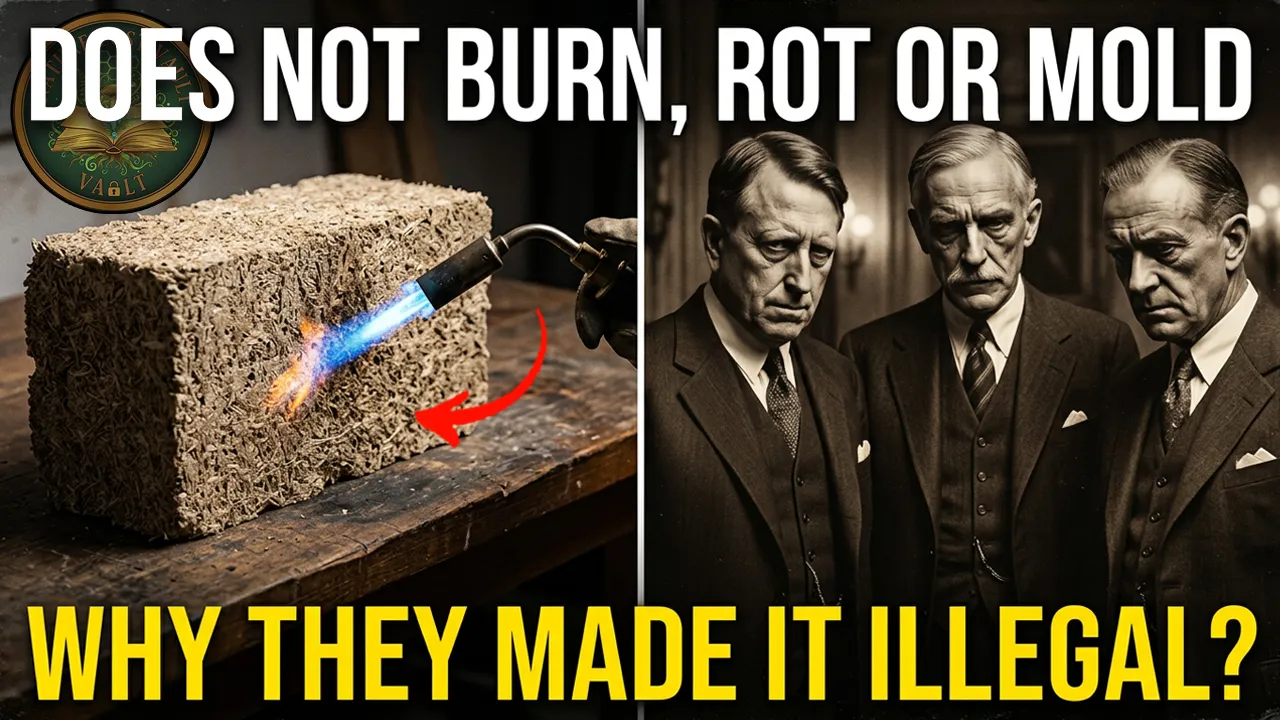
Table of Contents
1,400-Year-Old Foundations Still Standing
In the 6th century AD, along the Sarthe River in France, engineers of the Merovingian kingdom constructed bridge abutments from a mortar made of hemp fibers and lime. Those bridges are gone, but the hemp-lime foundations they rested on remain. Archaeologists found them completely intact 1,400 years later.
In India, inside the carved Buddhist caves of Ellora, the plaster lining the walls has protected intricate carvings from monsoon humidity for over 15 centuries. When scientists analyzed it in 2016, they found pounded hemp fibers. The caves flood during the rainy season. Yet the plaster has not crumbled, not molded, not failed.
The Alchemy of Hemp and Lime
The formula is almost absurdly simple. Take the woody inner core of a hemp plant called the hurd, the part that rope makers historically threw away as waste. Mix it with lime and water, pack it into wall forms around a timber frame, and wait. The lime reacts with carbon dioxide in the air through a process called carbonation. Over days, weeks, and years, the lime slowly reverts to calcium carbonate. It turns back into stone.
The hemp fibers become encased in a mineral matrix. The wall literally petrifies, becoming harder and more resilient every single year it stands. It is entirely carbon negative, locking away an estimated 325 kilograms of carbon per cubic meter for the entire life of the building.
Class A Fire Rating Without a Single Additive
Because of the high silica content in the hemp fibers, fire cannot take hold. When flames touch hempcrete, the lime binder forms a charred layer that extinguishes itself. In standardized tests conducted to the ASTM E119 fire resistance standard, hempcrete walls have withstood temperatures exceeding 1,700 degrees Fahrenheit for over an hour without significant heat transfer, earning the highest Class A fire rating without a single chemical additive.
The high pH of the lime binder, around 12, makes it biologically impossible for mold to establish. Mold requires a pH of 4.5 or lower to survive. The wall kills the chemistry before it begins. And the material breathes, absorbing excess humidity and releasing it slowly, so condensation never builds inside the wall cavity. Termites, carpenter ants, and boring beetles cannot eat it. There is no organic material their biology can process.
From Jamestown Mandates to Tax Stamps
In 1619, the colonial government of Jamestown issued a mandate: every farmer was legally required to grow hemp. The plant was so essential to survival that it functioned as legal tender. George Washington grew it at all five farms of Mount Vernon, recording the crop 90 times in his personal diaries. Thomas Jefferson considered it so valuable that when he designed an improved hemp processing tool, he refused to patent it. He wanted every farmer to have it for free.
The Three Men Who Killed Hemp
William Randolph Hearst was the most powerful newspaper publisher in America and the owner of vast timber holdings. Hemp could produce four times more paper per acre than trees. The DuPont family had just patented nylon in 1935 and was developing synthetic products to replace natural materials. Andrew Mellon was the Secretary of the Treasury, the wealthiest man in America, and the chief banker to the DuPont empire.
Hearst's newspapers ran a sustained campaign equating the industrial hemp plant with marijuana. The word "marijuana," then unfamiliar slang, was deliberately weaponized because most Americans did not know it referred to the plant their farmers had been growing legally for three centuries. The Marihuana Tax Act passed Congress in 1937 after hearings lasting only hours. The American hemp industry was dead within years.
What We Build With Instead
Today, the average American home is built from chemically treated pine studs so flammable that a house fire can consume the structure in under 10 minutes. The walls are filled with fiberglass insulation that compresses over time and causes respiratory damage. The interior is sealed with drywall that in a fire releases hydrogen sulfide and sulfur dioxide. Termites eat the frame. Mold grows inside the wall cavities. Every material in that wall must be purchased on a 30-to-50-year replacement cycle. The house is a subscription.
Hempcrete requires no replacement. It has no cycle. A home built correctly from hemp and lime does not degrade. It hardens.
Europe Never Stopped Building
France has constructed hempcrete homes since the early 1990s. In Belgium, a manufacturer called IsoHemp now produces more than one million hempcrete blocks annually. In England, contractors who work with it cannot understand why we pour toxic chemicals into conventional houses when a lightweight material that smells of the earth outperforms them all.
Hempcrete Returns to America
In December 2018, President Trump signed the Agriculture Improvement Act into law. Industrial hemp was legal at the federal level for the first time since 1937. In 2022, the International Code Council added hempcrete to its official building codes. After the 2025 wildfires tore through Los Angeles, architects began recommending hempcrete construction for rebuild zones. Homes that fire cannot consume in wildfire country.
Three men erased it. A continent remembered it. And the material itself never stopped doing what it has always done. It waited, it got harder, and it outlasted. The wall that cannot burn, cannot rot, cannot be eaten, and cannot be owned by a chemical monopoly is coming back. It hardens with every passing year into something stronger than the forces that tried to erase it.
Explore More Building & Construction
Discover forgotten techniques that built civilizations for millennia.
Browse Collection →