
Cork Insulation: Beats Fiberglass on Every Metric, Contains Zero Toxins
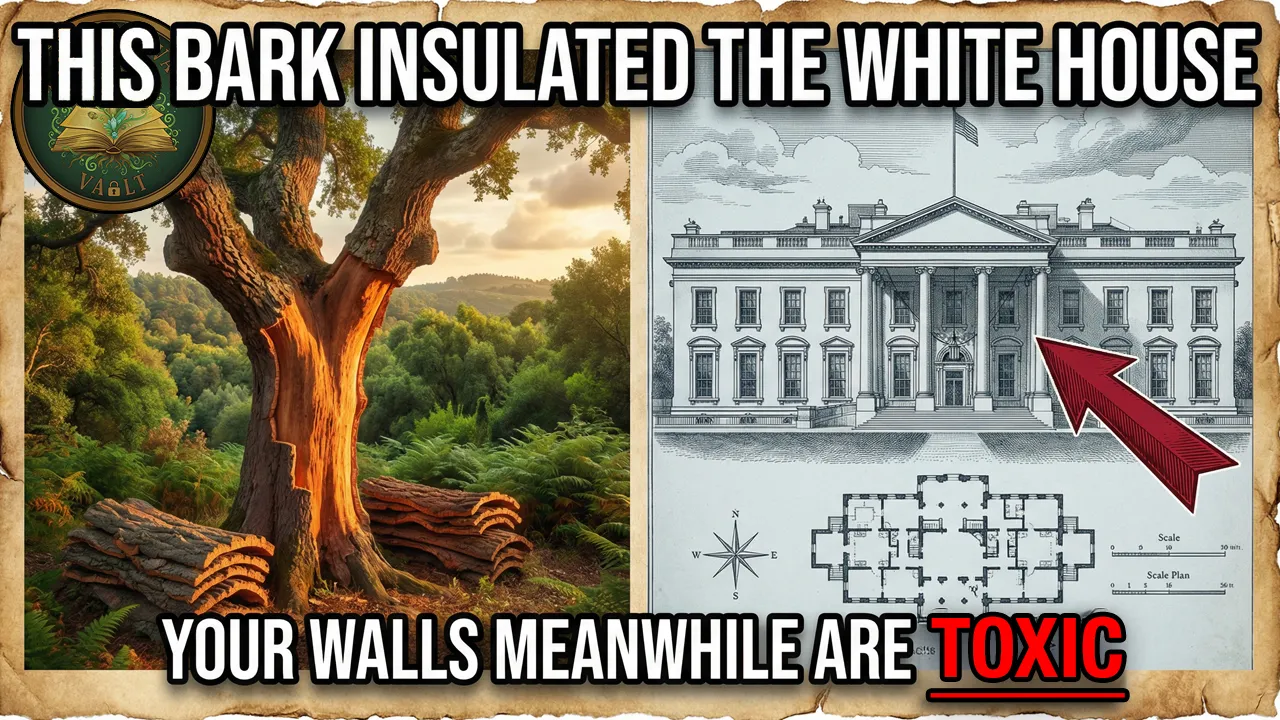

Table of Contents
60 Million Years of the Cork Oak
For 60 million years, the cork oak, Quercus suber, has grown in the forests of southern Portugal. It is a tree that defies the rules of forestry. Harvest its bark, and the tree does not die. It regenerates. The second harvest is better than the first. The third is better than the second. A single tree, first stripped at age 25, will produce superior cork every 9 years for three centuries. One tree, 12 harvests, 300 years.
From Roman Aqueducts to Frank Lloyd Wright
The Romans used cork to insulate the aqueducts carrying fresh water to a million people. Pliny the Elder documented it in the first century AD. The Moors expanded the cork forests across the Iberian Peninsula to keep their buildings cool in summer and warm in winter. They called it the tree that gives without dying. By the early 1900s, Thomas Armstrong had built cork board insulation into the walls of the Mayo Clinic, the Chicago Congregational Church, and the White House. Le Corbusier specified it. Walter Gropius specified it. Frank Lloyd Wright built it into Fallingwater in 1937.
Cork vs. Fiberglass: The Numbers
Cork runs from R-3.6 to R-4.2 per inch. Standard fiberglass batts run from R-2.9 to R-3.8 per inch. Cork outperforms fiberglass per inch. But the real difference is longevity. Foam insulation and fiberglass lose their thermal resistance over time through off-gassing. Cork's R-value is unchanged after 50 years. The same board installed in 1970 insulates exactly as well today as the day it was pressed.
70 Years of Formaldehyde in Your Walls
From the very beginning, fiberglass was held together by phenol formaldehyde, a compound the International Agency for Research on Cancer classifies as a known human carcinogen. For 70 years, millions of American homes were wrapped in a material that off-gassed cancer-causing compounds into bedrooms, nurseries, and living rooms. The last major US fiberglass manufacturer did not remove formaldehyde from its residential insulation until 2015. Cork contains zero formaldehyde. It requires no flame retardants because it is inherently fire resistant.
The Material That Breathes
Cork's microscopic cells, 14-sided and filled with gas, with walls made of suberin, allow vapor to pass through slowly while blocking liquid water entirely. In a wall assembly, moisture that enters the cavity can dry out. Fiberglass traps moisture. By the 1990s, building scientists identified an epidemic of black mold and rotting wall framing in post-war homes, traced directly to synthetic insulation that blocked vapor movement.
Saving the World's Oldest Managed Forests
The cork oak forests of the Iberian Peninsula are classified by the World Wildlife Fund as a biodiversity hotspot, home to the Iberian lynx and the Imperial eagle. Every tree stripped of its bark absorbs five times more carbon to regenerate than an unharvested tree. When cork disappeared from American walls, the forests lost their largest market. When you insulate a wall with cork, you are funding the oldest managed forest ecosystem on Earth.
Installing Cork Today
Thermacork panels are available in the United States through EcoSupply Center. They install exactly like any other rigid board insulation, cut to size, mechanically fastened to the framing. A 3-inch layer achieves R-12, meeting or exceeding code in most climate zones. No hazardous materials gear required. No itch. No off-gassing into your air. In Europe, passive house designers in Germany and Austria have returned to cork as the exterior insulation layer of choice.
A patent filed in 1938 did not erase it. A building code written in 1965 did not bury it. A generation of toxic pink batts could not replicate what this bark can do. The tree is still standing in the same forests the Romans mapped, waiting as it always has to give what it has always given. All it asks is that we remember it is there.
Explore More Building & Construction
Discover forgotten techniques that built civilizations for millennia.
Browse Collection →