
Stops Flu Entering Cells. This Plant Beat Aspirin in 1918 Before Carnegie & AMA Erased It.
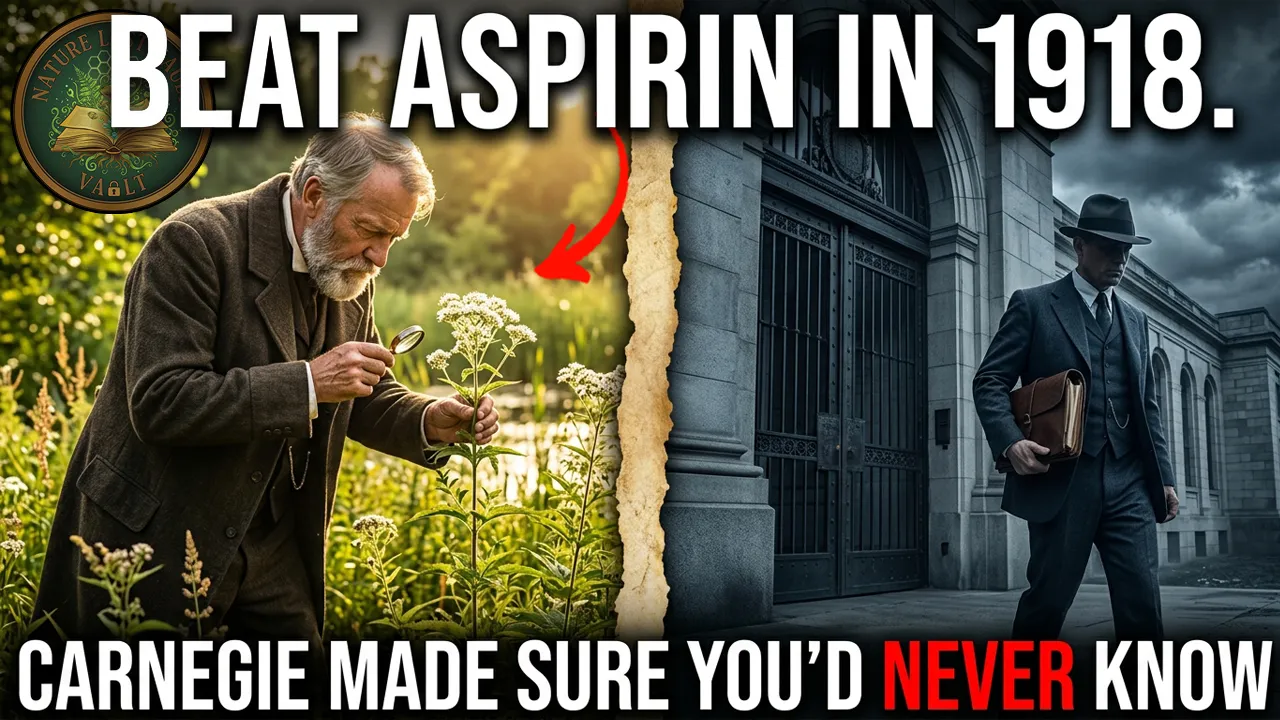
Table of Contents
- The Swamp Plant That Outperformed Aspirin
- Indigenous Knowledge and Colonial Adoption
- The Rise of Eclectic Medicine
- The Flexner Report: One Man, No Medical Degree
- The 1918 Pandemic: Two Medicines, Two Outcomes
- The Aspirin Question
- The Erasure of a Medical Tradition
- What Modern Science Confirmed
- Safety and Traditional Preparation
- How to Grow and Use Boneset
- FAQ
Recommended: Boneset Seeds & Extract
View Boneset Seeds View Boneset ExtractNote: Boneset contains pyrrolizidine alkaloids. German health authorities recommend against prolonged daily use. Traditional preparation is short-term only: a tea at the first sign of fever, taken for the duration of the illness and not beyond.
Affiliate links - supports our channel
The Swamp Plant That Outperformed Aspirin
In the fall of 1918, the deadliest pandemic in recorded history was killing 10,000 Americans a week. Two groups of doctors treated the exact same disease. One group had a death rate commonly put at 3 in every 100. The other reported a death rate of about 6 in 1,000. The group reporting far better survival was not relying on the new pharmaceutical wonder drug. They were using botanical medicines, among them a weed from the swamp.
Within about 20 years of that pandemic, the last school that trained licensed physicians to use it had closed. The plant is Eupatorium perfoliatum. The common name is boneset. And the story of how it was erased from American medicine involves a man who was not a doctor, a foundation with a financial interest in the outcome, and a single report that rewrote the practice of medicine in a decade.
| Metric | Value |
|---|---|
| Botanical name | Eupatorium perfoliatum |
| Family | Asteraceae |
| Native range | Eastern North America (wetlands, stream edges) |
| Traditional uses | Flu, fever, colds, "bone pains" of fever, respiratory infection |
| Indigenous users (documented) | Iroquois, Cherokee, Mohegan, Menominee, Delaware, and more |
| 1918 flu mortality (Eclectic) | ~6 per 1,000 patients (self-reported 1919 survey) |
| 1918 flu mortality (conventional care) | ~3 per 100 patients, commonly cited (~5× higher) |
| Active compounds | Sesquiterpene lactones, polysaccharides, flavonoids |
| Immune activity | Polysaccharide immune claim (1986) not confirmed in later in-vitro work |
| Modern finding | Blocks Influenza A viral attachment to host cells |
| Regulatory erasure | Flexner Report (1910) condemned Eclectic schools; the last closed in 1939 |
| Safety note | Contains pyrrolizidine alkaloids; short-term use only |
| Mature height | 3–5 feet (wetland perennial) |
Indigenous Knowledge and Colonial Adoption
The archive opens in a wetland meadow along the eastern seaboard, sometime in the 1600s. A tall perennial plant grows at the edge of a stream. Its paired leaves clasp the stem so tightly they appear to grow straight through it, as if fused to the stalk. White flower clusters crown each stalk in late summer.
The Iroquois, the Cherokee, the Mohegan, the Menominee, the Delaware. Many nations used the same plant for the same purposes: fever, colds, and a bitter tonic. The plant was Eupatorium perfoliatum. Boneset.
European settlers learned it from indigenous healers within a generation. The Eclectic physician Harvey Wickes Felter later explained the name: the plant earned "the vulgar name of boneset" for relieving "deep-seated aching pain (so-called 'bone pains')", the aching of influenza and of what early Americans called break-bone fever. In 1820, boneset entered the first edition of the United States Pharmacopeia. By the Civil War, soldiers packed it into their field kits alongside their ammunition. Farms kept bundles of dried boneset hanging from the rafters the way families now keep aspirin in the medicine cabinet.
The Rise of Eclectic Medicine
In the mid-1800s, a new school of medicine was growing in America. They called themselves Eclectics, from the Greek word meaning to choose from. Their philosophy was simple: treat the whole person, use what works, do no harm. They drew from Native American plant knowledge, from European herbal traditions, from African healers in the South. They built licensed medical schools across the country, some fifty-five in all, led by the Eclectic Medical Institute of Cincinnati (chartered 1845), and trained thousands of physicians.
Their most celebrated pharmacist was John Uri Lloyd, who ran a botanical medicines company in Cincinnati called Lloyd Brothers. He invented extraction techniques so precise the pharmaceutical industry eventually borrowed them. The medicines he sold most were plant-based. Boneset was among his staples.
The Flexner Report: One Man, No Medical Degree
In 1908, the Carnegie Foundation for the Advancement of Teaching set out to survey every medical school in the United States and Canada, working closely with the American Medical Association's Council on Medical Education. It hired Abraham Flexner, a man who had never practiced medicine, who held no medical degree, and who had spent his career as an educator of boys.
Flexner visited 155 medical schools. He did not test their outcomes. He did not compare their patient survival rates. He evaluated their laboratories, their equipment, and their alignment with a German university model built around pharmaceutical science.
In 1910, he published his verdict. Homeopathic schools: quacks. Naturopathic schools: quacks. Eclectic schools: quacks. All dismissed as charlatanism. All recommended for closure. The Eclectics had treated patients across six decades of epidemics and documented their outcomes in peer-reviewed journals. None of that evidence was examined. None of it was refuted. It was simply declared irrelevant by a man with no medical training, backed by AMA and Carnegie Foundation money, and written into law through state licensing boards one by one.
The 1918 Pandemic: Two Medicines, Two Outcomes
In the spring of 1918, a new strain of influenza emerged from military training camps. By fall, the second wave was catastrophic. Healthy young men and women were dying within 48 hours of first symptoms. Hospitals overflowed. Morgues ran out of space. Cities banned public gatherings.
Officials reached for the new wonder drug. In late September and October 1918, the US Navy, the Surgeon General and the Journal of the American Medical Association all recommended aspirin for influenza. Doses in some regimens ran from 8 to 31 grams a day, the equivalent of roughly 25 to 95 standard aspirin tablets. Bayer's American aspirin patent had expired in 1917, so every drug company could now make and sell it.
Eclectic physicians largely reached for their plants instead: gelsemium, boneset, pleurisy root, and the full botanical materia medica their tradition had built over 75 years.
In March 1919, John Uri Lloyd's company surveyed 1,000 Eclectic physicians about their outcomes. Taken together, the Eclectics reported a fatality rate of about 6 in 1,000 patients (0.6 percent). Mortality under conventional care commonly ran around 3 in every 100. The top remedy named was gelsemium (722 endorsements); boneset was endorsed by 328 of the thousand. The figures were self-reported and uncontrolled, collected by a company that sold botanical medicines, and no one ever ran the trial that could have settled it.
The Aspirin Question
In 2009, physician Dr. Karen Starko published a paper in Clinical Infectious Diseases examining something that had gone unquestioned for 90 years. The aspirin doses recommended in September and October 1918 were high enough to be toxic. At those levels, the drug flooded the lungs with fluid, causing pulmonary edema. The wet, hemorrhagic lungs found in early autopsy reports, the drowning deaths that made the 1918 flu unlike anything before it, were consistent with salicylate poisoning.
Aspirin advertisements ran in August 1918. Official recommendations came in September and early October. The death spike came in October. Starko's paper is a documented hypothesis, not a verdict. But the question it raises has never been satisfactorily answered.
The Eclectics' herbs did not drown anyone.
The Erasure of a Medical Tradition
In 1939, the Eclectic Medical Institute in Cincinnati, the last Eclectic medical school, graduated its final class. Boneset lingered in the National Formulary until around 1950. In Cincinnati, the Lloyd Library still keeps the Eclectics' journals on its shelves, the reports of 1918 among them.
The Flexner Report did not just close schools. It erased a lineage of medicine from legitimate practice. Permanently. Harvey Wickes Felter, the great Eclectic physician, wrote in his 1922 materia medica that boneset is "an admirable remedy 'to break up a common cold'", and that during "the severe pandemic of 1918-19" it "was one of the safest and most successful remedies employed." The library that holds them sits in Cincinnati. Most of the physicians who could have acted on them in the decades that followed were never trained to read it.
What Modern Science Confirmed
Boneset's modern research came from Germany, not America. In 1986, a team including Hildebert Wagner reported immune-stimulating polysaccharides in boneset, but the University of Münster group later could not confirm a direct immune boost in vitro.
An often-quoted 1981 German trial compared a boneset preparation with aspirin for the common cold and found similar relief, but it used a homeopathic dilution (Eupatorium perfoliatum D2), not the herb as a tea.
In 2011, Andreas Hensel's group at Münster reported that boneset extracts and the flavonoid eupafolin showed anti-inflammatory activity in cells, and that a dimeric guaianolide, one of its bitter sesquiterpene lactones, was active against the malaria parasite in the lab.
Then came the finding that closes the circle entirely. In 2016, the same Münster group showed that a hydroalcoholic boneset extract blocked influenza A viruses from attaching to host cells before infection could begin. Not suppressing symptoms after the fact. Stopping the virus at the door of the cell. It is a cell-culture result, not a clinical trial, but it fits what the Eclectic physicians reported in 1918.
Safety and Traditional Preparation
Boneset contains compounds called pyrrolizidine alkaloids. Older references said boneset was free of them, but a 2018 USDA study tested 49 samples and found them at 0.0002 to 0.07 percent, and hot infusions extracted them well. Use it short-term only, avoid it entirely with liver disease, and never take concentrated extracts for weeks at a time.
The traditional preparation is short-term: a tea from dried leaves and flower tops at the first sign of fever or flu, taken for the duration of the illness and not beyond. That is how the Iroquois used it. That is how the Eclectics used it across six decades of American epidemics.
How to Grow and Use Boneset
Boneset grows wild across eastern North America. It is easily cultivated as a native perennial. It prefers moist soil and partial sun: stream edges, rain gardens, wet meadows. It grows 3 to 5 feet tall and comes back every year without replanting.
Dried leaf and flower tops are available from reputable herbal suppliers. To make the traditional preparation, steep 1 to 2 teaspoons of dried herb in 8 ounces of boiling water for 15 minutes. Drink it warm, three times daily, at the very first sign of flu. It is bitter. Significantly bitter. The Iroquois and the Eclectic physicians both recorded that bitterness as part of its power.
The Eclectics did not lose because their medicine failed. They lost because their medicine could not be owned. Boneset grew in swamps. It could not be patented. It could not be manufactured at scale and sold at markup. Abraham Flexner's report removed it from legitimate practice in a single decade. It took 100 years for researchers to confirm in a laboratory what those physicians had documented across six decades of American epidemics. Somewhere in a wetland near you, the plant is still there. White flowers in August. Paired leaves fused to the stem. It has been waiting since 1939.
Frequently Asked Questions
What is boneset herb used for?
Boneset (Eupatorium perfoliatum) is a traditional herbal remedy used primarily for flu, fever and respiratory infections. It was used by the Iroquois, Cherokee, Mohegan, Menominee and Delaware nations for fevers and colds. After the 1918 flu pandemic, a 1919 survey of Eclectic physicians, who used boneset among other botanicals, recorded a self-reported fatality rate of about 6 in 1,000 patients, compared to about 3 in 100 commonly cited for conventional care. The name boneset came from its ability to relieve the deep bone-aching pain of severe fevers.
Does boneset extract work against flu?
Modern peer-reviewed research has documented that hydroalcoholic extracts of boneset directly inhibit Influenza A virus by blocking viral attachment to host cells before infection can begin, not just suppressing symptoms afterwards. This is a cell-culture result (Derksen et al., 2016), not a clinical one. The same University of Münster group reported anti-inflammatory activity and activity against the malaria parasite in 2011. A 1986 report of immune-stimulating polysaccharides could not be confirmed in later in-vitro work, and the often-quoted 1981 German trial against aspirin for colds used a homeopathic D2 dilution, not the herb.
How do you make boneset tea?
The traditional Iroquois and Eclectic preparation is a short-term tea from dried leaves and flower tops at the first sign of fever or flu. Steep 1 to 2 teaspoons of dried herb in 8 ounces of boiling water for 15 minutes, covered. Drink it warm, up to three times daily, for the duration of the illness only. It is notably bitter; both the Iroquois and Eclectic physicians recorded that bitterness as part of its power. Do not use for more than a few consecutive days.
How do you identify boneset (Eupatorium perfoliatum)?
Boneset is a tall perennial 3 to 5 feet high, growing in moist meadows, stream edges, ditches and wet woodland margins across eastern North America. Its most distinctive feature is the paired leaves that clasp the stem so tightly they appear fused into a single leaf pierced by the stem (hence perfoliatum). White flower clusters crown each stalk in late summer (July through September). Hairy stem, long tapered leaves with fine teeth. Do not confuse with Joe Pye weed (Eutrochium purpureum), a related plant with whorled leaves and pink-purple flowers, or with white snakeroot (Ageratina altissima), which is toxic and grows in drier woodland.
Is boneset safe to use?
Boneset contains pyrrolizidine alkaloids (PAs) which can be hepatotoxic with long-term use. A 2018 USDA study (Colegate et al.) tested 49 samples and found these alkaloids, mainly lycopsamine and intermedine, at 0.0002 to 0.07 percent, and hot infusions extracted them well. Concentrated extracts and multi-week daily dosing are not advised, and people with liver disease should avoid it entirely. Traditional use is short-term only: at the first sign of fever or flu, for the duration of the illness, then stopped. Do not use during pregnancy or while breastfeeding. Consult a healthcare provider if you are taking prescription medications or have liver conditions.
Explore More Medicinal Plants
Discover ancient healing plants backed by centuries of traditional use and modern science.
Browse Medicinal Plants Collection →