300 Medicines in One Tree. The Village Pharmacy Big Pharma Tried to Patent.
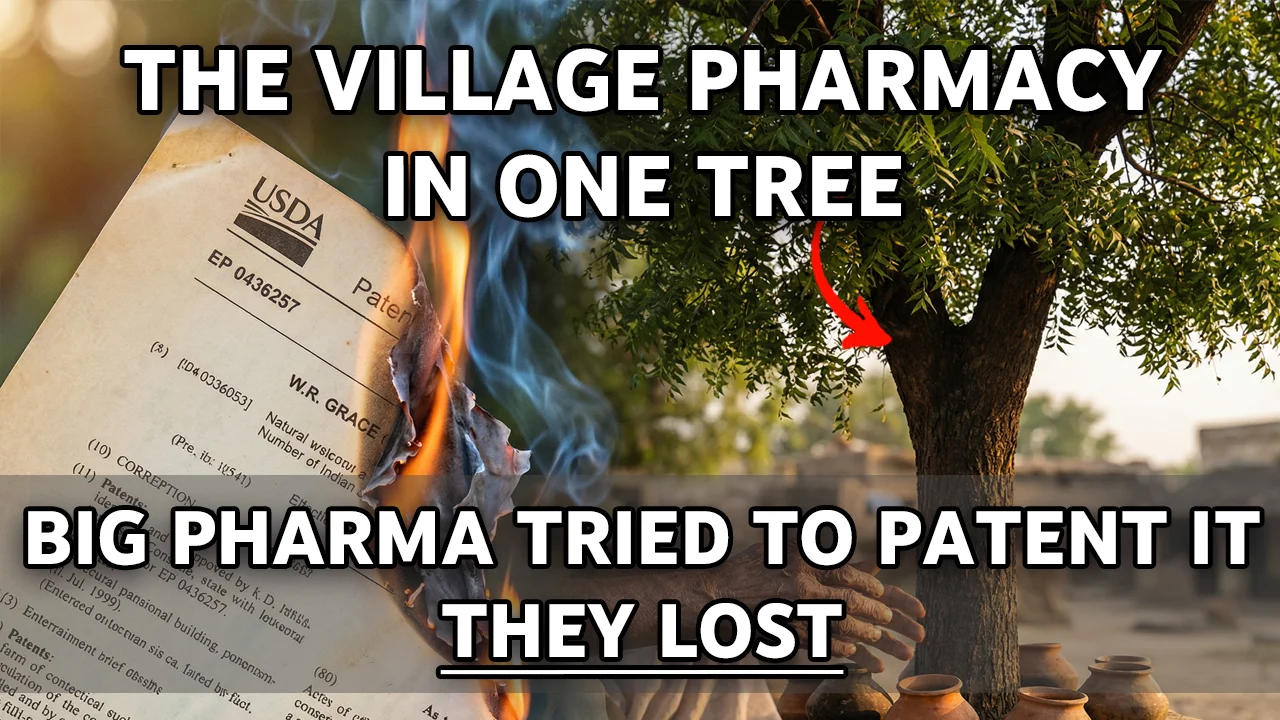
Table of Contents
Recommended: Organic Neem Leaf Powder & Neem Leaves
View Neem Leaf Powder Options View Neem Leaves OptionsAffiliate links - supports our channel
What is Neem?
| Scientific name | Azadirachta indica |
| Family | Meliaceae (mahogany family) |
| Native range | Indian subcontinent and Myanmar |
| Sanskrit name | Nimba / Arishtha ("reliever of sickness") |
| Persian name | Azad darakht-e-hind ("free tree of India") |
| Mature size | 50 to 65 feet tall; canopy up to 80 feet wide |
| Lifespan | 150 to 200 years |
| Bioactive compounds | 300+ identified |
| Signature compound | Azadirachtin (limonoid) |
| Other key compounds | Nimbin, nimbidin, gedunin, quercetin |
| Anti-MRSA activity (2022) | Effective at ~4 mg/mL leaf extract |
| Earliest medicinal record | Charaka Samhita, ~1500 BCE (Sarva Roga Nivarini) |
| USDA hardiness | Zones 10 to 12 (frost-sensitive) |
| Soil tolerance | Sandy, saline, drought-stressed soils |
| Annual seed yield | Up to 50 kg per mature tree |
| UN designation (1992) | "Tree of the 21st Century" |
| Disputed patent | EP0436257 (W.R. Grace + USDA, 1994) |
| Patent revoked | 8 March 2005, European Patent Office |
| Last new antibiotic class | 1987 (none since) |
There is a tree that holds the answer to the greatest medical crisis of our time.
For 4,500 years, it cured what antibiotics cannot. Every part of it, including bark, leaves, seeds and roots, fights bacteria, viruses, fungi, and parasites simultaneously. It kills the drug-resistant superbugs that are sending patients to die in isolation wards.
One tree provides more medicines than an entire pharmacy.
Then in 1994, a corporation and the United States government tried to own it. They filed a patent claiming they invented what Indian villages had known for 45 centuries. The tree that belonged to no one would finally belong to someone.
But the tree does not surrender easily.
This is the story of Neem. The village pharmacy that defeated an empire. The living antibiotic factory they could not control. And the answer waiting in plain sight while pharmaceutical companies charge $500 for what grows free.
4,500 Years of Village Pharmacy & the 2005 Patent Battle
The Indus Valley, c. 2500 BCE
Rewind roughly 4,500 years to the Indus Valley. A tree grows along the riversides. Its branches spread 80 feet wide. Its roots dive deep into earth that kills lesser plants. The people call it nimba, the bestower of good health. The Persians call it azad darakht-e-hind, the free tree of India. Free because it belongs to everyone and no one.
Every morning, villagers snap twigs from the tree and chew the ends into brushes. Their teeth stay strong. Their gums do not bleed. Infections that kill others never take root. When smallpox sweeps through villages, they hang neem branches above doorways. The air itself becomes medicine.
The Pesticide That Feeds Nations
When locusts arrive in clouds that darken the sun, they devour every crop in sight: wheat, rice, vegetables turned to dust. But the neem trees stand untouched. The insects starve rather than eat the leaves. By 1500 BCE, the Charaka Samhita, a foundational text of Ayurveda, lists neem as Sarva Roga Nivarini, the universal healer of all ailments. This was not superstition. It was observation refined across centuries, recorded in texts that would outlast empires. The tree protected villages for 4,000 years.
1920s Sudan: The German Entomologist
In the 1920s, a German entomologist working in Sudan watched locusts destroy every plant in sight - corn, sorghum, cassava, everything except one: the neem tree. He isolated the compound responsible: azadirachtin, a molecule so complex it took chemists another 50 years just to map its structure. (Morgan and Butterworth elucidated it in 1968 and the full stereochemistry was only resolved decades later.) Azadirachtin disrupts insect hormones, stops them from feeding, prevents them from reproducing. But the tree does not just stop insects. It stops us from dying.
1994: Patent EP0436257
In 1994, the chemical giant W.R. Grace and the United States Department of Agriculture filed European Patent EP0436257. The claim: exclusive rights to a fungicidal extraction method from neem oil. Their argument was that purifying the compound in a modern lab made it their invention. The patent would have granted 20 years of monopoly control over a process Indian villages had run by hand for 4,500 years.
Munich, 8 March 2005: Patent Revoked
Three women refused to let ancient knowledge become corporate property: Dr. Vandana Shiva from India, Magda Aelvoet from the European Parliament, and Linda Bullard from the International Federation of Organic Agriculture Movements. They brought evidence to the European Patent Office in Munich: not lab reports from the 1990s, but Sanskrit texts from 1,500 years before Christ was born. Palm-leaf manuscripts showing extraction methods perfected when Rome was still a village. Testimonies from Indian farmers whose ancestors had used neem to protect crops for 100 generations.
The corporation argued that their extraction method was novel. The patent office looked at the ancient texts. After a decade of legal battles, the EPO ruled on 8 March 2005: patent revoked. The official reason was lack of novelty. This knowledge was not new. It had never been hidden. It was written in the soil of India for 45 centuries. W.R. Grace had tried to patent the sun, and lost.
But to understand why they wanted to own it, you have to understand what this tree can do.
The Science: 300 Medicines Simultaneously
The Secret Pharmaceutical Companies Hate
A modern antibiotic is a single molecule. Penicillin, tetracycline, amoxicillin. One compound attacking bacteria through one specific pathway. Because it is a single attack, bacteria can figure it out. They mutate, they evolve, they adapt, they become resistant.
Neem is different. Neem is not one molecule. It is 300.
Azadirachtin, nimbin, gedunin, quercetin: 300 bioactive compounds working simultaneously, each attacking through a different pathway. When you use neem, you are not hitting bacteria with a sniper rifle. You are hitting it with an army.
- Some compounds shatter the cell wall
- Others strangle protein synthesis
- Others scramble DNA replication
- Others dissolve the biofilms, the protective shields bacteria build to hide from antibiotics
Bacteria cannot mutate fast enough to defend against 300 simultaneous attacks. Evolution needs predictable pressure, a single threat to adapt against. Neem provides chaos.
Confirmed by Modern Science
In 2022, researchers confirmed what villages knew for millennia: neem leaf extract kills MRSA, the methicillin-resistant superbug that turns simple cuts into death sentences in modern hospitals, at concentrations as low as 4 mg per milliliter.
It destroys drug-resistant Escherichia coli, salmonella, and the parasites that cause malaria. And it does this without creating resistance. 4,500 years of use. No adaptation, no immunity. The bacteria never learned.
The Bridge Between Old Drugs and the Future
A study in 2021 confirmed that when you combine neem extract with failing antibiotics, the drugs become powerful again. The neem does not cure alone. It weakens the bacteria's defenses. It strips away the biofilm. It opens the door so the old drugs can finish the job.
It is the bridge between what worked and what we need next. But we are not crossing it.
Why It's Not in Your Pharmacy
The Economics of Suppression
So why is it not in your pharmacy? Why, when the CDC warns we are entering a post-antibiotic era, when doctors watch patients die from infections that should be trivial, are we not planting this tree on every corner?
The answer is simple and brutal: you cannot patent a plant.
Pharmaceutical companies need 20 years of patent protection to justify the $2 billion it costs to develop a new drug. They need exclusivity. They need a monopoly. Neem offers none of that. It grows wild. Anyone can plant a seed. Anyone can harvest the leaves. Anyone can brew the tea. There is no profit margin in a cure that grows in your backyard.
The FDA Labeling Wall
In the United States, the FDA classifies neem as a dietary supplement or cosmetic. That means a company can sell it, but they cannot tell you what it does. If you bottle neem capsules, you cannot claim it cures infection on the label. You can only say it "supports immune health." Vague, meaningless, ignored by every doctor trained to prescribe only FDA-approved drugs.
To make a medical claim. To say this kills MRSA, you need FDA drug approval. That requires phase 1, phase 2, and phase 3 clinical trials costing a minimum of $500 million. No company will spend $500 million testing a tree that their competitor can sell for $10 the day after approval.
The economics are impossible by design.
The Crisis Accelerates
So neem remains in legal limbo, proven by history, confirmed by science, exiled by a system that confuses profit with progress.
The last new class of antibiotics was discovered in 1987. Nothing fundamentally new in nearly 40 years. The pipeline is not just dry. It is abandoned. Bacteria are winning.
The CDC reports 2.8 million antibiotic-resistant infections every year in the United States alone. 35,000 people die not from the infection itself, but from our inability to treat it. Infections that penicillin cured in 1950 now require drugs so toxic they destroy kidneys.
The Tree That Cannot Be Suppressed
But the tree does not care about our systems. It grows in India, where 18 million trees line the streets of villages and cities. It grows in sub-Saharan Africa, where its roots hold back the Sahara desert. It grows in South America, Southeast Asia, Australia. The United Nations called it the tree of the 21st century in 1992. 34 years later, we still have not listened.
The biopiracy battle of 2005 proved something critical. The law can stop a corporation from owning the tree. But it cannot force the system to use it.
The knowledge survives not in research journals or hospital formularies, but in practice: in the hands of grandmothers who still crush the leaves into paste for infected wounds. In the farmers who still spray neem oil to save their crops without poison. In the villages where a single tree protects an entire community from diseases that send city dwellers to emergency rooms.
When the antibiotics finally fail completely, when the superbugs overwhelm the last chemical defenses we have built, the neem tree will still be there, growing in the heat, producing its 300 compounds, waiting for us to remember what we pretended to forget.
The answer was never lost. Just ignored by those who needed ownership more than they needed a cure.
How to Identify, Grow & Use Neem
Identification
Neem is a fast-growing evergreen tree, 50 to 65 feet (15 to 20 m) tall at maturity, with a dense rounded canopy that can spread up to 80 feet wide. The leaves are pinnately compound, alternate, 8 to 16 inches long, with 10 to 30 dark-green, serrated, lance-shaped leaflets. The small white five-petaled flowers grow in drooping panicles and smell faintly of honey. The fruit is a single-seeded yellow-green drupe about 1/2 to 3/4 inch long when ripe, turning yellow then brown. The trunk is short and straight with rough, longitudinally fissured grey-brown bark. Neem is most easily confused with chinaberry (Melia azedarach), a related but more toxic Meliaceae - chinaberry has compound-of-compound (bipinnate) leaves and clustered purple flowers, neem has simple pinnate leaves and white flowers.
Climate & Soil
Neem is a tropical and subtropical tree, USDA hardiness zones 10 to 12. It tolerates drought, extreme heat, full sun, and remarkably poor or saline soils where almost nothing else will grow. It will not survive a hard freeze - even a brief frost can kill young trees and damage mature foliage. In temperate climates, grow neem in a large container that can move indoors near a bright south-facing window for winter, or treat it as a fast-growing summer container plant.
Planting
Use fresh seeds whenever possible - neem seeds lose viability rapidly (within a few weeks once dry). Soak seeds for 24 hours, then sow 1 inch deep in well-drained sandy loam. Germination typically takes 1 to 3 weeks at 25 to 35 C (77 to 95 F). Pot up seedlings into deep containers (taproots are aggressive) and transplant outdoors after the last frost. Mature spacing in the ground is 25 to 30 feet apart. First seed crop appears 3 to 5 years after planting, full production around year 10. Lifespan: 150 to 200 years.
Harvest & Use
Leaves can be harvested year-round once the tree is established. For traditional use, strip fresh leaves and either chew small twigs as a tooth brush (the bark is mildly bitter and antimicrobial), crush leaves into a paste for topical application on skin infections, ringworm, or acne, or steep dried leaves as a strong tea for hair rinse and bathing water. Neem oil is pressed from the seed kernels and is the most concentrated material: about 1 to 2 tablespoons mixed into a litre of water with a few drops of mild soap makes the standard horticultural insecticide spray. For skin use, dilute neem oil at least 1:10 in a carrier oil before applying.
In the kitchen, neem leaves are bitter and not a daily green. South Indian recipes use a few young leaves fried in ghee as a starter on Ugadi (the new year), and neem flowers are sometimes mixed with jaggery to mark seasonal transitions. Most culinary exposure to neem is via twigs used as tooth-cleaning brushes (datun) and neem-bark mouth rinses, where the bitter compounds provide oral-cavity antimicrobial action.
Safety
Topical neem oil and dilute leaf preparations have been used safely for millennia. Concentrated neem seed oil should never be ingested - pure neem oil has caused serious encephalopathy in children. Pregnant women, women trying to conceive, and breastfeeding mothers should avoid neem entirely; multiple animal and traditional sources document antifertility and abortifacient effects at high doses. People taking immune-modulating drugs, anticoagulants, or diabetes medication should consult a clinician before using neem supplements internally. Standard culinary or topical use - toothpaste, soap, leaf paste on skin, dilute insecticide spray - has a centuries-long safety record.
Frequently Asked Questions
What is neem and what is it used for?
Neem (Azadirachta indica) is a fast-growing tree in the Meliaceae (mahogany) family, native to the Indian subcontinent. Every part of the tree - leaves, bark, seeds, oil, and root - is used in traditional medicine. The Charaka Samhita (c. 1500 BCE) names it Sarva Roga Nivarini, the universal healer of all ailments. Modern uses include treating skin infections, parasites, fungal infections, periodontal disease, and as a natural insecticide and crop protectant. It contains over 300 bioactive compounds, including azadirachtin, nimbin, gedunin, and quercetin.
Does neem kill MRSA and antibiotic-resistant bacteria?
Yes. A 2022 study confirmed that neem leaf extract kills methicillin-resistant Staphylococcus aureus (MRSA) at concentrations as low as 4 mg per milliliter. Neem also has documented activity against drug-resistant Escherichia coli, Salmonella, and the parasites that cause malaria. Because neem works through hundreds of compounds attacking multiple bacterial pathways simultaneously, bacteria cannot evolve resistance the way they do to single-molecule antibiotics. A 2021 study also showed that combining neem extract with failing antibiotics restores their effectiveness by stripping the biofilm bacteria use to hide.
What was the 2005 neem biopiracy case?
In 1994 the chemical company W.R. Grace and the United States Department of Agriculture filed European Patent EP0436257, claiming a fungicidal extraction method from neem oil as their invention. Dr. Vandana Shiva of India, Magda Aelvoet of the European Parliament, and Linda Bullard of the International Federation of Organic Agriculture Movements challenged the patent using Sanskrit texts predating it by 3,500 years and palm-leaf manuscripts documenting the same extraction method. After a decade of proceedings, the European Patent Office revoked the patent on 8 March 2005 for lack of novelty - the knowledge was not new, it had simply been corporate-rewritten.
How do you grow neem?
Neem is a tropical and subtropical tree (USDA zones 10-12 outdoors) tolerant of drought, heat, poor soil, and even saline soil. It will not survive a hard freeze. Soak fresh seeds for 24 hours and sow 1 inch deep in well-drained soil; germination is 1 to 3 weeks at 25 to 35 C (77 to 95 F). Plant in full sun. In temperate climates, grow neem in a large container that can be wintered indoors near a bright window. Mature trees reach 50 to 65 feet (15 to 20 m), live 150 to 200 years, and start producing seeds in 3 to 5 years.
Is neem safe? Are there side effects?
Topical neem oil and traditional dilute leaf preparations are widely used and generally well-tolerated. Concentrated neem seed oil should never be taken internally - pure neem oil has caused serious toxicity in children. Pregnant women and people trying to conceive should avoid neem, since high doses are documented to suppress fertility and may cause miscarriage. People on immune-modulating medication, blood-thinners, or diabetes drugs should consult a clinician before using neem supplements. Standard culinary or topical exposure (toothpaste, soap, leaf paste on the skin) has been safely used for millennia.
Explore More Medicinal Plants
Discover ancient healing plants backed by centuries of traditional use and modern science.
Browse Medicinal Plants Collection →