
Tabby Concrete: Free, Indestructible, and It Gets Stronger Every Year
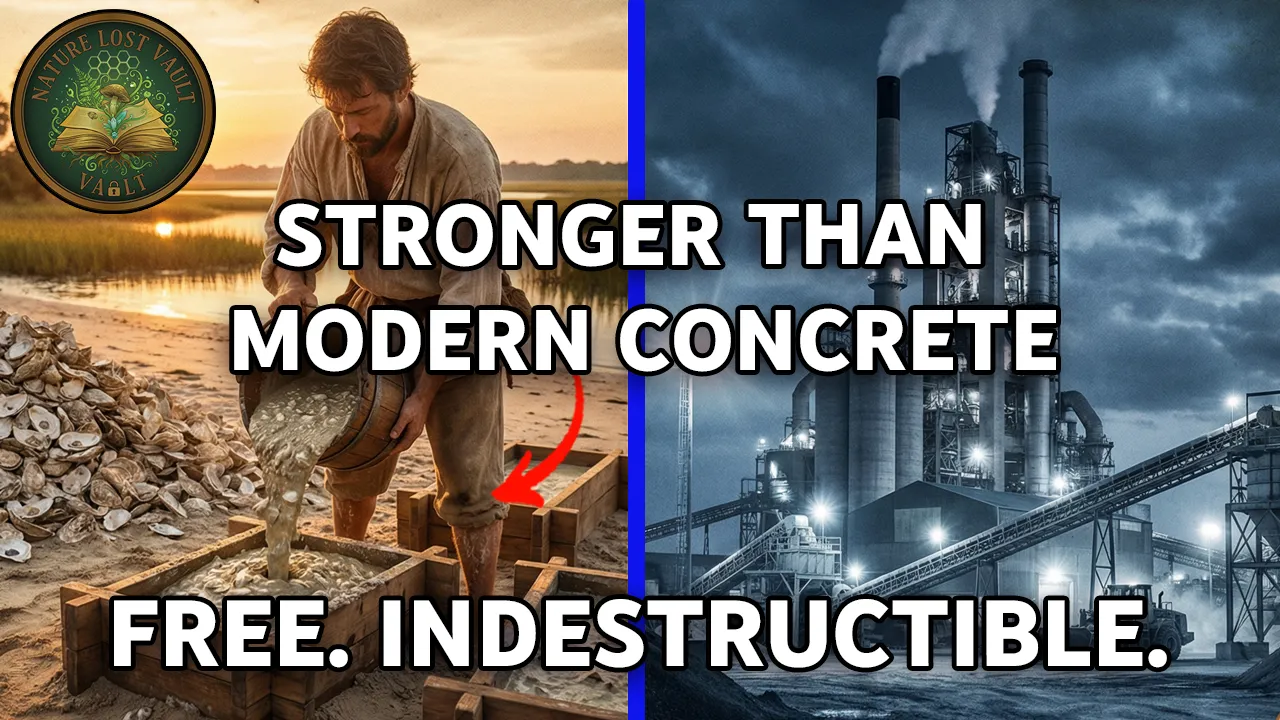
Table of Contents
The Fort That Swallowed Cannonballs
In 1702, the most powerful military force in the American colonies aimed its cannons at a fort on the Florida coast and fired for two months straight. The cannonballs disappeared into the walls. One English soldier wrote home: "The walls gave way to cannon fire as though you were sticking a knife into cheese." The fort is still standing. It has never needed structural repair in 330 years. The building material that defeated the British Empire that day cost nothing. It was made from garbage.
The Spanish Discovery on the Florida Coast
In 1580, Spanish explorers faced a massive problem. There was no useful stone in Florida. No granite, no limestone close enough to quarry. What they had was the beach: sand, water, and the shells of millions of oysters piled in massive heaps along the shore, the ancient waste of Native American communities. Someone made a brilliant decision: burn the shells. When you burn an oyster shell, the calcium carbonate inside converts to calcium oxide, quicklime, the exact same chemistry the Romans used to build the Pantheon.
The Spanish mixed that quicklime with water, sand, ash, and whole broken oyster shells. They poured it into wooden molds and left it to cure. What came out was a stone that absorbed impact instead of shattering, that breathed, and that performed better in the humid, salt-soaked, hurricane-prone air of the Southeast than expensive granite and brick.
The Chemistry of Shell and Lime
The alkaline ash from the bonfire accelerates carbonation. Tabby sets through a slow natural cycle where calcium hydroxide actively absorbs carbon dioxide from the air. It pulls carbon out of the atmosphere to convert itself back into calcium carbonate, the very material the shells were made of. Over years, the wall literally becomes shell again. The longer it stands, the harder and more integrated it gets.
Portland cement does not work this way. It sets through a rapid chemical reaction, reaching maximum strength in 28 days, and then immediately starts to degrade. It does not breathe. Moisture trapped inside expands and cracks the concrete. A Portland cement structure on the American coast requires constant repair. Most carry a design life of 50 years. Many fail in 20.
Thomas Spalding and the Tabby Standard
Thomas Spalding grew up in Oglethorpe's tabby house on St. Simons Island, inherited Sapelo Island, and built everything on it from tabby: his home, his sugar mill, and the quarters for hundreds of enslaved people. He standardized the 12-inch molds and the exact proportions of lime, shell, and sand. He published his methods in the Southern Agriculturist Journal. Planters along the Georgia and Carolina coast copied him. The ruins of Spalding's tabby are still standing on Sapelo Island after 200 years of hurricanes, flooding, and zero maintenance.
A Wall That Heals Itself
Tabby's porosity, the quality that made it look soft and vulnerable, was exactly what saved it. Tabby breathes. Water enters and exits without building pressure. Architect Colin Brooker found that when a micro-crack forms in a tabby wall, free calcium in the mix migrates into that crack, absorbs carbon dioxide from the air, and seals it. The wall heals itself. Portland cement cannot do this. Once it cracks, the damage propagates.
Portland Cement: The Repair That Destroys
When preservation architects surveyed old tabby structures in the mid-20th century, they discovered something horrifying. Some historic sites had been repaired using Portland cement. Those were the ones falling apart. Wherever modern concrete had touched the old tabby, the cement sealed moisture inside the walls, suffocating the structure from within. Where the tabby had been left completely alone, it was intact. The repair had done more damage than 200 years of hurricanes.
The cement industry, if ranked as a country, would be the third largest carbon emitter on Earth. Every ton of Portland cement produces nearly a ton of CO2. Tabby generated no industrial emissions. The bonfire that burned the shells gave off smoke for a day and was gone.
Tabby Returns to the Coast
Preservation architects in Beaufort County, South Carolina, the county with more tabby ruins than anywhere else, now insist on lime-based repairs for historic structures. The American College of the Building Arts in Charleston revived the teaching of traditional tabby work. In 1988, the public library in Camden County, Georgia was built using revival tabby.
Building With Shells, Sand, and Ash
If you live anywhere within 100 miles of saltwater and a working oyster reef, you can build this way. You need shells, sand, ash, water, and wooden forms. The same forms Thomas Spalding used on Sapelo Island in 1820. The wall you pour this year will be stronger in 50 years than it is today.
We did not abandon tabby because it failed. The Horton House on Jekyll Island has stood since 1742. Fort Frederica has outlasted the civilization that built it. Every tabby structure still standing on the American coast is an argument made in lime and shell and silence. We abandoned tabby because it could not be patented, because it could not be centralized, because a material you make from the beach does not generate quarterly revenue.
Explore More Building & Construction
Discover forgotten techniques that built civilizations for millennia.
Browse Collection →