
Roman Concrete: The Self-Healing Formula That Gets Stronger Over 2,000 Years
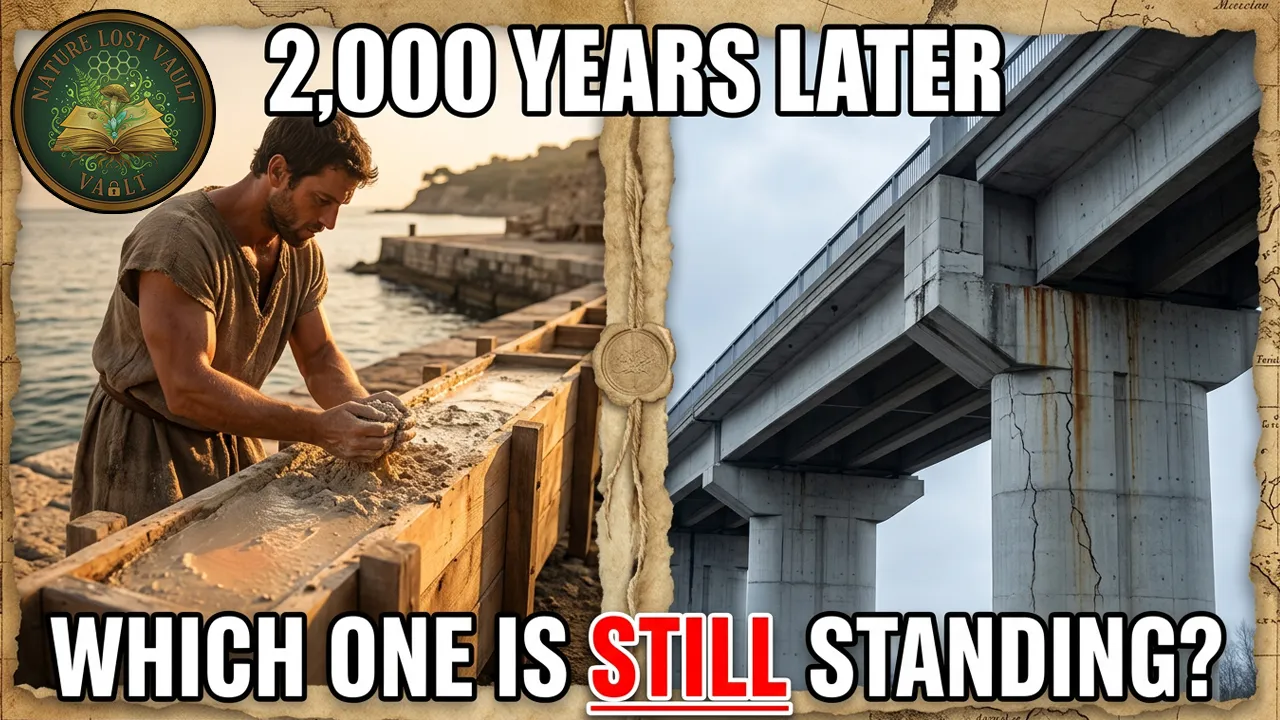

Table of Contents
The Dome That Has Never Been Repaired
By 128 AD under Emperor Hadrian, the Pantheon was complete. Its concrete dome spans 142 feet. It contains no steel reinforcement. It has never been repaired, and it has not moved a fraction of an inch in nearly 1,900 years. It is not a ruin. It is a functioning building. Meanwhile, the concrete under your feet, poured in the 1970s, is already crumbling. Engineers spend $91 billion just to patch the nation's bridges every single year.
Vitruvius and the Imperial Recipe
The recipe was first written down by military engineer Marcus Vitruvius Pollio. His ten-volume work De Architectura described a mortar of volcanic ash, quicklime, and seawater packed against volcanic rock and left to cure. Vitruvius noted that structures built this way were "impregnable to the waves and every day stronger." Nobody took that phrase literally for 2,000 years. They should have.
In 27 BC, Emperor Augustus commissioned his engineers to standardize the imperial concrete mix. They selected a specific volcanic ash from the Alban Hills called red pozzolana, and Augustus decreed it the official material of Roman construction.
The White Lumps That Turned Out to Be the Secret
When researchers examined Roman concrete under microscopes, they kept finding small bright white lumps. For decades, the assumption was that Roman builders were sloppy and had not mixed their mortar properly. Then in January 2023, a team led by MIT Professor Admir Masic published a landmark study in Science Advances.
The Romans were not using slaked lime. They were using quicklime, the raw, highly caustic form mixed directly with volcanic ash at extreme heat. As it cooled, the quicklime formed tiny concentrated reservoirs of reactive calcium distributed throughout the entire structure. When a microscopic crack forms, water seeps in and touches these hidden calcium reservoirs. New calcium carbonate crystals grow inside the fracture. The crack seals itself. The concrete repairs its own damage automatically.
Stronger in Seawater
In marine environments, the self-healing goes even further. As seawater percolates through Roman harbor walls, it reacts with the volcanic ash and limestone to form a rare crystal called aluminous tobermorite. This crystal binds the structure, making it harder, denser, and more resistant to fracture with every passing decade. Pliny the Elder described these seawalls as "a single stone mass, impregnable to the waves and every day stronger." He was describing a dynamic chemical process that science would not fully understand for nearly 2,000 years.
Portland Cement: Fast, Cheap, and Designed to Fail
In 1824, a British bricklayer named Joseph Aspdin burned powdered limestone and clay in his kitchen oven and called the result Portland cement. It set fast and was cheap to produce. By the 1920s, the Portland Cement Association had embedded 125 engineers into state highway departments and city planning offices across America. Traditional lime-based mortars were systematically written out of building codes.
Modern Portland cement cures rapidly, creating immense internal stress. As it cures, it shrinks, forming thousands of invisible micro-cracks. Those cracks let in water. Steel rebar rusts when wet, expanding up to four times its original size, literally blowing the concrete apart from the inside. A typical modern bridge is engineered to last 50 years. The Pantheon is 1,897 years old.
The $3.7 Trillion Infrastructure Gap
America currently faces a $3.7 trillion infrastructure gap. A material that built harbors meant to last forever was replaced by a material that guarantees perpetual repair. One generates revenue once. The other is a subscription model disguised as engineering.
When MIT published its 2023 study, the response from the construction industry was polite interest. No government mandate, no building code revision. The Portland cement industry produces 4.4 billion tons annually. It is the third most manufactured substance on Earth. A concrete that lasts 10 times longer threatens a $300 billion global industry.
Natural Hydraulic Lime: The Living Alternative
The raw materials are not patented. Volcanic ash deposits exist across the American West. Quicklime is sold at local building supply stores. Natural hydraulic lime (NHL) is commercially available and produces mortar with properties similar to ancient Roman formulations. It breathes, flexes, and seals hairline cracks without shattering. It is the only material that should ever be used to repoint historic brick homes.
There is a building in Rome that is 1,897 years old with a concrete dome that has never once needed what those bridges need every decade. The Romans did not build for quarterly profit cycles. They built for permanence. That philosophy cannot be sold on a recurring basis. So it was replaced by one that can. The recipe is not lost anymore. It is waiting for builders willing to remember what permanence actually costs and what it saves.
Explore More Building & Construction
Discover forgotten techniques that built civilizations for millennia.
Browse Collection →