
Black Locust: Harder Than Concrete, Lasts 100 Years Without Treatment
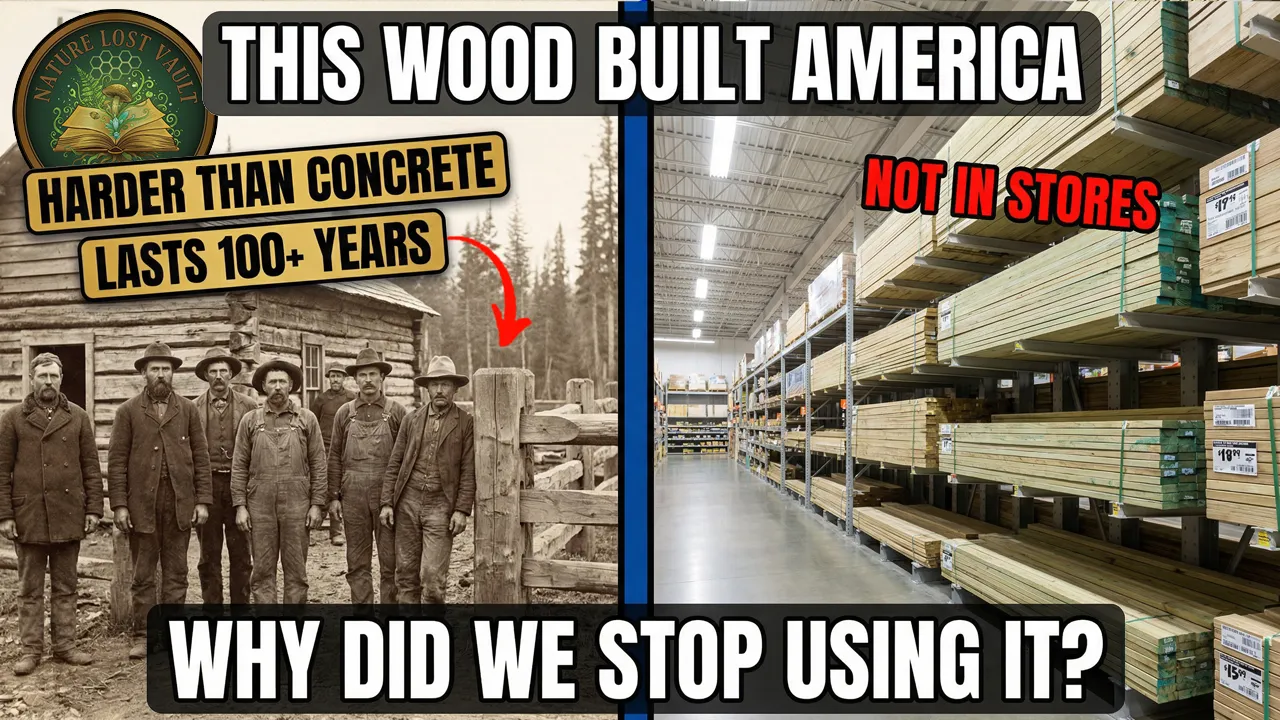
Table of Contents
The Wood That Survived Jamestown
In 1607, English colonists at Jamestown, Virginia scrambled to build shelter before winter. They sank four poles into the ground, one at each corner, and framed walls between them. The wood they chose would determine whether they survived. In 1707, exactly 100 years later, naturalist Mark Catesby visited the ruins. He found something impossible. Those original poles, both above and below ground, remained perfectly sound. No rot, no decay, no damage from a century of rain, soil, and insects. He wrote that the posts looked as if they were sunk yesterday.
The wood was black locust. Cherokee and Iroquois carved bows from it because nothing else matched its strength. They used it for tool handles that lasted generations. They called it the wood that refuses to die.
The Wood That Won the War of 1812
By 1812, black locust decided a war. American shipbuilders faced the British Navy, the most powerful fleet on Earth. British warships used oak pins to hold their planks together. American ships used treenails, wooden pegs harder than nails that swelled when wet, creating bonds tighter than metal. When cannonballs struck, British ships shattered. Oak failed. Planks separated. American ships held firm.
The British lost battle after battle until they figured it out. By 1820, Philadelphia exported 50,000 to 100,000 black locust treenails to England every year. The British rebuilt their navy with American wood.
Harder Than Oak, Stronger Than Concrete
Black locust has a Janka hardness of 1,700 pounds-force, harder than white oak at 1,360. It has a crushing strength of 10,200 pounds per square inch, comparable to concrete. It contains robinin, a natural compound that kills fungi and insects without chemicals.
Tests by the US Forest Service proved black locust takes 100 years to rot, even when buried in soil. Fence posts set in the 1920s remain solid. Telegraph poles from the 1870s still stand in the West 150 years later. The Ford Island Bridge in Hawaii, built in the 1910s, used black locust pilings. After a century in saltwater, the most corrosive environment on Earth, those pilings are still in use. At the Biltmore Estate in North Carolina, a black locust pergola over 100 years old still stands. Harvard Forest in Massachusetts has fence posts installed a century ago that remain intact.
The Tree That Heals Dead Soil
Black locust is one of the few nitrogen-fixing hardwoods. Rhizobium bacteria colonize its roots, pull nitrogen from the air, and convert it into ammonia that enriches the soil. Studies show black locust soil has 1.3 to 3.2 times more nitrogen than surrounding areas. It fixes 75 to 150 kilograms of nitrogen per hectare per year, fertilizing neighboring plants without synthetic inputs.
When ranchers cleared millions of acres of black locust for cattle in the late 1800s, the soil cracked within 20 years. Rivers dried, grass died, cattle starved. The tree they called a weed had been holding the ecosystem together. By the 1970s, ecologists reclassified it as a keystone species, essential for soil stability and land reclamation. NASA researchers called it a lesson in endurance, with roots reaching 200 feet deep, tapping water no annual crop could touch.
CCA and the Rise of Planned Obsolescence
In 1933, Indian chemist Sonti Kamesam invented chromated copper arsenate (CCA), a mixture of chromium, copper, and arsenic that made cheap pine last longer. By the 1940s, CCA-treated lumber dominated the American market. Lumberyards sold soft pine at high markups, called it pressure-treated, and guaranteed 20 to 30 years of durability. Black locust required no treatment and lasted 100 years naturally, but natural durability created a problem. Customers who bought black locust fence posts in 1950 did not need replacements until 2050.
Pressure-treated pine rots in 15 to 20 years, generating new sales every generation. The math is simple: planned obsolescence beats permanence. By the 1990s, studies revealed CCA leached arsenic into soil and water. On December 31, 2003, CCA was banned for residential use. The chemicals changed but the model did not. Treated lumber still rotted faster than black locust.
Why Lumberyards Do Not Stock It
Black locust refuses to fit industrial systems. The trees grow crooked as they compete for light, creating tension wood that warps when sawn. The locust borer, a native beetle, drills tunnels through trunks. Sawyers accustomed to straight pine find black locust difficult to mill. Major lumber distributors refused to stock it.
The supply problem became self-reinforcing. Lumberyards did not stock black locust because customers did not ask for it. Customers did not ask because they had never heard of it. Contractors defaulted to pressure-treated pine because it was at every Home Depot and Lowe's. The wood that built America disappeared not because it failed, but because it did not generate recurring revenue.
Hungary's Million-Acre Example
In Hungary, black locust covers one million acres, 20% of forested land. Farmers harvest it for fence posts, firewood, honey production, and export lumber. European architects specify it for decking, bridges, and urban green spaces. In 2013, Brooklyn Botanical Garden used black locust decking and won an AIA design award. But in the country where the tree is native, it remains a niche product sold by small mills.
Pressure-treated lumber is a 9.3-billion-board-foot market in the United States. If black locust captured just 1%, that would be 93 million board feet worth $93 million annually. The market is not demand-constrained. It is supply-constrained. People would buy black locust if they knew it existed.
The Unkillable Tree
Cut it down. Ten new shoots emerge from the roots. Burn it and it regrows. Poison it and fragments underground wait decades for the chemicals to fade. The USDA admitted in 1948 that black locust cannot be eradicated. That resilience is the point.
Climate change is accelerating. Droughts, floods, heat. The systems feeding 8 billion people were built for stability. That stability is ending. Black locust was born for chaos. It grows in soil too poor for wheat. It survives cold that kills pine. It produces timber without irrigation or fertilizer. When industrial systems fail, black locust will be ready.
We did not lose black locust. We just stopped selling it. You do not need permission to plant a tree. The posts your great-grandfather sunk in 1920 are still standing. The knowledge lives in every fence post, solid after a century, in every crooked grove fixing nitrogen where corn failed. Strength was always here, growing in the dirt, free.
Explore More Building & Construction
Discover forgotten techniques that built civilizations for millennia.
Browse Collection →