Eastern Redbud (Cercis canadensis): The Native American Legume George Washington Planted at Mount Vernon in 1785 - Now Patented and Sold Only for the Look of Its Leaves
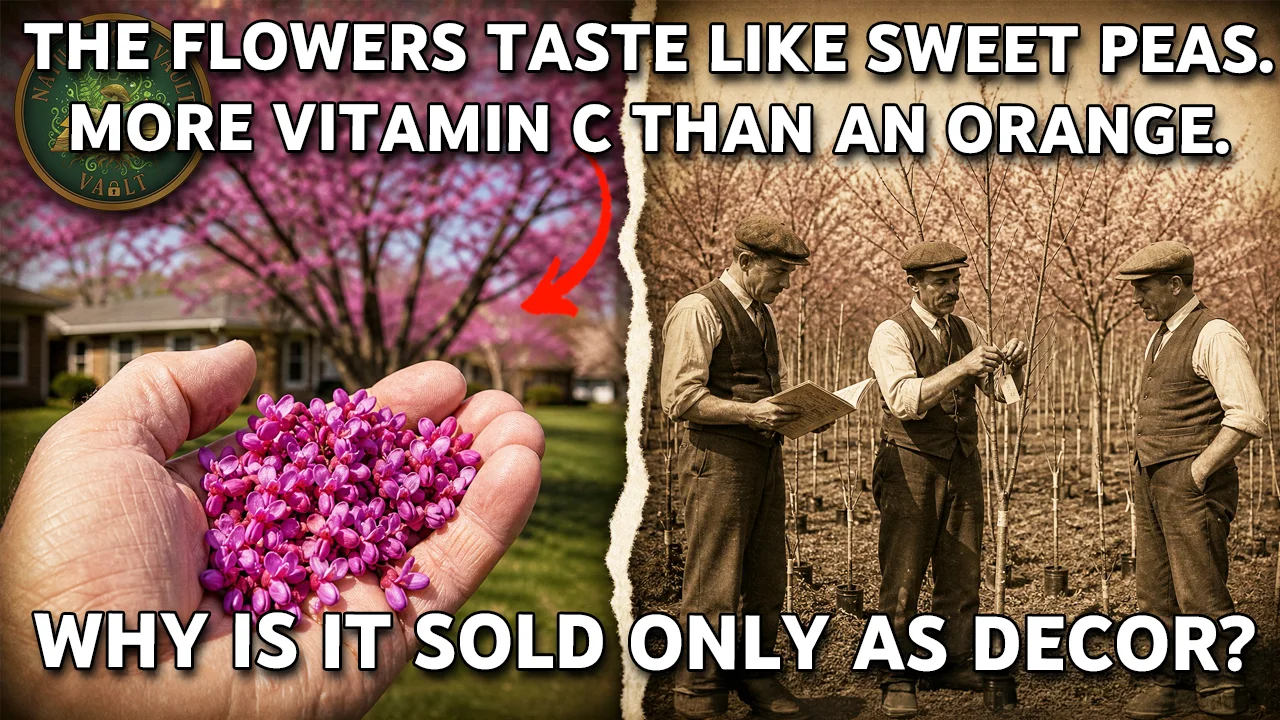
Table of Contents
- What is Eastern Redbud?
- From George Washington's 1785 Mount Vernon Diary to Native American Snow-Pea Pods & the 1937 Oklahoma State Tree
- Legume Chemistry: Seed Protein, Vitamin C & the 2017 NC State Anthocyanin Study
- Why It Stays Buried: The 1990s Ornamental-Only Breeding Program & the Plant Patents
- How to Consume Redbud (Flowers, Buds, Green Pods & Roasted Seeds)
- How to Source Eastern Redbud (Forage, Grow & Buy)
- Frequently Asked Questions
Recommended Products:
Eastern Redbud Tree Redbud Seeds Care Kits
Safety note: Eat a small portion the first time (as with any new-to-you food). Skip any tree you know has been sprayed - rules out most commercial landscaping. Every cultivar (weeping, purple-leaved, variegated) is edible; the patent covers how the tree looks, not what is inside it.
Affiliate links - support our channel
What is Eastern Redbud?
Right now, in front yards from Connecticut down to Texas, a small tree is finishing its bloom. Bright magenta flowers growing straight out of the bark, covering the branches, sometimes covering the trunk itself. You have photographed this tree. Your neighbor probably paid a nursery for one.
Every single one of those flowers is food. Raw, off the branch, with no cooking and no preparation at all. They taste like sweet green peas with a little lemon behind them.
Almost nobody in America eats them. And the reason is written down, in public, in a United States patent.
The tree is eastern redbud (Cercis canadensis). It belongs to the pea family (Fabaceae) - the same botanical family as garden peas, beans, and lentils - and that is the clue everybody walks past.
| Metric | Value |
|---|---|
| Scientific name | Cercis canadensis L. (1753, Linnaeus) |
| Family | Fabaceae (pea/legume family - printed on the nursery tag) |
| Common names | Eastern redbud, American Judas tree (misnomer), spicewood |
| European relative | Cercis siliquastrum - the "Judas tree" (a different species) |
| Native range | Connecticut to Texas; most of the eastern US |
| USDA hardiness | Zones 4-9 |
| Height at maturity | 15-30 feet; small understory tree |
| Bloom timing | February (Deep South) to May (North) - BEFORE leaves emerge |
| Flower feature | Magenta pea-shaped blossoms growing directly out of the bark (cauliflory) |
| Pods | Flat legume pods, 2-4 inches long, 6-12 seeds each |
| Seed protein (dry basis) | Low to mid twenties percent (older analyses; dried-lentil range) |
| Seed fat (dry basis) | Modest; green seeds carry essential linoleic and alpha-linolenic acids |
| Flower vitamin C | Present; older figures unconfirmed |
| Flower anthocyanins | 2,263-8,730 mg/kg dry flower - cyanidin, peonidin, petunidin, malvidin |
| Key modern study | Perkins-Veazie, Ma, Werner (2017) - NC State, on flower pigments |
| George Washington's diary | Spring 1785 - records transplanting redbuds into the Mount Vernon grounds |
| Thomas Jefferson | Grew them at Monticello |
| Oklahoma state tree | 1937 - the "Judas" name reportedly gave some lawmakers pause |
| NC State breeding program | 1990s onward; goal: new ornamental cultivars |
| Funding | Support from the nursery industry |
| Named plant patents | US Plant Patent 23,998 ('Whitewater'); US Plant Patent 27,712 (foliage in green, white, purple and pink, 2017) |
| 2018 HortScience checklist | Dozens of named cultivars sorted entirely by appearance |
| Native American uses | Flowers raw or boiled; seeds roasted; young pods cooked like snow peas; buds pickled like capers |
| Cultivars & edibility | Every named cultivar (weeping, purple-leaved, variegated) is still fully edible |
From George Washington's 1785 Mount Vernon Diary to Native American Snow-Pea Pods & the 1937 Oklahoma State Tree
1785: Washington Writes Redbuds Into His Diary
In the spring of 1785, George Washington was redesigning the landscape around the mansion at Mount Vernon. His diaries, published as The Diaries of George Washington (vol. 4), record him transplanting trees from the woods into the grounds: sassafras, locusts, willows. And among them: the redbuds. Washington was not the only one. Thomas Jefferson planted them at Monticello. And long before either of those men picked up a shovel, the people already living here were eating it.
Native American Food Use
Ethnobotanical records from the early 1900s describe Native peoples across the eastern United States using every edible part of the tree:
- Flowers eaten raw or boiled
- Mature seeds inside the pods roasted like any legume
- Young green pods cooked the way you would cook a snow pea
- Tight, unopened buds pickled and used the way a modern chef uses capers
Botanists have never hidden the family relationship. It is printed on the nursery tag in the word Fabaceae. Watch what happens after the flowers fade: flat green pods hang from the branches, 2 to 4 inches long, with 6 to 12 seeds inside each. Those are legumes, the same botanical family as garden peas, beans, and lentils.
The Judas Name Problem & the 1937 Oklahoma Vote
Part of why the American tree lost its food identity is a name. In southern Europe and the Middle East there is a close relative, Cercis siliquastrum, known for centuries as the Judas tree. The story goes that Judas Iscariot hanged himself from one, and the pale flowers turned red. That tree is not this tree. But the two look close enough that early settlers carried the European name across the Atlantic and hung it on the American species. When Oklahoma moved to make the redbud its state tree in 1937, the old Judas name reportedly gave some lawmakers pause.
Legume Chemistry: Seed Protein, Vitamin C & the 2017 NC State Anthocyanin Study
Seed: Low-to-Mid Twenties Percent Protein - a Dried-Lentil Range
Older seed analyses in the wild-food literature put redbud seed protein in the low to mid twenties percent on a dry basis, with modest fat. That is dried-lentil territory, hanging on a tree in a suburban front yard. The green seeds also carry linoleic acid and alpha-linolenic acid - two essential fatty acids the human body cannot manufacture on its own. The alpha-linolenic acid disappears once the seeds mature and dry out, which tells you exactly when to harvest for that nutrient.
Flowers: Vitamin C in the Hungry Month
The flowers carry vitamin C, but the figure often quoted for it comes from an older analysis that could not be traced, so treat it as a bonus rather than the reason. The real reason is that the flowers are free, already in your yard, and arrive in the hungriest month of the year - before anything in the vegetable garden is up.
The 2017 NC State Anthocyanin Study
Here is the turn, and this is the part worth staying for. In 2017, three researchers - Penelope Perkins-Veazie, Guoying Ma, and Dennis Werner, working out of North Carolina State University - published a study on redbud flower pigments. They gathered flowers from wild eastern redbud and from named cultivars, and they measured the compounds producing the color.
They were measuring it in order to sell it. Color is the product. But what they found are anthocyanins, with names like cyanidin, peonidin, petunidin, and malvidin. That is the same class of antioxidant pigment that makes blueberries and red cabbage worth putting on a nutrition label. Total anthocyanin content came back between 2,263 and 8,730 milligrams per kilogram of dry flower. So the data exists. It was gathered by the ornamental program itself, as a side effect of trying to breed a prettier tree.
Why It Stays Buried: The 1990s Ornamental-Only Breeding Program & the Plant Patents
The 1990s Raleigh Breeding Program
Somewhere in the last century, the redbud stopped being a tree and became a product. Until the 1990s, every new redbud variety in America came from a chance seedling that somebody happened to spot. Then a formal breeding program went to work on it in Raleigh, North Carolina, and the tree was redesigned on purpose.
The Money Trail (Published)
The program ran with support from the nursery industry, from people who sell trees for a living. Its goals were ornamental: new forms, new leaf colors. Not a word about nutrition, or flavor, or how much food the tree actually makes. Nobody was paying for that.
The Patent Loop: US Plant Patent 23,998 & 27,712
The output of that money is a catalog. In 2018, the journal HortScience published a checklist of every named redbud cultivar in existence. Dozens of them, sorted entirely by appearance. Weeping. Purple leaves. Gold leaves. Leaves variegated in white. Every entry describes the tree the way a catalog describes a curtain.
And a good number of them are patented. United States Plant Patent 23,998 covers a redbud called 'Whitewater'. This is the legal claim, word for word: "A new and distinct variety of redbud tree, characterized by its weeping growth habit, and attractive green and white variegated foliage." That is the entire claim. Growth habit and foliage. The patent goes on to describe the redbud as a tree grown for its attractive purple flowers and its interesting foliage color. Nowhere in the legal document does anyone mention that a human being can eat it.
It is not just one patent. Plant Patent 27,712, granted in 2017, covers a redbud with variegated leaves in purple, pink and white, young foliage the filing describes as "green, white, purple, and pink." That is what the breeding was for.
Every one of those patented trees carries a royalty. A share of the sale price flows back to the institution that bred it, funding the next round of breeding and the next patented cultivar. That loop works. It has produced genuinely beautiful trees. But look at what the loop cannot pay for.
The mechanism, in one sentence:
Nobody owes a royalty on a flower you pick and eat in your own driveway. There is no revenue in a free lunch, so there is no research budget for one. That is the whole mechanism. Not a cover-up. An incentive.
How to Consume Redbud (Flowers, Buds, Green Pods & Roasted Seeds)
Redbud gives you four separate harvests off the same tree, each with a different window. Nothing needs to be foraged from the wild - the tree in your driveway will do.
1. Flowers (The Main Event)
Wait for the bloom. The flowers open before the leaves do, anywhere from February in the Deep South to May in the North. Pick the fully open magenta flowers straight off the bark, rinse them, and eat.
Raw, off the branch, no preparation. Tart, green, faintly sweet. On a fully open blossom, the pale upper section is the sweet part and the darker lower section carries the bitterness, so some people pull the two apart before eating.
- Scatter across salads - the color and the sweet-pea flavor lift a plain green salad.
- Set on top of cakes, cheeses, and cocktails - the magenta pops visually.
- Freeze into ice cubes for spring lemonades and iced teas.
- Beat into pancake or muffin batter at the last minute.
2. Buds (Tight, Unopened) - Pickled Like Capers
Pick the closed pea-shaped buds before they open. Pack them into a jar with brine (1 cup vinegar + 1 tbsp salt + 1 tsp sugar per pint), refrigerate 2-3 weeks. Use anywhere you would use a caper: on pizza, pasta, fish, tomato salads.
3. Green Pods - Cook Like Snow Peas
A few weeks after the flowers drop, flat green pods appear along the branches, 2-4 inches long. Take them while they are still flexible and bright green, before any bulge shows where the seed is swelling. Once the pods stiffen and the seeds bulge, they become tough and stringy.
- Quick stir-fry with garlic and sesame oil, 2-3 minutes.
- Blanched into salads (30 seconds boiling, ice-water shock).
- Dropped whole into hot broth or ramen.
4. Mature Seeds - Roast Like Any Legume
Once the pods dry and the seeds inside harden, shell them out and treat like any dry legume: roast at 350°F / 175°C for 15-20 minutes, or grind into a protein-dense flour additive. Older analyses put them at low-to-mid twenties percent protein on a dry basis.
Honest Safety Notes
- Eat a small portion the first time, as with any food that is new to you. Watch for individual sensitivity - especially if you have known legume/pea family allergies.
- Skip any tree you know has been sprayed. This rules out a lot of commercial landscaping and some big-box-nursery stock (pre-treated with systemic neonicotinoids). Only harvest from trees whose treatment history you know.
- Every named cultivar is edible - including the purple-leafed ones (like 'Forest Pansy'), the weeping ones ('Ruby Falls', 'Whitewater'), and the variegated ones. The plant patents cover how the tree looks. They have nothing to do with what is inside it.
- Do not confuse with toxic legume trees. Black locust (Robinia pseudoacacia) pods, seeds, bark and leaves are toxic, and Kentucky coffeetree (Gymnocladus dioicus) has toxic raw seeds and pulp. Eat only pods and seeds you are sure came from a redbud.
- Do not confuse with the European "Judas tree" (Cercis siliquastrum). Both are edible in the same way, but they are different species with different bloom timing.
- Native pollinators eat here too. The blossoms are one of the earliest spring nectar sources for native bees; harvest a share, not the whole tree.
How to Source Eastern Redbud (Forage, Grow & Buy)
1. Identify & Forage (You Almost Certainly Have One Nearby)
Eastern redbud is native from Connecticut to Texas and grows wild in every state in that range - along woodland edges, in city parks, in cemeteries, and in the yards on your street. Identification is easy - four features:
- Small (15-30 foot) understory tree with heart-shaped alternate leaves.
- Magenta-pink pea-shaped flowers growing DIRECTLY OUT OF THE BARK before the leaves emerge in early spring (this feature - called cauliflory - is unmistakable).
- Flat green pods 2 to 4 inches long hanging from the branches in early summer, turning brown as they mature.
- Snap a young twig and it smells faintly of green pea - the Fabaceae signature.
Foraging rules: skip any tree you know has been sprayed (commercial landscaping is a common culprit); only take a modest share of a wild tree's bloom - the flowers are one of the earliest spring nectar sources for native pollinators.
2. Grow Your Own (One of the Most Rewarding Native Trees)
Redbud is one of the most forgiving native trees you can plant. Hardy in USDA zones 4-9, tolerates most soils (does best in slightly acidic well-drained loam), thrives at woodland edges in full sun to partial shade, and blooms reliably in its 3rd-4th year. Reaches 15-30 feet at maturity and stays there.
Plant a nursery tree in spring or fall. Water weekly the first year. Mulch. Wait.
Important: every named cultivar - including patented weeping cultivars ('Ruby Falls', 'Whitewater'), purple-leaved 'Forest Pansy', and variegated 'Carolina Sweetheart' or 'Whitewater' - is still fully edible. The patent covers how the tree looks, not what is inside it. If you want maximum bloom yield and largest pod set, the plain wild-type Cercis canadensis outperforms the more heavily-bred ornamentals.
3. Buy Nursery Trees or Care Kits
Reputable native-plant nurseries and mail-order tree suppliers stock nursery-grown Cercis canadensis. What to look for on a tag:
- The Latin name spelled out: Cercis canadensis (the American native). Not Cercis siliquastrum (the European Judas tree) or Cercis chinensis (Chinese redbud) unless you know that is what you want.
- Nursery stock that has not been pre-treated with systemic neonicotinoid pesticide. Many big-box-store trees are. Ask the nursery, or buy from an organic-certified supplier.
- A cultivar note if you want a specific look (weeping, purple-leaved, variegated) - but remember, plain wild-type is the highest-yield for food.
- A hardiness match to your USDA zone.
Wait one full season after transplanting before harvesting flowers or pods for eating - it lets the plant establish and clears any residual nursery treatment from its system.
» Eastern redbud nursery tree (fastest to first bloom)
» Eastern redbud seeds (grow from scratch)
» Care kits (fertilizer, protection, staking for young trees)
Frequently Asked Questions
Are eastern redbud flowers actually edible?
Yes. Every part above ground - flowers, tight unopened buds, young green pods, and mature seeds - is edible. The flowers can be eaten raw straight off the branch, with no cooking and no preparation. They taste like sweet green peas with a little lemon behind them.
The reason this comes as a surprise is not chemistry - it is naming and marketing. Eastern redbud (Cercis canadensis) belongs to the pea family (Fabaceae), the same botanical family as garden peas, beans, and lentils - which is exactly why the seeds are so protein-dense (older analyses put the seed at low-to-mid twenties percent protein on a dry basis, the same range as a dried lentil).
Ethnobotanical records from the early 1900s describe Native peoples across the eastern United States eating the flowers raw or boiled, roasting the seeds inside the pods, cooking the young green pods the way you would cook a snow pea, and pickling the tight unopened buds and using them the way a modern chef uses capers. George Washington planted redbuds at Mount Vernon (his diaries for the spring of 1785 record him transplanting them from the woods). Thomas Jefferson planted them at Monticello. Every named cultivar - including the weeping ones, the purple-leafed 'Forest Pansy' family, and the variegated white-and-green cultivars - is still fully edible.
What is the nutritional content of eastern redbud flowers, seeds, and pods?
The three edible parts each carry a different nutritional profile:
- FLOWERS: some vitamin C (older figures unconfirmed). Anthocyanin pigments in the 2,263 to 8,730 mg per kilogram of dry flower range (Perkins-Veazie, Ma, and Werner 2017, NC State) - the same class of antioxidant pigment (cyanidin, peonidin, petunidin, malvidin) that puts blueberries and red cabbage on nutrition labels.
- GREEN PODS: harvested young while still bright green and flexible, they carry the flavor and texture of a snow pea. They also contain linoleic acid and alpha-linolenic acid - two essential fats the human body cannot manufacture. Alpha-linolenic acid disappears once the seeds mature and dry out.
- SEEDS: older analyses put the seed at low to mid twenties percent protein on a dry basis, with modest fat - the protein range of a dried lentil.
Why is eastern redbud not sold as food, if it is edible, native, and this nutritious?
The answer is a market incentive, not a conspiracy.
Until the 1990s, every new redbud variety in America came from a chance seedling somebody happened to spot. Then a formal ornamental breeding program went to work at Raleigh, North Carolina. It ran with support from the nursery industry.
All of it from people who sell trees for a living, and the goals were ornamental. Not a word about nutrition. The output is a catalog - the 2018 HortScience redbud cultivar checklist lists dozens of named cultivars sorted entirely by appearance: weeping, purple leaves, gold leaves, variegated white.
And a good number are patented. US Plant Patent 23,998 covers 'Whitewater,' a redbud "characterized by its weeping growth habit, and attractive green and white variegated foliage." Plant Patent 27,712 (2017) covers a variegated purple-pink-white cultivar. Neither legal document mentions that a human being can eat the tree. Every one of those patented trees carries a royalty that flows back to the institution that bred it, funding the next round of patented cultivars. Nobody owes a royalty on a flower you pick and eat in your own driveway. That is the whole mechanism. Not a cover-up. An incentive.
How do you eat redbud flowers, buds, pods, and seeds - and when do you harvest each?
Four separate harvests off the same tree, each with a different window.
- Flowers. Bloom opens before the leaves, February (Deep South) to May (North). Pick fully open magenta flowers straight off the bark, rinse, and eat raw. Scatter across salads, set on cakes, freeze into ice cubes for spring drinks. The pale upper section of an open blossom is the sweet part; the darker lower section carries bitterness (pull them apart if you prefer).
- Buds (tight, unopened). Pick before they open. Pickle in brine (1 cup vinegar + 1 tbsp salt + 1 tsp sugar per pint) for 2-3 weeks. Use anywhere you would use a caper.
- Green pods. A few weeks after the flowers drop, take flat green pods 2-4 inches long while still flexible and bright green, before any bulge shows where the seed is swelling. Cook like snow peas - quick stir-fry, blanched into salads, dropped into ramen.
- Mature seeds. Once the pods dry and seeds harden, shell them out and roast at 350°F / 175°C for 15-20 minutes, or grind into a protein-dense flour additive.
Two safety notes: eat a small portion the first time (as with any new-to-you food), and skip any tree you know has been sprayed - which rules out most commercial landscaping.
Where can you source eastern redbud - forage, grow, or buy?
Three routes.
(1) Identify and forage. Eastern redbud is native from Connecticut to Texas. Identification is easy: small (15-30 foot) understory tree; magenta pea-shaped flowers growing directly out of the bark in early spring (called cauliflory - unmistakable); heart-shaped alternate leaves; flat green pods 2-4 inches long in early summer. Snap a young twig and it smells faintly of green pea. Skip any tree you know has been sprayed; take only a modest share of a wild tree's bloom.
(2) Grow your own. One of the most forgiving native trees: USDA zones 4-9, tolerates most soils, full sun to partial shade, blooms reliably in 3rd-4th year, reaches 15-30 feet. Every named cultivar - including patented weeping, purple-leaved, and variegated forms - is still fully edible. For maximum bloom yield, plain wild-type outperforms the heavily-bred ornamentals.
(3) Buy. Reputable native-plant nurseries and mail-order tree suppliers stock nursery-grown Cercis canadensis. On a label, look for: the Latin name spelled out; the plant part specified (whole tree, seed, or graft); confirmation the tree has NOT been treated with systemic pesticide (many big-box-nursery stock has been pre-treated with neonicotinoids that persist in the plant tissue). Prefer organic-certified or systemic-pesticide-free nursery stock. Wait one full season after transplanting before harvesting.
Explore More Medicinal Plants
Discover ancient healing plants backed by centuries of traditional use and modern science.
Browse Medicinal Plants Collection →