
American Beautyberry (Callicarpa americana): The Southern Hedgerow Shrub the USDA Confirmed Matches DEET After Screening 40,000 Chemicals
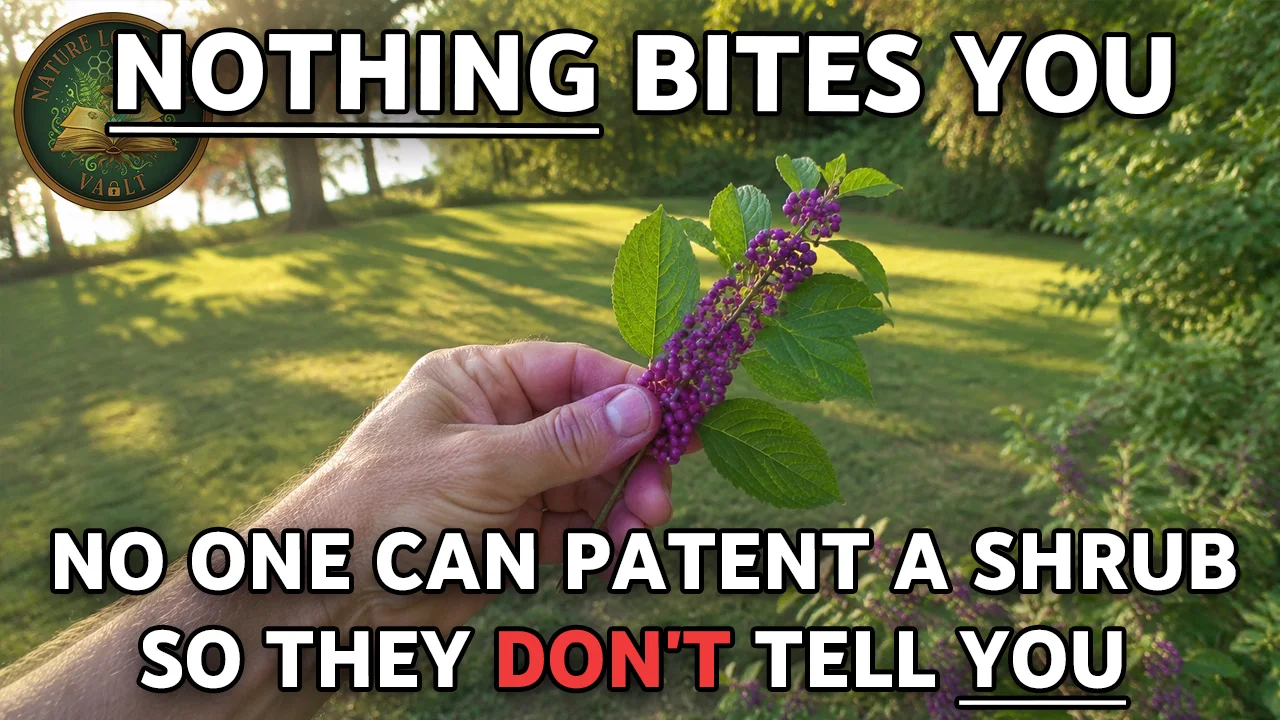

Table of Contents
- What is American Beautyberry?
- Choctaw & Creek Healers, Southern Fencerow Farmers & the 1942 USDA Lab
- The 2006 Cantrell & Klun Study: Callicarpenal vs DEET
- Why It Stays Buried: 40,000 Chemicals, an Army Patent & the Suburban Fog
- How to Identify, Grow & Use Beautyberry (and the Bucket Trap)
- Frequently Asked Questions
What is American Beautyberry?
Somewhere in the Deep South, on a hot evening before the war, a man walked out to his fence line and snapped off a branch heavy with bright purple berries. He crushed a handful of the leaves between his palms until they went green and wet, and he rubbed them down the neck and flanks of his mule. Then he ran the crushed leaves along his own forearms. Within a few minutes, the cloud of mosquitoes and biting flies that had been working the animal in the heat began to thin out and lift away. He had not bought anything. He had not mixed anything in a bottle. He had reached into the tangle of brush growing wild along nearly every Southern fencerow and pulled out a defense his family had leaned on for generations.
What nobody standing in that yard could have known was that, a few hundred miles away, the United States government was about to spend years and test more than 40,000 chemicals chasing the very thing already growing in his hedge.
This is Callicarpa americana, American beautyberry. A deciduous shrub in the mint family (Lamiaceae), 3 to 6 feet tall, recognizable in autumn by dense whorls of bright magenta-purple berries clustered along the stems where the leaves meet. It grows wild from Maryland south to Florida and west to Texas, in lowland forests, hedgerows, and the abandoned edges of old fields. The catalogs file it under ornamental. Almost everyone who knows it at all walks past it on a trail without a second glance. But Indigenous healers of the Alabama, Choctaw, Creek, and Seminole nations - whose use of this plant the USDA's own plant guide still records - reached for it as malaria fever-tea, dysentery medicine, rheumatism wash, and the most widely used Southern insect repellent for centuries before the United States government invented DEET.
| Metric | Value |
|---|---|
| Scientific name | Callicarpa americana |
| Family | Lamiaceae (mint family) |
| Common names | American beautyberry, French mulberry, sour-bush, sow-berry, Spanish mulberry |
| Native range | Lowland southeastern US (Maryland to Florida, west to Texas, parts of Oklahoma) |
| Growth habit | Deciduous shrub, 3-6 ft tall, arching branches |
| Identifying feature | Dense whorls of bright magenta-purple berries in leaf axils, late summer to autumn |
| Indigenous use | Alabama, Choctaw, Creek, Seminole - sweat-bath tea (malaria, rheumatism), root tea (dysentery), crushed-leaf insect repellent |
| USDA documentation | USDA NRCS plant guide records the Indigenous medicinal uses |
| Active compound | Callicarpenal (sesquiterpene) |
| Other active terpenes | Intermedeol, spathulenol |
| USDA study lead chemist | Charles Cantrell (USDA-ARS), Oxford, Mississippi |
| USDA study lead entomologist | Jerry Klun (USDA-ARS) |
| Year work began | 2004 (12-month investigation) |
| Year result published | 2006 |
| Performance vs DEET | Within ~21% of DEET against Aedes aegypti |
| Also effective against | Lone star tick (Amblyomma americanum), fire ants |
| DEET development | USDA Orlando, FL, 1942-1946 - 40,000+ compounds screened |
| DEET patent / public release | US Army patent 1946; civilian release 1957 |
| Mosquito-dunk active ingredient | Bacillus thuringiensis israelensis (Bti) |
| Bti discovered | 1976, Yoel Margalith, Negev Desert, Israel |
Choctaw & Creek Healers, Southern Fencerow Farmers & the 1942 USDA Lab
The Sweat Lodge, the Root Tea & the Crushed Leaf
This story does not begin in a government lab. It begins in the gardens and sweat lodges of the people who were here first - the Alabama, Choctaw, Creek, and Seminole. The United States Department of Agriculture's own plant guide still records what they did with this shrub. They boiled the roots, leaves, and branches into a strong tea and carried it into sweat baths to bring down malarial fevers and ease rheumatism. They boiled the roots to settle dysentery. And they crushed the leaves, the way that farmer did, and worked them into the skin of people and horses to drive off mosquitoes and ticks. Some wove whole branches into bridles and harnesses, so the animals carried the protection with them.
The Knowledge Crossed Over
Most people never heard this part of the history. But the knowledge did not die when the settlers arrived. It crossed over. Farmers across the Deep South kept crushing those leaves long into the twentieth century, passing the habit down the same way you pass down where the good fishing hole is. One of those memories landed on a botanist. His grandfather had told him plainly that up in northeastern Mississippi, people crushed beautyberry leaves to keep the biting bugs off themselves and off their working animals. He held onto that. And a few decades later, a government chemist would prove his grandfather right.
1942: A Federal Laboratory in Orlando, Florida
The year is 1942. The place is a small federal laboratory in Orlando, Florida. Scientists working for the Department of Agriculture had a serious wartime problem on their hands. American troops were fighting in the jungles of the Pacific, and the insects there carried disease faster than any enemy. The best repellents anyone had lasted about two hours. The military wanted ten. So the scientists started testing chemical compounds. Not dozens. Not hundreds. Over the next several years, they screened more than 40,000 of them. In 1946, they found their winner - a synthetic compound the Army would patent, and then, in 1957, hand to the American public. You know it as DEET. It works, and it works well, and it has been smeared on American arms every summer since. But the same government that ran through 40,000 chemicals to invent a repellent in a laboratory already had, growing wild across its own southern states, a shrub that did most of the same job for nothing. The answer was in the lab. It was also in the ditch.
The 2006 Cantrell & Klun Study: Callicarpenal vs DEET
Oxford, Mississippi: The Grandfather's Tip Reaches a Lab Bench
For decades, beautyberry sat in the gap. Remembered by a few farmers. Written up in a dry government plant guide. Otherwise ignored. Then, in 2004, that grandfather's tip finally reached a laboratory bench at the USDA Agricultural Research Service unit in Oxford, Mississippi. Chemist Charles Cantrell and entomologist Jerry Klun decided to test the folklore. Over a 12-month study, they pulled three active compounds out of the leaves and isolated the strongest, a sesquiterpene compound they called callicarpenal.
2006: The Published Result
In 2006, they reported their finding. The beautyberry leaf could go toe to toe with the military's famous spray. The plant compound landed only about 21% below the chemical that took 40,000 tries to find. And it did not stop at mosquitoes. The same callicarpenal turned away the lone star tick (Amblyomma americanum) and fire ants. Put plainly: the bush in the fencerow had been carrying a broad-spectrum repellent nearly as strong as the one the Army patented, the entire time. The grandfather had been right. It only took the better part of a century, and a federal research unit, to admit it.
The Chemistry
Callicarpenal belongs to a class of plant defense molecules called sesquiterpenoids, 15-carbon hydrocarbons many plants in the mint family use to deter insect feeding. Beautyberry leaves also contain intermedeol and spathulenol, two related terpenes with documented repellent activity. The compounds are concentrated in glandular trichomes on the leaf surface, which is why a fresh, hard crush - bruising the leaf until cells rupture and the volatile oils release - is dramatically more effective than a dried leaf or a casual scuff. The traditional Choctaw and Mississippi-farmer instruction to crush the leaves "between your palms until they are bruised and green" is a near-perfect amateur extraction protocol for these terpenes.
Why It Stays Buried: 40,000 Chemicals, an Army Patent & the Suburban Fog
You Cannot Patent a Shrub
DEET was only the first thing that pushed the old plant out of memory. The economics behind it are straightforward. A synthetic molecule like DEET (N,N-diethyl-meta-toluamide) can be patented, manufactured in a factory at industrial scale, branded, advertised, and sold for decades. You cannot patent a shrub. Beautyberry grew wild from Maryland to Texas, and any farmer with a fence line had access to it. The plant offered the consumer-repellent industry no business model: no exclusive supply chain, no recurring revenue, no marketing hook. The 1957 civilian release of DEET locked in the consumer mosquito-spray category, and the beautyberry story slid out of the medicine cabinet and into the dry pages of the USDA plant guide where almost no one would ever read it.
Round Two: The Truck and the Fog
The second thing that pushed the old plant out of memory was louder, and it came rolling down quiet suburban streets on the back of a truck. The fog. The chemical mist that crews spray across yards and neighborhoods to knock the mosquitoes down. The poison in most of those foggers traces straight back to a flower. For centuries, people ground the dried heads of a kind of chrysanthemum into a fine powder and used it to kill insects. Ancient Persia knew it. It sold in early American drugstores as plain insect powder. That flower had a nearly perfect design: deadly to insects, gentle on mammals, and fast to break down in sunlight. It did its job and was gone. Then chemists took it apart and rebuilt it. They engineered synthetic copies - pyrethroids - and the whole point of the redesign was to make them stronger and to make them last far longer than the flower ever would.
The Fog Kills the Predators Too
That is where the quiet damage starts. A fog of synthetic pyrethroids does not choose its target. It kills the mosquito, yes. But it also kills the honeybee on the clover, the butterfly drifting through the garden, the firefly blinking over the grass at dusk, and the dragonfly and the spider that eat mosquitoes by the hundred. For a long time, in most neighborhoods, nobody said anything. The predators die alongside the pests, which means that once the fog clears, the yard is often left more open to mosquitoes than it was before. The loud solution makes the problem worse. Meanwhile beautyberry kept growing in the fencerow, quietly, in the same lots the fogger had just passed through.
How to Identify, Grow & Use Beautyberry (and the Bucket Trap)
Identification
American beautyberry is a deciduous shrub, 3 to 6 feet tall, with arching branches and large opposite oval-to-lance-shaped leaves 3 to 6 inches long, lightly toothed, with a slight aromatic smell when crushed (the mint-family signature). The unmistakable identifying feature is the autumn fruit: dense whorls of bright magenta-purple berries, each about the size of a small pea, clustered tightly around the stem at the leaf axils. No native North American shrub has the same berry color in the same arrangement. Small pale pink to lavender flowers in similar whorls appear in midsummer before the berries form. The plant prefers moist, well-drained, slightly acidic soil and dappled forest edges, though it tolerates full sun in cooler parts of its range.
Growing It
Beautyberry is a tough, low-care shrub - one of the reasons Southern landscapers do plant it ornamentally, even when they do not know its other use. USDA hardiness zones 6 to 10. Plant in spring or autumn from nursery stock, in moist well-drained soil, full sun to partial shade. Spacing: 4 to 6 feet apart. Water through the first season; after establishment it is drought-tolerant. Deer tend to leave it alone, pest pressure is low, and it tolerates pruning hard - cut to about 12 inches above the ground in late winter and it will rebound with fresh vigorous shoots, which is also when the highest-terpene young leaves are produced. Set one near the porch or the patio where you sit in the evenings. When the bugs come up, the medicine is two paces away.
The Crushed-Leaf Repellent Method
Strip a small handful of fresh green leaves from the shrub. Crush them hard between your palms until they are bruised and green and wet, breaking the leaf cell walls so the volatile terpenes - callicarpenal, intermedeol, spathulenol - release into the pulp. Rub the crushed leaves over your exposed skin: arms, ankles, the back of the neck, behind the ears. Run them lightly along the hems and collars of your clothing. Reapply every 1 to 2 hours, or whenever you notice the protection thinning out. This is the same method Indigenous healers and Southern farmers used; the 2006 USDA study confirms the science. The protection is real but shorter-lasting than DEET - the leaf compound performs at about 79% of DEET's effectiveness.
The Bti Bucket Trap (Yard-Level Control)
Pair the leaf-rub with a yard-level breeding-trap that targets only mosquito larvae and nothing else. Take an ordinary 5-gallon bucket and fill it about two-thirds with water. Drop in a handful of grass clippings, dead leaves, or hay, and let it sit for a day. As the plant matter ferments, it releases the same CO₂ signature that tells a female mosquito this is a perfect nursery; she comes to lay her eggs. Then add a mosquito dunk (about $10 a pack at any hardware store). The active ingredient is Bacillus thuringiensis israelensis (Bti), a soil bacterium isolated by Israeli scientist Yoel Margalith in 1976 from a stagnant pond in the Negev Desert. Bti kills only the larvae of mosquitoes, blackflies, and a few close relatives. It leaves bees, butterflies, fish, frogs, birds, your pets, and you completely untouched. One dunk lasts about 30 days. Cover the bucket with fine wire mesh so no animal, child, or pet can fall in, and set it in the shade. The mosquito comes to your bucket to breed, and her young never crawl out of it. The fog kills everything in the yard; this kills nothing except the thing biting you.
Safety
Crushed beautyberry leaves applied to the skin have a long traditional safety record, and most people tolerate the bruised-leaf rub without irritation. Do a small patch test on the inner forearm first if you have sensitive skin or known plant allergies, especially within the mint family. Avoid getting crushed-leaf juice in the eyes or on open wounds. The berries themselves are not a culinary food but can be made into a tart jelly (with sugar and pectin); they are mildly astringent eaten raw in small amounts and not classified as toxic. For pets: the topical repellent has a long historical use on horses and farm dogs; for cats, who are more sensitive to terpenes, use sparingly or skip and consult a veterinarian. Children: avoid applying near the eyes and mouth, and use a smaller dose. As with any plant medicine, harvest only from shrubs you know have not been chemically sprayed.
Frequently Asked Questions
What is American beautyberry and what is it used for?
American beautyberry (Callicarpa americana) is a deciduous shrub in the mint family (Lamiaceae), 3 to 6 feet tall, native to the lowland southeastern United States from Maryland south to Florida and west to Texas. It is easiest to identify in autumn, when dense whorls of bright magenta-purple berries cluster along the stems where the leaves meet. Indigenous healers of the Alabama, Choctaw, Creek, and Seminole nations used it as medicine - the boiled roots, leaves, and branches as a sweat-bath tea for malarial fevers and rheumatism, root decoctions for dysentery, and crushed leaves rubbed on the skin of people and working animals as an insect repellent. The USDA's own plant guide records the indigenous use. Modern research has confirmed the repellent application: the leaves contain callicarpenal and related terpenoids that drive off mosquitoes, lone star ticks, and fire ants.
Does beautyberry really repel mosquitoes like DEET?
Yes, close to it. In 2004 USDA chemist Charles Cantrell and entomologist Jerry Klun, working at the agency's Oxford, Mississippi research unit, decided to test the longstanding folk-medicine claim that crushed beautyberry leaves repel mosquitoes. Over a 12-month study they isolated three active terpenes from the leaves, identified callicarpenal as the strongest, and reported in 2006 that the leaf extract performed within roughly 21% of DEET against Aedes aegypti, with confirmed activity against the lone star tick (Amblyomma americanum) and fire ants. DEET itself was the product of a USDA wartime program that screened over 40,000 compounds between 1942 and 1946. Beautyberry was growing wild in every Southern fence line the entire time.
Why isn't beautyberry sold as a commercial mosquito repellent?
You cannot patent a shrub. DEET is a synthetic molecule the US Army patented in 1946 and released to the public in 1957, generating billions in retail sales over six decades. Beautyberry grows wild from Maryland to Texas - anyone can plant one, anyone can crush a leaf. The active compound, callicarpenal, is a natural terpene and is not exclusively monetizable in the same way a synthetic patent is. Combined with the rise of pyrethroid fogging in suburban yards (a broad-spectrum approach that kills mosquito predators along with mosquitoes), the commercial market never had a reason to develop beautyberry as a consumer product. The grandfather's-tip method - strip a few leaves, crush, rub on skin - still works. It just generates no recurring revenue.
How do you use beautyberry to repel mosquitoes?
Plant or locate an American beautyberry near the porch, patio, or seating area where you spend evenings. When mosquitoes come up, strip a small handful of leaves from the shrub, crush them between your palms until they go bruised and green and the leaf cells rupture (this is what releases the callicarpenal), and rub the crushed pulp on the exposed skin of your arms, ankles, neck, and along your clothing. Reapply every 1 to 2 hours as needed. The same method drove mosquitoes off mules, horses, and farm dogs in the early 20th-century Deep South. The protection is real but shorter-lasting than DEET - the 2006 study placed the leaf compound at about 21% below DEET in effectiveness. For yard-level mosquito control, pair the leaf-rub with a Bti mosquito-dunk bucket trap (see the use-it section).
Is beautyberry safe for skin, kids, and pets?
Crushed beautyberry leaves have been used as a topical insect repellent on human skin and on working animals for centuries with a long traditional safety record. Most people tolerate the bruised-leaf rub without irritation. As with any plant medicine, do a small patch test on the inner forearm first - mild contact reactions are possible, especially in sensitive individuals or those with mint-family allergies. The berries themselves are not classified as a culinary fruit (some people make a tart jelly from them, but they are bland and slightly astringent raw) and have a long history of being eaten in small amounts without incident. Avoid the eyes and any open cuts when applying crushed leaves. For dogs and horses, the traditional topical use has a long safety record; for cats, who are more sensitive to plant terpenes in general, use it sparingly or not at all and consult a veterinarian if you are uncertain.
Explore More Medicinal Plants
Discover ancient healing plants backed by centuries of traditional use and modern science.
Browse Medicinal Plants Collection →