
Ground Ivy (Glechoma hederacea): The Saxon Alehoof Erased by the 1516 Bavarian Beer Law That 2023 Trials Show Suppresses MRSA
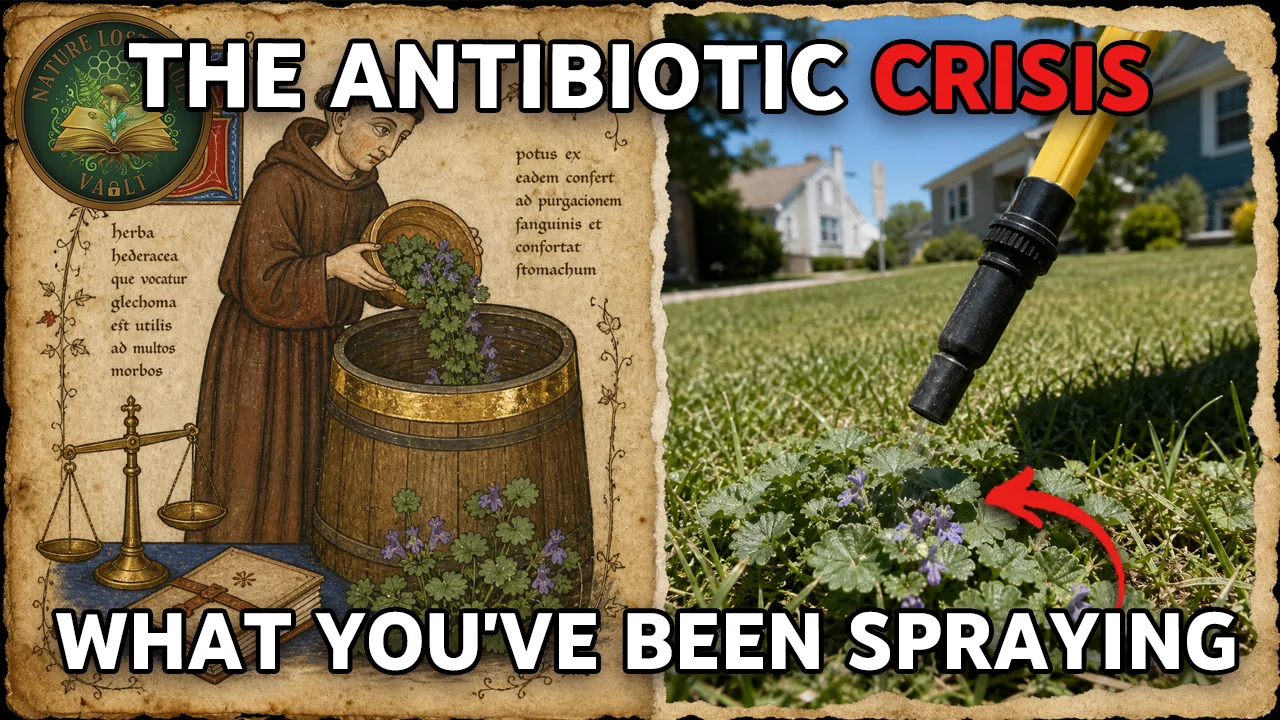
Table of Contents
What is Ground Ivy?
Every year, Americans pour more than $2 billion onto their lawns to destroy the plants growing in them. Herbicides, selective sprays, pre-emergent treatments - all of it aimed at the green things that dared to grow where they were not specifically invited. And every year, in the exact same country, infections that no antibiotic can stop claim more lives than they did the year before. Today, 1.3 million deaths a year worldwide trace directly to bacteria that have learned to shrug off our strongest drugs. That is more than HIV. More than malaria. The deadliest of them all is one doctors name with a kind of dread: MRSA. And right now, it is winning.
Hold those two facts next to each other for a second, because almost nobody does. We are spending an absolute fortune to eradicate a specific category of plant. And inside the leaves of one of those plants is one of the most carefully documented natural defenses against the exact bacteria currently killing us. This is not folklore. This is peer-reviewed laboratory work. There is one plant in particular, growing right now within a few feet of most front doors in America. Researchers have tested it against drug-resistant staph and watched it heal an infected wound. Yet people have been pulling it out of the ground in frustration for a thousand years. The ancient Saxons believed it was worth protecting. It turns out, they were onto something we are only now confirming.
This is Glechoma hederacea, family Lamiaceae (the mint family). Most people know it as creeping Charlie, ground ivy, or gill-over-the-ground. But its oldest English name tells the real story: alehoof. That name is a clue, and it points to a historical crime that happened in the year 1516. It spreads by runners that creep along the soil and root at every single node, so when you pull one strand, you leave behind ten more. It survives frost. It survives drought. It survives the chemical assault you throw at it and comes back the next spring like nothing happened.
| Metric | Value |
|---|---|
| Scientific name | Glechoma hederacea |
| Family | Lamiaceae (mint family) |
| Common names | Creeping Charlie, ground ivy, gill-over-the-ground, alehoof, tunhoof, run-away-robin |
| Old Saxon brewing name | Alehoof (the ale-herb) |
| Native range | Europe and southwest Asia; naturalized across most of North America |
| Growth habit | Perennial; stolons root at every node; 4-8 in tall, indefinite spread |
| Hardiness | USDA zones 3-10; tolerant of frost, drought, shade, and most consumer herbicides |
| Key active compounds | Ursolic acid, rosmarinic acid, oleanolic acid (triterpenes); flavonoids |
| Recorded by Galen (~150 CE) | For inflammation |
| Recorded by Hildegard of Bingen (12th c.) | For tinnitus (ringing in the ears) |
| Recorded by John Gerard (1597) | Tonic, astringent, gentle stimulant; English texts called it a cure-all |
| Primary brewing role | Central herb in gruit ale (pre-hops European brewing) |
| Bavarian Reinheitsgebot | 23 April 1516 - beer restricted to water, barley, hops only |
| Effect of the 1516 law | Gruit herbs (alehoof included) legislated out of brewing |
| 2023 lab study | Ursolic acid extract suppressed multi-drug-resistant S. aureus |
| 2023 animal model | Infected wound closed (new skin and hair) within 10 days |
| Solubility of triterpenes | Poor in water; require cold infusion, alcohol, or fat to extract |
| Heat sensitivity | High heat degrades the active triterpenes - hot tea pulls almost nothing |
| US annual lawn herbicide spend | ~$2 billion (ground ivy among top targets) |
| Annual global deaths from AMR | ~1.3 million (more than HIV, more than malaria) |
Galen, Hildegard, Gerard & the 1516 Reinheitsgebot
The archive opens on Glechoma hederacea. Most people know it as creeping Charlie, ground ivy, or gill-over-the-ground. But its oldest name tells the real story: alehoof. That name is a clue, and it points to a historical crime that happened in the year 1516. First, the plant itself, because its medicinal record is not vague. It is filled with specific names and exact dates.
Galen (~150 CE): Inflammation
Galen of Pergamon, the Greek physician whose work shaped Western medicine for a thousand years, recommended it for inflammation. His texts circulated through Byzantine, Arabic, and Latin medical traditions and were taught in European universities into the seventeenth century. When Galen wrote it down, the prescription stayed written down.
Hildegard of Bingen (12th century): Tinnitus
Hildegard of Bingen, the 12th-century German abbess, composer, and healer, recorded the use of ground ivy for ringing in the ears in her medical texts. Hildegard's Physica is one of the most detailed surviving herbal compendia of the medieval period and was based on direct clinical observation in her abbey infirmary.
John Gerard (1597): Tonic, Astringent, Stimulant
In 1597, the English herbalist John Gerard wrote ground ivy into his massive Herball, or Generall Historie of Plantes, calling it a tonic, an astringent, and a gentle stimulant. By the early 1800s, American settler physicians had carried it across the Atlantic and were using it for so many things that in England it was simply called a cure-all. Then it fell out of the books. Not because it stopped working - because something replaced it, and that something could be controlled.
The Story Behind "Alehoof"
For thousands of years, beer was not made with hops. Ale was bittered and preserved with a mixture of herbs called gruit, and one of the most common herbs in that mixture was this exact plant. It clarified the beer. It preserved it. It flavored it. The Saxons brewed with it. The English brewed with it. The names stuck: alehoof, tunhoof, gill-over-the-ground - all brewing words, for a brewing herb.
1516: The Bavarian Reinheitsgebot
Here is where the history turns. The right to sell gruit was not free. In much of northern Europe, brewing was a strict monopoly, the gruitrecht, held by the church, by bishops, and by the nobility, who ran licensed gruit houses and aggressively taxed every batch. The herbs were the product, and the product was controlled. Hops were different. Hops were a cultivated crop. You could grow them on a massive farm, count them, regulate them, and tax them at the point of production. A wild herb that anyone could pick for free from a meadow could not be taxed the same way.
So when the rulers of Bavaria passed their famous purity law on 23 April 1516, the Reinheitsgebot, restricting beer to only water, barley, and hops, they did something that sounded like quality control but worked like a corporate takeover. They legislated an ancient herbal tradition completely out of existence. A free herb the common people grew themselves was permanently replaced by a crop the powerful could own. That was round one. The plant survived it, of course. It always does. But the human knowledge started to thin.
The Science: Ursolic Acid, Rosmarinic Acid & the 2023 MRSA Study
What's Inside the Leaves
Modern phytochemistry has identified several closely related families of bioactive compounds in Glechoma hederacea. The most studied are the pentacyclic triterpenes: ursolic acid, oleanolic acid, and related molecules, together with the phenolic acid rosmarinic acid, named for its abundance in rosemary but found throughout the mint family. These compounds have well-characterized activity against bacterial cell membranes and biofilms, and rosmarinic acid is one of the most studied natural anti-inflammatory polyphenols of the last two decades.
2023: Suppression of Multi-Drug-Resistant S. aureus
In 2023, researchers ran the plant through detailed chemical analysis, isolated the ursolic acid fraction, and tested the extract against multi-drug-resistant clinical samples of Staphylococcus aureus, the exact bacterial family that includes MRSA. It suppressed them. Then they took it further, into an animal model. An extract gel was applied to an infected wound. It brought the bacterial load down compared to a standard pharmacy ointment, and the wound completely closed, with new skin and new hair, within 10 days.
What the Result Is, and Isn't
This is a laboratory and an animal result. It is not yet a human trial. Anyone who tells you this is a proven pharmaceutical cure is getting ahead of the science. But the trajectory is undeniably consistent across centuries of traditional use and across modern study, and it points directly at the exact problem keeping infectious disease doctors up at night. The same triterpenes are mechanistically active against bacterial biofilms - the protective shields that let MRSA and other resistant organisms evade single-molecule antibiotics - and the rosmarinic-acid fraction adds an anti-inflammatory layer that fits the historical record of use for swollen, painful tissue.
The Preparation Catastrophe
But here is the most important detail in this entire archive. When modern scientists first tested industrial preparations of this plant - the standardized tinctures manufactured for long shelf life - some of them came back showing almost nothing. Completely inactive. And that is exactly how a real medicine gets dismissed as peasant superstition. You test it wrong, you get nothing, and you write it off.
These compounds are incredibly fragile. The triterpenes that actually matter are barely water-soluble, so a quick cup of hot tea pulls out almost none of them. High heat chemically degrades the delicate parts. The old healers knew to prepare it cold, or to extract it in fat, or in alcohol. Not because they understood the microscopic chemistry, but because a thousand years of quiet observation had taught them exactly what worked. Modern medicine forgot the preparation, tested the wrong version, and confidently concluded the plant was nothing. The plant was never nothing. The knowledge of how to use it was what we lost.
Why It Stays Buried: $2 Billion of Lawn Herbicide and the Tincture That Killed the Medicine
Round One: The 1516 Brewing Erasure
The Bavarian Reinheitsgebot of 1516 looked like quality control. It worked like a vertical takeover of the European brewing industry. The gruit monopoly held by the church and the nobility was a fragile rent: it depended on the legal right to license wild herbs that anyone could, in principle, pick for free from a meadow. Hops solved that problem. A cultivated row crop is countable, taxable, and trademarkable. Within a century of the Reinheitsgebot, alehoof had vanished from the recipe books of all the major brewing regions. The plant did not go anywhere. The institutional memory of how and why to use it did.
Round Two: The $2 Billion Lawn Industry
The second erasure happened in America in the 20th century, and it is still happening every spring. Americans now spend roughly $2 billion a year on lawn herbicides, and ground ivy is a top target. There has been no real biological-control research from the United States Department of Agriculture. The official answer to ground ivy is simply chemical: the same herbicide names sitting on the shelf at every garden store, applied to a plant that survives almost all of them anyway. The herb the Saxons protected, brewed, and healed with is, in modern America, a line item on a plastic bottle of weed killer.
Round Three: The Tincture That Killed the Medicine
The third and most cynical erasure was scientific. When the first wave of commercial herbal-medicine companies in the 1980s and 1990s scaled up Glechoma extracts for the supplement market, the standard process was a hot water decoction or a quick alcohol soak optimized for shelf stability, not for triterpene content. Some of the batches that came back from independent testing showed almost no measurable activity. The conclusion that filtered into mainstream pharmacology textbooks was that the plant was empirically inert: not interesting, not worth funding, certainly not worth competing with a patent. That conclusion was wrong, but it became the consensus, and it took until the 2023 reanalysis with proper extraction chemistry to start dismantling it.
The Symmetry
There is a terrifying, strange symmetry to it. A plant we cannot kill, that survives absolutely everything, sitting quietly in the cracks of the sidewalk. While the bacteria we are desperately trying to kill learns to survive everything we have. One of them has been on our side the entire time. The economics of the situation are also straightforward: ground ivy does not need you to water it, feed it, or protect it. It cannot be patented. A bottle of dried herb costs less than a single co-pay on a hospital antibiotic. There is no $2.5 billion-a-year revenue line in selling it. So no one sells it, and the herbicide aisle keeps growing.
How to Identify, Forage & Prepare Ground Ivy
Identification
Look for a low-growing creeping perennial, 4 to 8 inches tall, with square stems (a mint-family signature - roll a stem between your fingers and feel the four corners), scalloped round-to-kidney-shaped leaves about 1 inch across with shallow lobes, and small blue-violet two-lipped tube-shaped flowers in spring. Crush a leaf - it should smell distinctly minty (some people describe it as a cross between mint and pine). The stems are stoloniferous: they trail along the ground and root at every node, which is why pulling one strand leaves ten more behind. Common lookalikes are henbit (Lamium amplexicaule) and purple deadnettle (Lamium purpureum) - same family, similar growth, also edible, but with stalkless upper leaves clasping the stem, where ground ivy's leaves are clearly stalked.
Foraging
Ground ivy is at peak medicinal potency in spring, just before and during flowering, when the leaves are tender and the triterpene content highest. Harvest the top 2 to 4 inches of the stem with leaves attached. Use scissors or pinch at a node - the plant will regrow within days. Never harvest from sprayed lawns, roadsides, or dog-walking paths. The same chemical-tolerance that makes ground ivy difficult to kill makes it efficient at storing residues from herbicides, vehicle exhaust, and dog urine. Forage from your own untreated yard, an organic garden, or a known clean woodland edge.
Cold Infusion (the Right Way to Make Tea)
Rinse a generous handful of fresh leaves, bruise them lightly with the back of a knife, place in a glass jar, and cover with cold filtered water. Seal and steep in the refrigerator for 8 to 12 hours. Strain. Drink within 24 hours. Cold-infused ground ivy has a mild, faintly minty, faintly bitter taste. This is the preparation that preserves the rosmarinic-acid fraction.
Alcohol Tincture (the Gruit-Brewer Method)
Pack a clean glass jar two-thirds full of fresh wilted leaves (wilted = 12 to 24 hours air-drying after harvest, to reduce water content). Cover completely with 40 percent vodka or higher, seal, and steep in a dark cupboard for 4 to 6 weeks, shaking every few days. Strain through cheesecloth into a dropper bottle. Typical adult dose for medicinal use is 1 to 2 mL (about a half dropperful) up to three times a day, diluted in a small glass of water. This is the closest modern analog to how Saxon and English gruit-brewers extracted the active compounds. Alcohol pulls out both the water-soluble phenolics and the fat-soluble triterpenes that water alone misses.
Oil Infusion (for Topical Wound and Skin Use)
This is the form best suited for the kind of topical wound use the 2023 animal study evaluated. Wilt fresh leaves for 24 hours to drive off surface water, pack loosely in a clean glass jar, cover completely with extra-virgin olive oil, seal, and steep in a warm dark spot for 4 to 6 weeks. Strain through cheesecloth into a dropper bottle. Apply a few drops to minor wounds, cuts, scrapes, eczema patches, or insect bites once or twice a day. Do not use on deep wounds, puncture wounds, animal bites, or anything you would otherwise take to a clinic - serious infections need clinical care.
Safety
Ground ivy has been a culinary, brewing, and medicinal herb in Europe for at least 2,000 years and is generally well tolerated in moderate amounts. The standard cautions: the plant contains volatile compounds, including pulegone, that can be hard on the kidneys and liver at very high doses, so do not take large medicinal-strength doses for extended periods. Pregnant women should avoid medicinal-strength preparations. Horses should not be fed ground ivy - veterinary toxicity has been documented at high intake (this is a horse-specific sensitivity, not a general human warning). People with kidney or liver disease should consult a clinician before regular use. As always, harvest from soil and locations you trust, away from chemical exposure.
Frequently Asked Questions
What is ground ivy (Glechoma hederacea) and where does it grow?
Ground ivy (Glechoma hederacea) is a perennial creeping plant in the mint family (Lamiaceae), native to Europe and southwest Asia and naturalized across most of North America. It is more familiar by its common names: creeping Charlie, gill-over-the-ground, alehoof, tunhoof. It spreads by stolons that root at every node, has scalloped round-to-kidney-shaped leaves about 1 inch across, and produces small blue-violet two-lipped mint flowers in spring. The crushed leaves smell distinctly minty. It thrives in shade, moist soil, and disturbed ground, and is one of the most successful lawn 'weeds' in cool-temperate climates: it survives frost, drought, mowing, and most consumer herbicides.
Does ground ivy actually kill MRSA?
A 2023 study isolated ursolic acid from Glechoma hederacea leaves and tested the extract against multi-drug-resistant clinical samples of Staphylococcus aureus, the bacterial family that includes MRSA. The extract suppressed bacterial growth. The same team then applied an extract gel to an infected wound in an animal model: it brought the bacterial load below a standard pharmacy ointment, and the wound closed with new skin and hair within 10 days. This is laboratory and animal evidence, not a human clinical trial - anyone claiming ground ivy is a proven MRSA cure is overstating the science. But the result aligns with what Galen, Hildegard, and English herbalists recorded for two thousand years, and the mechanism (ursolic acid + rosmarinic acid attacking bacterial membranes and biofilms) is well-characterized.
What was alehoof and why did it disappear from beer?
Before hops took over European brewing, ale was bittered and preserved with a mixture of herbs called gruit. Glechoma hederacea was one of the most common gruit herbs - the Old English name alehoof literally meant 'ale-herb'. The right to sell gruit (the gruitrecht) was a strict monopoly held by the church, bishops, and nobility, who ran licensed gruit houses and taxed every batch. Hops were different: a cultivated crop you could grow on a large farm, count, and tax at production. In 1516 the Bavarian Reinheitsgebot (beer purity law) restricted beer to water, barley, and hops only, legislating gruit herbs - including alehoof - out of European brewing. It looked like quality control. It worked like a corporate takeover, replacing a free wild herb anyone could pick with a cultivated commodity the powerful could own.
How do you prepare ground ivy correctly?
The active triterpenes in ground ivy - ursolic acid, rosmarinic acid, oleanolic acid - are barely water-soluble and degrade in high heat. A quick cup of hot tea pulls almost none of them out. This is why some industrial standardized tinctures of Glechoma tested inactive: the modern preparation killed the medicine. The traditional ways still work. (1) Cold infusion: steep fresh leaves in cold water 8 to 12 hours, strain, drink within a day. (2) Alcohol tincture: pack a jar with fresh leaves, cover with 40% vodka or higher, steep 4 to 6 weeks, strain - this is the closest analog to how gruit-brewers extracted the herb. (3) Oil infusion: pack a jar with wilted (24-hour wilted) leaves, cover with olive oil, steep 4 to 6 weeks in a warm dark spot, strain - this is the form best suited for topical wound and skin use, where the 2023 animal study saw closure in 10 days.
Is ground ivy safe? Any side effects?
Ground ivy has a long human-use history in tea, food, and traditional medicine, and is generally well tolerated in moderate amounts. The standard cautions: it contains volatile compounds (including pulegone) that can be hard on the kidneys at very high doses, so do not take large medicinal doses for extended periods. Pregnant women should avoid medicinal-strength preparations. Horses should not be fed it - veterinary toxicity has been reported at high intake. Harvest from soil you know, away from roadsides, dog-walking paths, and recently sprayed lawns (its tolerance of herbicides means it absorbs and stores them). For most adults, modest culinary or topical use, and short courses of cold-infusion tea, are within the historical safety record that includes a millennium of European brewing and folk medicine.
Explore More Medicinal Plants
Discover ancient healing plants backed by centuries of traditional use and modern science.
Browse Medicinal Plants Collection →