
Mullein (Verbascum thapsus): The 2,000-Year Lung Medicine Erased From American Pharmacy
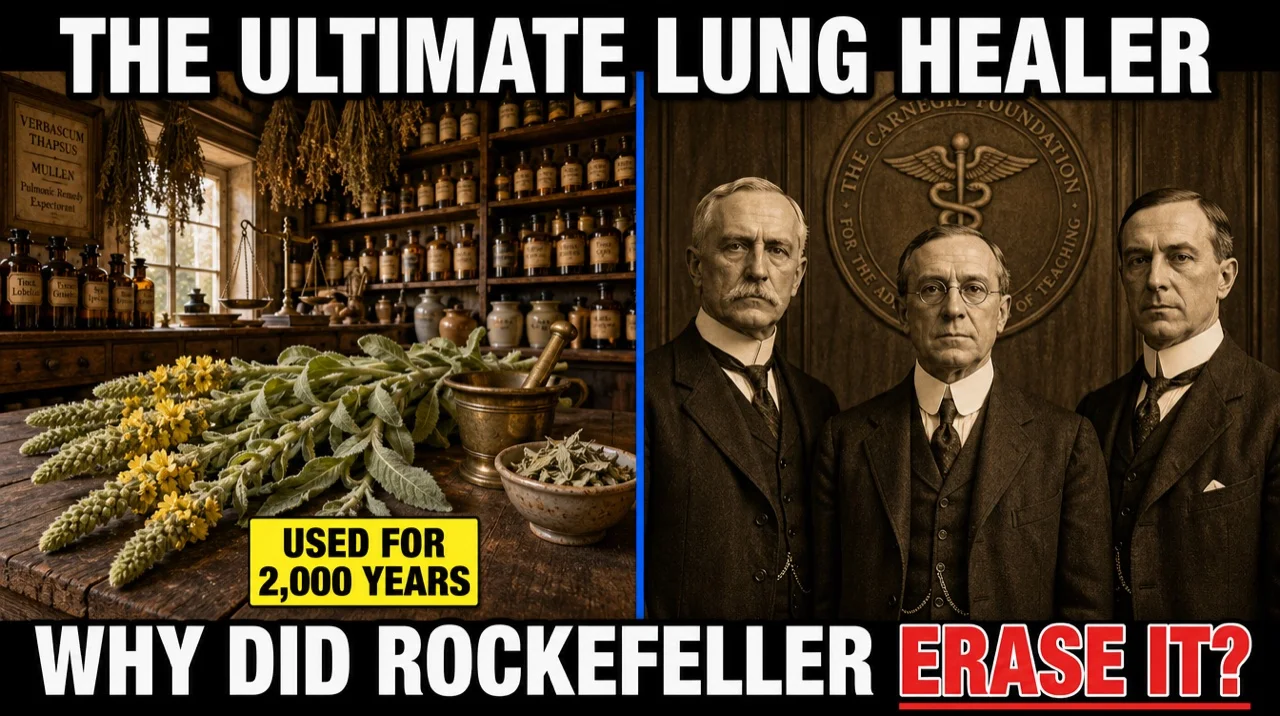
Table of Contents
Recommended Products:
Mullein Leaf Extract Mullein Seeds (Grow Your Own)
Affiliate links - support our channel
What is Mullein?
In 1883, at St. Vincent's Hospital in Dublin, a physician named Francis Quinlan was weighing his patients week after week. They had consumption, the disease we now call pulmonary tuberculosis. Weight was the scoreboard: gain, and you were winning; lose, and you were dying. There were no antibiotics. Streptomycin would not be isolated for another 60 years.
Quinlan was testing a remedy he had learned from the Irish countryside, not from medical school. For generations, Irish families had treated consumption with mullein milk: soft, woolly leaves from a tall roadside plant, boiled in milk and drunk warm. The plant was grown in Irish gardens and sold by Dublin chemists. Quinlan reported seven cases in the British Medical Journal. In early-stage patients, the mullein milk seemed to work much like cod liver oil, the standard treatment of the day, and several patients gained weight. He asked for more trials. They never came.
This is mullein, Verbascum thapsus, also called the Lungwort, the Quaker's Rouge, the Aaron's Rod, and the Bullock's Lungwort. A biennial plant in the figwort family (Scrophulariaceae). In its first year, it grows as a rosette of large silver-green leaves so soft they feel like felt. In the second year, it sends up a single yellow flower spike that can reach 10 feet tall by late summer. A single mature plant produces 100,000 to 250,000 seeds. It grows in disturbed soil along highways, railroad tracks, abandoned lots, and field edges across most of North America. You have driven past it 10,000 times. The global market for asthma and COPD drugs is worth tens of billions of dollars a year. The plant Quinlan's patients were given is completely free.
| Metric | Value |
|---|---|
| Botanical name | Verbascum thapsus |
| Family | Scrophulariaceae (figwort family) |
| Common names | Common mullein, Lungwort, Quaker's Rouge, Aaron's Rod, Bullock's Lungwort |
| Life cycle | Biennial (rosette year 1, flower stalk year 2) |
| Mature height | 6–10 feet (1.8–3 m) flower stalk |
| Seeds per plant | 100,000–250,000 |
| First modern clinical report | 1883 (F. J. B. Quinlan, St. Vincent's Hospital, Dublin, BMJ) |
| Earliest pharmaceutical catalog | 1st century AD (Dioscorides, De Materia Medica) |
| Active compounds | Saponins, mucilage, verbascoside, iridoid glycosides |
| Mechanism (leaf) | Saponins thin/mobilise mucus, mucilage soothes bronchial tissue |
| Mechanism (flower) | Verbascoside reduced inducible nitric oxide synthase (iNOS) in lab studies |
| 2001 ear drop trial (103 children) | Herbal oil containing mullein matched anesthetic ear drops for ear pain |
| German Commission E status | Approved 1990 for respiratory catarrh |
| Dropped from US National Formulary | After 1936 (listed in NF IV, 1916) |
| Standard tea dose | 1 tsp dried leaf / cup, steep 10 min, strain through coffee filter, up to 3× daily |
| Bronchodilator market | $23.64 billion (projected $32.94 billion by 2034) |
2,000 Years of Continuous Use
The archive opens in the 1st century AD, with the Greek army physician Pedanius Dioscorides, who compiled De Materia Medica, the pharmaceutical reference text that would dominate Western medicine for the next 1,500 years. In it he describes tall, woolly plants he calls phlomos, whose leaves treat coughs and chest complaints. Common mullein, Verbascum thapsus, is the plant most often identified with that name.
Bullock's Lungwort: Roman Cattle and Medieval Healers
The use never changed. Medieval herbalists gave mullein for the chest. Farmers gave it to cattle with sick lungs, and the plant became Bullock's Lungwort. Its other names show how useful it was: dipped in tallow, the stalks burned as torches called hag's tapers; young women rubbed the rough leaves on their cheeks for color, hence Quaker's Rouge; and fishermen scattered the seeds in ponds to stun fish.
Across the Atlantic: The Native American Adoption
Across the Atlantic, in the same century, mullein was already established in North America. European colonists brought the seeds. Native American tribes immediately recognized the medicine. The Cherokee brewed the leaves into tea for coughs and asthma. The Mohegan dried the leaves and smoked them in clay pipes for chest congestion, a practice still preserved in modern herbal smoking blends. The Menominee, the Forest Potawatomi, and the Penobscot all used the smoke from smoldering mullein leaves to relieve asthma attacks. Mullein went on to line the roads from Maine to California.
1883: Mullein Milk in Dublin
In the 19th century, tuberculosis (consumption) was one of the leading causes of death in Europe and North America. In Ireland, families treated it with mullein milk, and in 1883 Dr. F. J. B. Quinlan of St. Vincent's Hospital, Dublin reported seven consumptive patients treated with it in the British Medical Journal. In early cases it compared favorably with cod liver oil. In 1916, the dried leaves entered the fourth edition of the US National Formulary, the American reference of approved drugs, together with a fluid extract; the flowers went into a "pectoral" chest tea.
Modern Science: Verbascoside, Lab Studies & the 2001 Ear Drop Trial
For roughly a century after mullein was removed from American medical training, the plant remained outside the laboratory. In the last twenty years that has changed. Researchers in Italy, Turkey, Israel, and Ireland have begun testing the plant and its compounds. The results so far support, in laboratory terms, what Irish families relied on by tradition, although no large modern trial of mullein alone for cough has been run.
The Mechanism: Saponins, Mucilage, Verbascoside
Mullein contains three classes of compounds that act on respiratory tissue through complementary mechanisms. Saponins in the leaf physically thin and mobilise the thick mucus produced by infected bronchial tissue, the same mechanical effect that guaifenesin (the active ingredient in Mucinex) is licensed for. Mucilage, a polysaccharide gel released when the dried leaf is steeped, coats and soothes the inflamed mucous membranes of the throat and upper airways. Verbascoside, a phenylethanoid glycoside concentrated in the yellow flowers, has shown anti-inflammatory activity in laboratory studies.
2010: Verbascoside and iNOS
Italian researchers led by Lorenza Speranza published a study in Phytotherapy Research examining the anti-inflammatory action of verbascoside isolated from mullein. They drove human immune cells into an inflammatory state, then treated the cells with verbascoside. The compound significantly reduced the expression and activity of inducible nitric oxide synthase (iNOS), an enzyme that fuels inflammation. It also reduced the production of superoxide free radicals.
2002: Antibacterial Activity in the Lab
Arzu Ucar Turker and N. D. Camper ran mullein extracts through a battery of bench tests and reported in the Journal of Ethnopharmacology that the extracts inhibited the growth of several bacteria. The water extracts, closest to a kitchen tea, performed well.
2001: The Ear Drop Trial in 103 Children
The best human evidence involves the flowers. In 2001, pediatricians in Israel published a randomized trial in Archives of Pediatrics and Adolescent Medicine. 103 children aged 6 to 18 with ear pain from acute otitis media received either standard anesthetic ear drops or an herbal oil of garlic, mullein, calendula and St. John's wort in olive oil. The herbal drops were as effective as the anesthetic drops. Mullein was one ingredient among four. No large modern trial of mullein alone for cough has been run; in 2011, researchers at the Cork Institute of Technology noted that mullein's activity against Mycobacterium had never been properly tested.
1990: German Commission E Approval
The German Commission E, the European regulatory body that evaluated herbal medicines for the German government for over two decades, formally approved mullein flower in 1990 for the treatment of respiratory catarrh. This is one of the most rigorous herbal medicine approvals in Western regulatory history. The FDA has never issued any equivalent recognition. In the United States, mullein remains classified as a dietary supplement. Producers cannot legally make any medical claim about it. But the medicine is still there, and the science is now formal.
Why It Was Buried: Koch, Streptomycin & the Bronchodilator Industry
On 24 March 1882, Robert Koch showed in Berlin that tuberculosis was caused by a bacterium, Mycobacterium tuberculosis. It was one of the great discoveries in medical history, and it redrew the map of what counted as medicine. Before Koch, consumption was managed with rest, fresh air, rich food, cod liver oil, and something to soothe the cough. After Koch, the goal was a weapon against the bacillus. A plant that soothed but did not kill was suddenly beside the point, and Quinlan's call for trials in 1883 went nowhere.
Dropped From the Formulary
Mullein clung on in the official books for a while. Listed in the US National Formulary in 1916, it was dropped after 1936, as American pharmacy moved to standardized, single-compound drugs that could be measured, branded, and owned. It became, officially, not a drug.
In 1943, Albert Schatz, working in Selman Waksman's laboratory at Rutgers, isolated streptomycin, the first antibiotic that worked against tuberculosis. It was patented and manufactured by Merck; Schatz later had to sue for his share of the royalties. Tuberculosis became a curable condition, and a market. Mullein was no longer needed for TB.
1966: The Albuterol Patent
But asthma, bronchitis, chronic obstructive pulmonary disease, and respiratory infection were still everywhere. Smoking had created a generation of damaged lungs. Industrial pollution had created another. By the 1960s, American emergency rooms were filling with people who could not breathe. In 1966, a research team at Allen and Hanburys, a British pharmaceutical subsidiary of Glaxo, synthesized a chemical called salbutamol. Marketed in the United States as albuterol, it was a beta-2 adrenergic receptor agonist that relaxed the smooth muscle around the bronchial tubes in seconds. The FDA approved it in 1981. By the 1990s, it was the standard rescue medication for asthma worldwide. The patented brand name was Ventolin.
The $92 Billion Lung Industry
Today, the global bronchodilator market is worth $23.64 billion per year and projected to reach $32.94 billion by 2034. Albuterol alone generates $4.59 billion annually. The combined market for asthma and COPD therapeutics is $92.30 billion and projected to reach $155.25 billion by 2030. GlaxoSmithKline, AstraZeneca, Teva Pharmaceuticals, Merck, and Boehringer Ingelheim divide this market between them.
A single Ventolin inhaler, before insurance, retails in the United States for between $50 and $80. A typical asthmatic patient uses 12 to 24 inhalers per year, an annual cost of $600 to nearly $2,000. The patent on the original formulation expired in the 2010s, but the price remains high because the pharmaceutical industry has continuously developed new combination inhalers that pair albuterol with corticosteroids and reset the patent clock. The plant that produces the same expectorant action mechanically cannot be patented. We did not lose mullein. We just stopped looking down.
How to Use Mullein (Tea, Oil, Identification)
Identification: The Felted Leaf Test
Mullein is one of the easiest medicinal plants in North America to identify, but its first-year rosette can be confused with foxglove, a dangerous heart poison. In the first year, it grows as a low rosette of large soft leaves arranged like a flat star against the ground. The leaves are silver-green, 4 to 12 inches long, and covered in fine hairs that feel exactly like felt or velvet. This is the diagnostic feature. Foxglove (Digitalis purpurea) leaves are softly hairy but not thickly felted, with toothed edges and a wrinkled, veiny surface; when in doubt, wait for the second-year flower stalk.
In the second year, the plant sends up a single tall flowering stalk reaching 6 to 10 feet, covered in small five-petaled yellow flowers blooming a few at a time from June through September. It grows in disturbed soil along highways, railroad tracks, abandoned lots, gravel pits, and field edges. It thrives in poor compacted soil and needs no water.
Where and When to Harvest
Harvest the leaves in the first year, before the plant flowers, when the medicinal compounds are concentrated. Choose plants growing well away from roadsides and farm fields, since the felted leaves trap dust and chemical residue like a filter. Cut the leaves in the morning after the dew has dried. Hang them in small bunches in a dark, well-ventilated space for two weeks until they are completely dry and crumble easily. Store in an airtight glass jar away from light and humidity. The yellow flowers, harvested in the second year as they open, are even more medicinally valuable than the leaves.
Mullein Tea (For Cough & Bronchial Support)
Use one teaspoon of dried mullein leaf per cup of boiling water. Steep for 10 minutes. Strain the tea through a coffee filter or fine cheesecloth, because the small hairs from the leaves can irritate the throat if not removed. This is the most important step and the one most often skipped. Drink up to three cups per day during respiratory illness. Sweeten with honey if desired, which is itself an old respiratory remedy.
Mullein Flower Oil (For Ear Infections)
The yellow flowers, harvested in the second year, are the most concentrated source of verbascoside. They are traditionally infused in olive oil for two weeks in a sunny window, then strained. The infused oil is a traditional remedy for ear discomfort: a few warmed drops on the outer ear. In a 2001 trial in 103 children, an oil combining mullein with garlic, calendula and St. John's wort was as effective as anesthetic ear drops for ear pain. Never use oil in an ear with a suspected perforated eardrum, discharge, or ear tubes, and have ear infections in children assessed by a doctor.
Smoke Inhalation (Traditional Use)
The Mohegan, Menominee, Forest Potawatomi, and Penobscot all used the smoke from smoldering dried mullein leaves to relieve asthma attacks. The dried leaves are still included in modern herbal smoking blends sold for respiratory support. Smoke inhalation is a traditional rather than evidence-based use; it is documented historically but does not appear in modern clinical trials.
Safety
Mullein is one of the safest medicinal herbs known. No serious adverse events have been reported in modern clinical trials, and it has about 2,000 years of traditional use. Strain the tea thoroughly to avoid throat irritation from the hairs. Do not harvest from roadsides, parking lots, or farm field edges, since the leaves trap heavy metals and pesticide residue. Mullein seeds contain saponins, were traditionally used as a fish poison, and should not be ingested; only the leaves and flowers are used medicinally. Pregnancy and breastfeeding data is limited; consult a qualified practitioner. As with any herbal medicine, mullein does not replace medical care for serious respiratory conditions; if you have asthma, COPD, or active pulmonary infection, work with your doctor.
Frequently Asked Questions
What is mullein and what is it used for?
Mullein (Verbascum thapsus) is a tall biennial plant in the figwort family (Scrophulariaceae) that produces a rosette of soft silver-green felted leaves in its first year and a yellow flower spike up to 10 feet tall in its second year. It has been used as a respiratory medicine for about 2,000 years. Dioscorides described woolly phlomos plants for coughs and chest complaints in De Materia Medica in the 1st century AD, and common mullein is the plant most often identified with that name. Native nations including the Potawatomi and Penobscot smoked the dried leaves to ease asthma. Mullein leaf was listed in the US National Formulary from 1916 until 1936. The mechanism is now better understood: saponins in the leaf thin and mobilise mucus, mucilage coats and soothes inflamed airways, and verbascoside in the flowers reduced the inflammatory enzyme iNOS in laboratory studies. The German Commission E approved mullein flower in 1990 for respiratory catarrh.
Is mullein really good for the lungs? What does the science say?
The laboratory evidence supports the traditional use, but large human trials are missing. A 2010 study by Speranza and colleagues (Phytotherapy Research) showed that verbascoside isolated from mullein significantly reduced the expression and activity of inducible nitric oxide synthase (iNOS), an enzyme that fuels inflammation, in human immune cells. In 2002, Turker and Camper (Journal of Ethnopharmacology) found that mullein extracts inhibited the growth of several bacteria in laboratory tests. The best human evidence is a 2001 randomized trial in 103 children with ear pain, in which an herbal oil of garlic, mullein, calendula and St. John's wort was as effective as anesthetic ear drops. No large modern trial of mullein alone for cough has been run. The German Commission E approved mullein flower for respiratory catarrh, and the European Medicines Agency lists it as a traditional herbal medicine for sore throat with dry cough and colds.
How do you make mullein tea and what is the correct dose?
Use one teaspoon of dried mullein leaf per cup of boiling water. Steep for 10 minutes. Strain the tea through a coffee filter or fine cheesecloth, because the small hairs from the leaves can irritate the throat if not removed. This is the most important step and the one most often skipped. Drink up to three cups per day during respiratory illness. The leaves are best harvested in the first year, before the plant flowers, when the medicinal compounds are most concentrated. Choose plants growing well away from roadsides and farm fields, since the felted leaves trap dust and chemical residue. Hang the leaves in small bunches in a dark, well-ventilated space for two weeks until they crumble easily, then store in an airtight glass jar. The yellow flowers, harvested in the second year, are even more medicinally valuable than the leaves and are traditionally infused in olive oil for ear infections.
How do you identify mullein?
Mullein is one of the easiest medicinal plants in North America to identify, but its first-year rosette can be confused with foxglove, a dangerous heart poison. In the first year, it grows as a low rosette of large soft leaves arranged like a flat star against the ground. The leaves are silver-green, 4 to 12 inches long, and covered in fine hairs that feel exactly like felt or velvet when you touch them. This is the diagnostic feature. Foxglove (Digitalis purpurea) leaves are softly hairy but not thickly felted, with toothed edges and a wrinkled, veiny surface; when in doubt, wait for the second-year flower stalk. In the second year, the plant sends up a single tall flowering stalk reaching 6 to 10 feet, covered in small five-petaled yellow flowers blooming a few at a time from June through September. It grows in disturbed soil along highways, railroad tracks, abandoned lots, gravel pits, and field edges. It thrives in poor compacted soil and needs no water. A single mature plant produces 100,000 to 250,000 seeds, which is why you can drive past a thousand of them on any American back road in summer.
Are there side effects or precautions for mullein?
Mullein is one of the safest medicinal herbs known. No serious adverse events have been reported in modern clinical trials, and it has about 2,000 years of traditional use across multiple cultures. The single most important practical precaution is to strain the tea thoroughly through a coffee filter or fine cheesecloth, because the leaf hairs can irritate the throat. Do not harvest from roadsides, parking lots, or farm field edges, since the felted leaves trap heavy metals, road salt, and pesticide residue. Mullein seeds contain saponins, were traditionally used as a fish poison, and should not be ingested; only the leaves and flowers are used medicinally. Pregnancy and breastfeeding data is limited, so consult a qualified practitioner before use. As with any herbal medicine, mullein does not replace medical care for serious respiratory conditions. If you have asthma, COPD, or active pulmonary infection, work with your doctor and consider mullein as a complementary support, not a replacement for prescribed treatment.
Explore More Medicinal Plants
Discover ancient plants that healed civilizations before the pharmaceutical industry existed.
Browse Medicinal Plants Collection →