
Chios Mastic Gum (Pistacia lentiscus): The 2,500-Year Tree Resin That Kills H. pylori, Stomach Ulcers & Gastric Cancer Bacteria
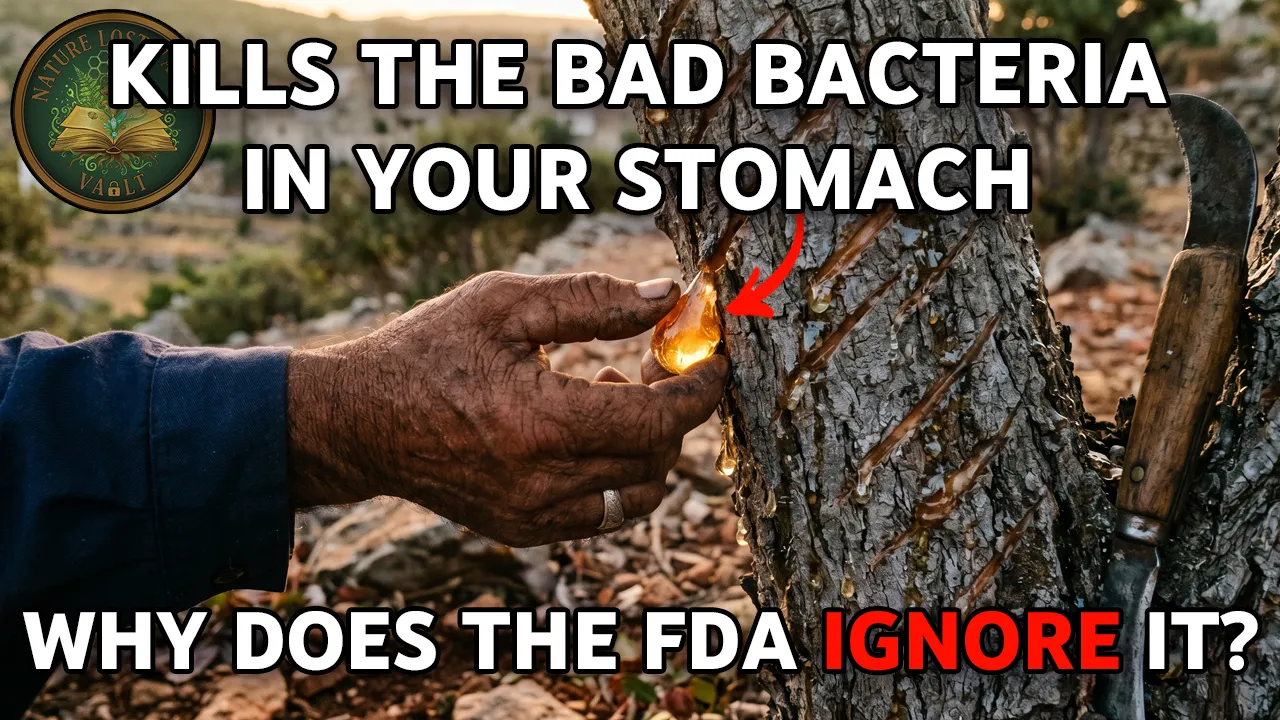
Table of Contents
What is Chios Mastic Gum?
Your pharmacy sells a drug cocktail that costs $500 and fails in one out of every five patients. A farmer on Chios is collecting the cure with his hands.
On the southern coast of a small Greek island in the Aegean Sea, he walks into a grove of low evergreen trees before dawn. He carries a small curved knife. He scores five shallow cuts into the bark of each tree. By noon, clear amber droplets are forming along the wound, catching the light like frozen honey. They call them the tears of Chios. He collects them one by one, the same way his grandfather did, and his grandfather before him, for roughly 2,500 years.
This is Chios mastic gum, the dried resin of Pistacia lentiscus var. Chia, an evergreen shrub in the cashew family (Anacardiaceae). The droplets kill a bacterium living in the stomachs of half the people on Earth. The bacterium causes ulcers. It causes gastric cancer. The World Health Organization classifies it as a Class I carcinogen, the same category as asbestos and tobacco smoke. By 2040 it is projected to kill more than 1.3 million people a year worldwide, more than breast cancer and prostate cancer combined. Mastic kills it at concentrations smaller than a grain of sand dissolved in a glass of water, and it works against strains that have evolved resistance to every modern antibiotic on the market. The New England Journal of Medicine published the proof in 1998. Most American doctors have never heard of it.
| Metric | Value |
|---|---|
| Botanical name | Pistacia lentiscus var. Chia |
| Family | Anacardiaceae (cashew family) |
| Origin | Southern Chios, Greece (24 villages, "Mastichochoria") |
| Earliest documented use | 5th century BCE (Herodotus, Egyptian embalming) |
| First written prescription | ~400 BCE (Hippocrates) |
| Active compounds | Isomasticadienolic acid + 80+ bioactives |
| H. pylori MIC (1998 Nottingham) | 0.06 mg/ml (1000× reduction in viable bacteria) |
| 2023 Egyptian RCT eradication | 63.3% (triple therapy) → 92.2% (triple + mastic) |
| Standard digestive dose | 350 mg, 3× daily for 14 days (capsules) |
| Cholesterol trial dose | 5 g/day for 18 months (Nutrients, 2024) |
| Plaque reduction (oral health) | >40% reduction in S. mutans |
| EU regulatory status | EMA-approved traditional herbal medicine (2016) |
| UNESCO status | Intangible Cultural Heritage of Humanity (2014) |
| EU origin protection | Protected Designation of Origin (PDO) |
| Drying time | ~20 days, traditional method unchanged |
2,500 Years of Continuous Use
The archive opens in the 5th century BCE. The Greek historian Herodotus, writing the first known work of history in the Western world, documents that Egyptian embalmers use a gum imported from a Greek island to preserve the bodies of their dead. Archaeological analysis of Egyptian mummies dating back more than 2,700 years has since identified the residue on linen wrappings. It is Chios mastic.
Around 2,400 years ago, Hippocrates, the Greek physician who founded Western medicine, prescribes the same resin for indigestion, for stomach pain, for respiratory infections, and for freshening the breath. He calls it by a single Greek word: mastichein, meaning to chew. The word mastic, the word masticate, and the English word chewing gum all descend from this one Greek verb.
In the 4th century BCE, Theophrastus catalogs the mastic tree in Enquiry into Plants, the founding text of Western botany. He notes that the resin only forms in significant quantities on one stretch of coast on one island. This remains true today. Every attempt to transplant Chios mastic, including botanical gardens in Turkey 8 nautical miles away, has failed to produce commercial-quality resin.
Around 2,000 years ago, the Greek physician Dioscorides catalogs mastic in De Materia Medica, the pharmaceutical reference that remains the standard medical textbook in Europe for the next 1,500 years. He prescribes it for the stomach, for the gums, for wounds that will not heal, and for what he describes as the corruption of the teeth.
In the Byzantine Empire, from the 4th century through the 15th, the mastic trade is controlled directly by the Emperor. The price, at its peak, matches the price of gold by weight.
In 1493, on a return voyage from the Caribbean, a Genoese sailor named Christopher Columbus writes a letter to the treasurer of Aragon announcing the discovery of the New World and noting, in the same letter, the existence of mastic trade on Chios. He had visited the island years earlier to recruit sailors. He knew exactly what the resin was worth.
In 1566, the Ottoman Empire conquers Chios. The Sultan immediately places the 24 mastic villages, the Mastichochoria, under the direct control of the Valide Sultan, the Sultan's mother. The villages are built as fortresses. No doors open to the street. Residents enter their homes by ladder and pull the ladder up behind them. The entire architecture of these villages exists to protect a single plant's resin.
In 1822, during the Greek War of Independence, the Ottoman army arrives on Chios and executes one of the largest massacres in 19th century Europe. 42,000 civilians are killed. The 24 mastic villages are spared by direct order of the Sultan. He still wants the resin.
By 2014, the traditional cultivation of Chios mastic is inscribed by UNESCO as an Intangible Cultural Heritage of Humanity. The European Union grants it Protected Designation of Origin status. Only resin harvested from the southern strip of Chios can legally be sold as Chios mastic anywhere in the European Union.
Every empire that conquered Chios tried to own the mastic. None of them stopped harvesting it. The continuity is unbroken. The only place in the world where this medicine has been forgotten is the United States.
Modern Science: H. pylori, Cholesterol & More
To understand why mastic was buried in the United States, you have to understand what happened in 1982. Two Australian scientists, Barry Marshall and Robin Warren, published a paper claiming that most stomach ulcers were not caused by stress, diet, or excess acid. They were caused by a bacterial infection. They named it Helicobacter pylori. The medical establishment rejected the claim for over a decade. In 1984, Marshall drank a petri dish of H. pylori cultures himself to prove the theory. The pair received the Nobel Prize in Physiology or Medicine in 2005.
The $9.7 Billion Industry That Fails 1 in 5 Patients
The moment the bacterial cause of ulcers was proven, an entire pharmaceutical industry pivoted. Antacids were replaced by a new protocol: triple therapy. A proton pump inhibitor to suppress stomach acid, plus two antibiotics to kill the bacteria. The prescription costs between $400 and $600 per course. The global market for H. pylori eradication therapies is projected to reach $9.7 billion by 2033.
By the early 2000s, the first cracks appeared. H. pylori was evolving resistance. By 2015, clarithromycin resistance alone was reducing treatment success rates by up to 50%. The American College of Gastroenterology formally recommended against standard triple therapy in most regions of the world. Today, the eradication rate of first-line triple therapy is below 80%. More than 20% of patients experience treatment failure, and the industry's answer has been to pile on more antibiotics, more expense, and more resistance.
1998: The Nottingham Letter to NEJM
In December 1998, in a letter to the editor of the New England Journal of Medicine, a team led by Dr. Farhad Huwez at University Hospital Nottingham (UK) tested crude mastic gum against H. pylori in the laboratory. Not pharmaceutical-grade extract. Crude resin, exactly as the farmers of Chios have harvested it for 2,500 years. The results were extraordinary. Mastic killed H. pylori at concentrations of 0.06 mg/ml, with a thousandfold reduction in viable bacteria. It worked against strains that were already resistant to standard antibiotics. The letter closed with a single observation: the anti-peptic-ulcer properties of mastic, documented clinically for over 2,400 years, are at least partly explained by this direct bactericidal effect.
The paper was read by perhaps a few hundred gastroenterologists worldwide. No pharmaceutical company launched a mastic-based product, because mastic cannot be patented. The molecule responsible for the antibacterial activity, isomasticadienolic acid, occurs in the crude resin in its active form. There is no version a drug company can own.
2010: The Chios General Hospital RCT
A team at Chios General Hospital published a randomized controlled trial in Phytomedicine showing that mastic alone, at 1 g/day for 14 days, eradicated H. pylori in roughly 30% of patients with active infections. Mastic monotherapy outperforming nothing was already a clinically meaningful result for an unpatentable resin.
2023: The Egyptian Trial - 63.3% → 92.2%
In 2023, a team of Egyptian gastroenterologists published in the American Journal of Clinical Pathology the most important mastic trial yet. 180 patients, all confirmed H. pylori positive, randomized to two groups. Group A received the standard triple-drug antibiotic regimen alone. Group B received the same triple-drug regimen plus mastic gum. The standard regimen alone achieved 63.3% eradication. The regimen plus mastic achieved 92.2% eradication. Adding a piece of tree resin that has been harvested by hand for 25 centuries increased the eradication rate of a multi-billion-dollar pharmaceutical protocol by 29 percentage points. The paper was published in November 2023. The FDA has not updated its treatment guidelines.
Beyond H. pylori: Cholesterol, Skin, Plaque, IBD
The H. pylori research is only part of what mastic does:
- Cholesterol & metabolic markers - In a clinical trial published in Nutrients (2024), 5 g/day of mastic gum reduced total cholesterol, triglycerides, LDL cholesterol, and apolipoprotein B in human subjects over 18 months.
- Skin aging - A 2024 study showed mastic extract inhibits both elastase and collagenase, the two enzymes responsible for breaking down the structural proteins of skin, at concentrations competitive with pharmaceutical-grade compounds in expensive anti-aging creams.
- Oral health - Mastic has been documented reducing oral bacterial plaque by over 40%. Chewing a single small piece of resin for 15 minutes produces measurable reductions in Streptococcus mutans, the primary bacterium responsible for tooth decay.
- Inflammatory bowel disease - A 2007 study in the World Journal of Gastroenterology documented significant reductions in inflammatory markers in patients with Crohn's disease treated with mastic for 4 weeks.
Mastic contains more than 80 distinct bioactive compounds working in combination. No synthetic drug on the pharmaceutical market combines antibacterial, anti-inflammatory, cholesterol-lowering and anti-collagenase activity in a single molecule. The tree on Chios does. It has done it for 2,500 years, and nobody can patent it.
Why It Was Buried in the United States
In February 2016, the European Medicines Agency formally approved mastic gum as a traditional herbal medicinal product for mild dyspeptic disorders and minor skin inflammation. This is the highest category of approval available for a product with 2,500 years of continuous use but insufficient modern industry funding for full pharmaceutical trials.
In the United States, mastic gum is sold as a dietary supplement, unregulated, and typically unknown to the gastroenterologist who prescribed the antibiotics. The reason is straightforward and uncomfortable: there is no patent.
Every step of the regulatory pathway that brings a drug to market in the US is built on the assumption that the developer will recover the cost of clinical trials, hundreds of millions of dollars, through 20 years of patent-protected sales. Mastic violates that economics. The mastic tree only produces commercial-quality resin on one stretch of coastline on one Greek island. Every attempt to transplant it has failed. The active molecule, isomasticadienolic acid, occurs in the crude resin in its active form. There is no proprietary version a drug company can own.
Result: a 2,500-year-old medicine with peer-reviewed evidence of 92.2% H. pylori eradication when added to triple therapy sits in plain sight, sold as a supplement, ignored by the gastroenterology guidelines of the country with the highest per-capita H. pylori treatment spending on Earth. The pharmaceutical industry's $9.7 billion eradication market depends on continuing to prescribe drugs that fail in 1 of every 5 patients. There is no incentive to add a piece of resin that costs $20 a bottle to that protocol.
Chios mastic never left. We just forgot.
How to Use Mastic Gum (Forms, Dose, Sourcing)
Sourcing: How to Find Real Chios Mastic
Chios mastic is available in the United States and most of Europe. It is sold in two forms: whole resin tears (small, irregular, pale yellow crystals) and powdered capsules. The highest grade is called Grade A or Pitta mastic, graded by the Chios Mastic Growers Association.
If the packaging does not carry the Protected Designation of Origin (PDO) stamp from the European Union, it is not Chios mastic. It is likely lower-quality resin from another Pistacia species, and the clinical data does not apply to it. You can find authentic mastic in Mediterranean grocery stores, Middle Eastern specialty shops, and increasingly in health food stores.
For Breath Freshening & Oral Health
Chew a single small tear, about the size of a pea, for 15 to 20 minutes. Both the historical record and modern dental research confirm this works. The ancient Greek women who chewed mastic for white teeth were not wrong; they were 2,400 years ahead of the dental industry.
For Digestive Use & H. pylori (Capsules Only)
Chewing does not deliver the resin to the stomach. The clinical trials all used powdered mastic in capsule form, taken orally so the resin reaches the stomach intact.
- 1998 Nottingham protocol: 1 g/day for 14 days.
- 2010 Chios General Hospital trial: 350 mg, 3× daily for 14 days.
- 2023 Egyptian adjunct trial: 350 mg, 3× daily for 14 days, alongside standard triple-drug antibiotic regimen.
If you are currently on an H. pylori treatment protocol, do not stop the antibiotics on your own. The Egyptian data shows that adding mastic to the antibiotics is what produced the 92.2% eradication rate. Work with your gastroenterologist.
For Cholesterol Support
The trial dose was 5 g/day, delivered in capsule form, taken consistently over months (the 2024 Nutrients study ran for 18 months).
Safety
Mastic is well tolerated. No serious adverse events have been reported in any clinical trial to date. Mastic is in the same plant family as cashews and pistachios (Anacardiaceae); if you have a confirmed cashew or pistachio allergy, exercise caution. Pregnancy data is limited; consult a qualified practitioner before use during pregnancy or breastfeeding. As with any herbal medicine, mastic does not replace medical care; talk with your doctor before adding it to a prescribed treatment protocol.
Frequently Asked Questions
What is mastic gum and what is it used for?
Mastic gum is the dried resin of the mastic tree (Pistacia lentiscus var. Chia), an evergreen shrub that grows on the southern coast of the Greek island of Chios. The tree is scored by hand and produces clear amber droplets called the tears of Chios. The same trade has been continuous for at least 2,500 years. Hippocrates prescribed it 2,400 years ago for indigestion, stomach pain, respiratory infections, and oral hygiene. Modern research has documented bactericidal activity against Helicobacter pylori (the cause of most stomach ulcers and a Class I carcinogen for gastric cancer), reductions in total cholesterol, LDL, triglycerides and apolipoprotein B, anti-inflammatory effects in inflammatory bowel disease, and a >40% reduction in oral bacterial plaque. The European Medicines Agency approved mastic gum in 2016 as a traditional herbal medicinal product for mild dyspeptic disorders and minor skin inflammation.
Does mastic gum kill H. pylori?
Yes. The 1998 Nottingham study published in the New England Journal of Medicine (Huwez et al.) tested crude mastic against H. pylori in vitro and documented a thousandfold reduction in viable bacteria at concentrations as low as 0.06 mg/ml, including against strains resistant to standard antibiotics. A 2010 randomized trial at Chios General Hospital found that mastic monotherapy at 350 mg three times daily for 14 days eradicated H. pylori in roughly 30% of patients. The most important trial to date is the 2023 Egyptian RCT (American Journal of Clinical Pathology) of 180 confirmed H. pylori-positive patients: standard triple-drug therapy alone produced 63.3% eradication, and the same regimen plus mastic gum produced 92.2% eradication, a 29 percentage-point improvement. Do not stop antibiotics on your own; the data supports adding mastic alongside the prescribed protocol, under your doctor's supervision.
What is the correct mastic gum dosage?
Dosage depends on the goal. For H. pylori support, the published clinical protocols are: 1 g/day for 14 days (1998 Nottingham), or 350 mg three times daily for 14 days (2010 Chios General Hospital and 2023 Egyptian adjunct trial). For cholesterol support, the trial dose was 5 g/day in capsule form (Nutrients, 2024). For breath freshening and oral health, chew a single small tear (about pea-sized) for 15-20 minutes. Whole tears chewed in the mouth do not deliver enough resin to the stomach to address H. pylori; the digestive protocol requires powdered mastic in capsule form so the resin reaches the stomach intact. Mastic is well-tolerated and no serious adverse events have been reported in clinical trials to date.
How do you tell real Chios mastic from fake mastic gum?
Authentic Chios mastic carries the European Union Protected Designation of Origin (PDO) stamp from the Chios Mastic Growers Association. Only resin harvested from the southern strip of Chios known as the Mastichochoria (the 24 mastic villages) can legally be sold as Chios mastic anywhere in the EU. The highest grade is called Pitta mastic. Look for irregular pale yellow to translucent crystals, typically 1-3 mm in diameter, with a distinctive pine-cedar aroma when chewed. If the package does not show the PDO stamp or the Chios Mastic Growers Association certification, it is likely lower-grade resin from a different Pistacia species (often Pistacia lentiscus from outside Chios, Pistacia atlantica, or Pistacia khinjuk), and the clinical trial data does not apply to it.
Why is mastic gum not approved in the United States?
Because mastic cannot be patented. The mastic tree only produces commercial-quality resin on one stretch of coastline on one Greek island; every attempt to transplant it elsewhere, including botanical gardens in Turkey only 8 nautical miles away, has failed. The active molecule (isomasticadienolic acid) occurs naturally in the crude resin in its bioactive form, so there is no proprietary version a pharmaceutical company can own. Without patent protection there is no incentive for industry to fund the multi-hundred-million-dollar Phase III trials the FDA requires for drug approval. The European Medicines Agency approved mastic in 2016 as a traditional herbal medicinal product (a category that recognises >30 years of continuous medicinal use, including >15 years inside the EU). In the US, mastic is sold as an unregulated dietary supplement, typically unknown to gastroenterologists prescribing the standard antibiotic protocols.
Explore More Medicinal Plants
Discover ancient plants that healed civilizations before the pharmaceutical industry existed.
Browse Medicinal Plants Collection →