Wild Violet (Viola): The 2,000-Year Medicinal Herb Growing Free In American Lawns
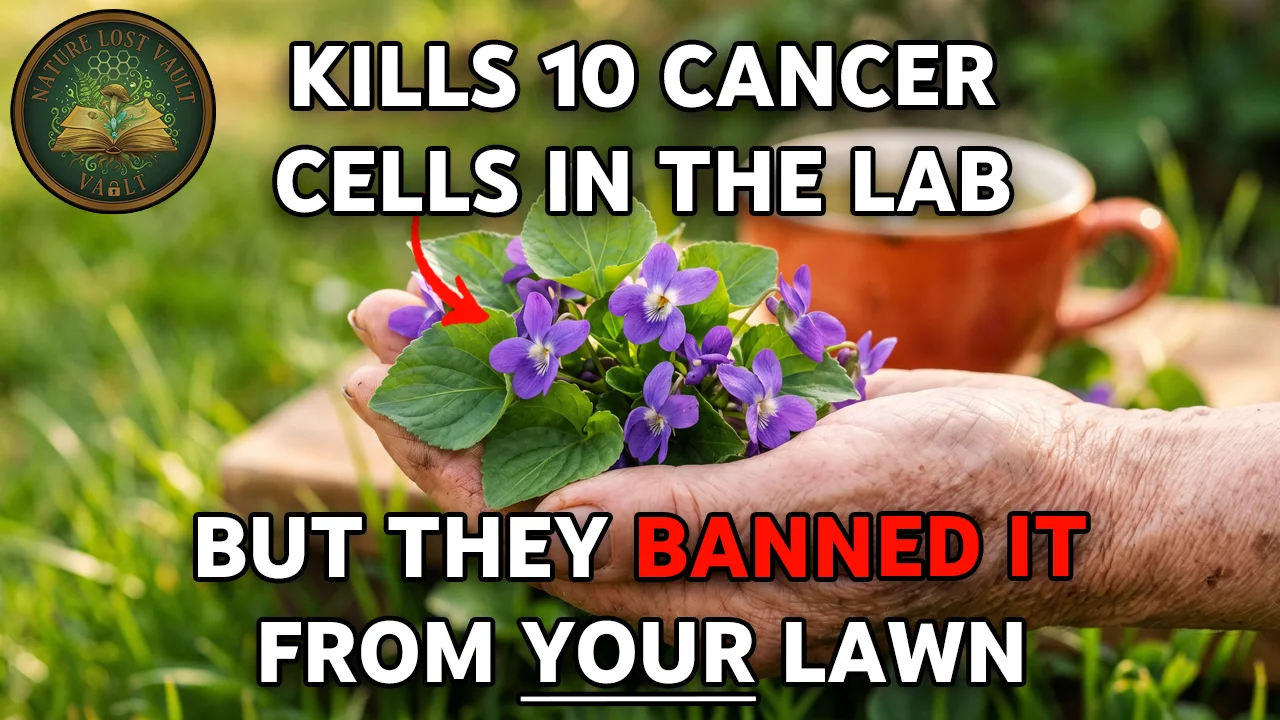
Table of Contents
Recommended Products:
Dried Wild Violet Leaves & Flowers
Wild Violet Seeds for Planting
Affiliate links - support our channel
What is Wild Violet?
Walk outside into any American lawn right now and look down. Those small, heart-shaped leaves growing between the blades of grass, the ones your herbicide label calls a "broadleaf weed," are an edible spring green that foraging guides describe as rich in vitamin C. The same leaf contains a molecule that researchers at Uppsala University in Sweden documented killing 10 different types of human cancer cells in the laboratory.
This is wild violet (genus Viola), primarily Viola odorata (the European sweet violet) and Viola sororia (the common blue violet of North America). It is the state flower of Illinois, Wisconsin, New Jersey, and Rhode Island. Dioscorides listed it in De Materia Medica nearly 2,000 years ago. Pliny the Elder recorded seventeen violet remedies. And since the Second World War, the lawn-care industry has built ever stronger herbicide blends to kill it, because it grows without permission and it cannot be patented.
| Metric | Value |
|---|---|
| Botanical name | Viola odorata, Viola sororia |
| Family | Violaceae (violet family) |
| Earliest documented use | 1st century AD (Dioscorides, Pliny) |
| Primary traditional uses | Anti-inflammatory, lymphatic, anti-tumor, cough |
| Key active compounds | Cyclotides (Cycloviolacin O2), rutin, salicylic acid, anthocyanins |
| Vitamin C (leaves) | Often cited as high; published figures vary |
| Best harvest window | April-May (young leaves & flowers) |
| Edible parts | Leaves & flowers (NOT the roots) |
| Modern research | 25+ years of peer-reviewed cancer & immune studies |
| Distribution | Every US state, Canada, Europe, much of Asia |
2,000 Years of Medicinal Use
The archive opens in ancient Greece. In the fifth century BC, the poet Pindar praised Athens as iostephanos, "violet-crowned," and violets were sold and worn in Greek garlands.
In the first century AD, the Roman naturalist Pliny the Elder gave the violet a whole chapter of remedies in Naturalis Historia, seventeen in all. The purple violet, he wrote, was cooling: laid on the forehead it eased headaches, and worn as a chaplet it "dispelled the fumes of wine." Around 2,000 years ago, the Greek physician Dioscorides catalogs the sweet violet in De Materia Medica, the pharmaceutical reference that remains the standard medical textbook in Europe for the next 1,500 years. Every physician in Europe, from Dioscorides to the Renaissance, is taught to recognize and prescribe it. Saxon monastic herbals list it. Medieval Persian medicine adopts it as banafsheh, and it passes into the Unani medicine of India as banafsha, still in use today.
By the 1930s, the violet had been in medicinal use for nearly 2,000 years. Yet it was about to disappear from the medicine cabinet within a few decades.
Modern Science: Cyclotides & Cancer Research
In 1999, a team of researchers at Uppsala University in Sweden began investigating a class of plant proteins called cyclotides. These are rings of amino acids bonded in a structure so stable they resist boiling water, stomach acid, and most enzymes that would destroy a normal protein. The richest source of cyclotides on Earth, the team discovered, was the common violet.
2002: Violet Cyclotides Kill 10 Human Tumor Cell Lines
The team published their findings in Molecular Cancer Therapeutics. They tested three cyclotides extracted from common violets against 10 different human tumor cell lines, including lung cancer, breast cancer, colon cancer, and leukemia. The most potent compound, a molecule called Cycloviolacin O2, killed tumor cells at concentrations matching the potency of modern clinical chemotherapy drugs. The mechanism was unlike anything in the existing cancer pharmacopoeia. The cyclotides did not interfere with DNA replication. They did not block cell division. They punched holes directly through the membrane of the tumor cell, causing it to rupture. But the test was in a dish. In 2010, the same Uppsala group injected cycloviolacin O2 into mice: at doses the animals tolerated it showed no significant antitumor effect, and at 2 mg/kg it was lethal.
2010: Re-Sensitizing Drug-Resistant Breast Cancer Cells
Researchers led by Sarah Gerlach at Tulane University added the violet cyclotide to drug-resistant breast cancer cells that had stopped responding to chemotherapy. The cyclotide did not just kill the cells. It re-sensitized them to the drugs. Cells that had been untouchable became vulnerable again the moment the violet compound was added.
2016: Expanding Evidence
In 2016, a team documented that a violet cyclotide induced programmed cell death in cervical cancer cells within 24 hours.
The Other Molecules in a Violet Leaf
The cyclotides are only one layer. Violet leaves also contain:
- Rutin, a flavonoid that strengthens capillary walls. This may explain its traditional use for varicose veins, bruising, and fragile skin.
- Salicylates, cousins of aspirin, occur in small amounts in the leaves. Which is why a violet poultice has been used for 2,000 years to reduce pain and inflammation.
- Mucilage that soothes a dry throat and gently thickens soups.
- Anthocyanins in the flowers, the same antioxidant pigments that give deep blueberry extracts their premium market price.
Over 25 years of peer-reviewed research, violet cyclotides have become a serious subject of laboratory study, mostly as stable scaffolds that may one day help scientists design better drugs. The violet itself is not a cancer treatment. And you cannot patent a violet.
Why It Was Buried
To understand what happened to the violet, you have to understand what happened to the perfume industry.
For most of the 19th century, the sweet violet was a major commercial flower crop in Europe. In Toulouse, France, entire hillsides were covered in violet fields. In Parma, Italy, dedicated growers produced violet essence that commanded prices higher than any other floral extract.
In 1893, two German chemists named Ferdinand Tiemann and Paul Krüger synthesized ionone, the aromatic compound responsible for the violet's scent, in a laboratory for the first time. They built it from cheap industrial chemicals in a matter of hours. The moment ionone could be manufactured, it could be owned. Synthetic violet replaced real violet in most fragrances. The flower trade lingered, but violet growing around Toulouse dwindled through the twentieth century to a handful of growers.
During the Second World War, researchers developed synthetic plant hormones that made broadleaf plants grow themselves to death. After the war, 2,4-D and other selective herbicides were sold to homeowners with the promise of lawns of pure grass. Dandelions fell. Clover fell. A stubborn purple-flowered plant did not.
The violet, with its waxy leaves and deep rhizome, resisted the first generation. The herbicide companies responded with entirely new chemicals: Triclopyr. Dicamba. Sulfentrazone. Today, university extension services, including the University of Tennessee in its Wild Violet Control in Turfgrass guide, rank the violet among the most difficult perennial broadleaf weeds in managed turf.
The lawn industry sells blends of three and four herbicides in a single product to get through the violet's waxy leaves. A plant with a 2,000-year medicinal record is now a target of an industry that would prefer you spray it, rather than pick it.
How to Identify, Harvest & Use Wild Violet
Identification
Walk outside. Find the heart-shaped leaves growing close to the ground in moist, shaded soil. Key traits:
- Heart-shaped leaves about the size of a silver dollar when mature, with a slight cupping toward the center and finely toothed edges.
- Flowers in April and May, 5 petals, typically purple, blue or white, on a separate stem from the leaves.
- Low-growing clumps spreading by rhizomes.
- Found in lawns, forest edges, hedgerows, shaded garden borders.
Both Viola sororia (common blue violet, North America) and V. odorata (European sweet violet) are edible and medicinal. Do not confuse wild violet with African violet (Saintpaulia), an unrelated houseplant that is not edible.
Harvest
Harvest the young leaves in early spring. A pair of kitchen scissors works best, allowing you to leave the rhizome undisturbed so it produces again next year. Take no more than one-third of any patch. The roots should not be eaten (mildly emetic). Only the leaves and flowers.
Spring Tonic Infusion (Traditional Preparation)
A simple spring-tonic preparation:
- Pack a jar loosely with fresh violet leaves.
- Cover with just-off-the-boil water (not fully boiling).
- Cover the jar and let it steep overnight.
- Strain in the morning.
- Drink one cup a day through the spring.
Lymphatic Oil Infusion
For the traditional external application used for swollen glands and bruises:
- Fill a jar with fresh violet leaves.
- Cover with high-quality olive oil.
- Set in a warm place for 6 weeks.
- Strain and bottle.
Apply externally to swollen lymph nodes, bruises, or fibrocystic tissue.
Flowers in the Kitchen
The flowers can be eaten raw in salads, candied for desserts, or steeped in white vinegar to produce the bright purple herbal infusion that has been a kitchen staple in France and Italy for centuries. Combine with a squeeze of lemon juice to turn it pink.
Establishing a Patch
A single established patch of violets, left alone in a shaded corner of your yard, will produce an unlimited harvest for the rest of your life. It spreads by rhizomes. It never needs to be replanted. It never needs to be fertilized. It requires exactly one thing from you: that you stop spraying it.
Safety Notes
Wild violet leaves and flowers are edible and non-toxic. The roots are mildly emetic and should not be eaten. Violet is generally considered safe for most adults, including during pregnancy in culinary quantities, but medicinal doses are not recommended during pregnancy without professional guidance. Lesser celandine and wild ginger, which grow in the same damp spring habitats, are toxic lookalikes, so identify violets in flower. Always identify with certainty before consuming any wild plant, and never harvest from sprayed lawns or roadsides.
Frequently Asked Questions
What is wild violet and what is it used for?
Wild violet (genus Viola, primarily Viola odorata and Viola sororia) is a low-growing perennial herb with heart-shaped leaves and purple 5-petaled flowers. It has a medicinal record of about 2,000 years: Dioscorides listed it in the first century AD, and Pliny the Elder recorded seventeen violet remedies. Traditional uses include lymphatic support, sore throats, coughs, swollen glands, fibrocystic breast tissue, skin conditions and bruising. Modern peer-reviewed research from Uppsala University (2002) documented that violet cyclotides (ring-shaped proteins) kill 10 different human tumor cell lines in vitro, and a 2010 Tulane study found one restored drug sensitivity in resistant breast cancer cells. In mice, however, the lead cyclotide was toxic and showed no significant antitumor effect at tolerable doses. The leaves are often described as rich in vitamin C, but published figures vary.
How do you make wild violet leaf tea?
A simple spring-tonic preparation is an overnight infusion. Pack a glass jar loosely with fresh wild violet leaves (harvested in April or May), cover with water just off the boil (not fully boiling), cover the jar and let it steep overnight. Strain in the morning. Drink one cup per day through the spring as a tonic. For dried leaves, use 1 to 2 teaspoons per cup of near-boiling water and steep 15 minutes covered. The finished tea has a mild, slightly mucilaginous texture and grassy-sweet flavor.
Is wild violet edible and safe to eat?
Yes, the leaves and flowers of both the common blue violet (Viola sororia) and the European sweet violet (Viola odorata) are edible and non-toxic. The leaves are commonly added to spring salads, steamed like spinach, or dried for tea. The flowers can be eaten raw in salads, candied, or steeped in vinegar for bright purple infusions. IMPORTANT: only the leaves and flowers are edible. The roots (rhizomes) are mildly emetic and should not be eaten. Do not confuse wild violet with African violet (Saintpaulia), which is an unrelated houseplant and not edible. Always identify with certainty and avoid plants from sprayed lawns.
How do you identify wild violet?
Wild violet grows close to the ground in moist, shaded soil. Key traits: heart-shaped leaves about the size of a silver dollar when mature, with a slight cupping toward the center and finely toothed edges. Flowers appear in April and May, 5 petals, typically purple, blue or white, on a separate stem from the leaves. Plants form low clumps that spread by rhizomes. Found in lawns, forest edges, hedgerows and shaded garden borders across every US state, Canada, Europe and much of Asia. It is the state flower of Illinois, Wisconsin, New Jersey and Rhode Island.
What is Cycloviolacin O2 and what does it do?
Cycloviolacin O2 is a cyclotide, a ring-shaped protein of about 30 amino acids, isolated from the common violet by researchers at Uppsala University in Sweden. Unlike most proteins, its circular structure makes it extremely stable, resisting boiling water, stomach acid and digestive enzymes. In a 2002 study published in Molecular Cancer Therapeutics, Cycloviolacin O2 killed 10 different types of human tumor cells in the laboratory at concentrations matching clinical chemotherapy drugs. But in 2010 the same group tested it in mice: at doses the animals tolerated it showed no significant antitumor effect, and at 2 mg/kg it was lethal. Its mechanism is unusual: it punches holes directly through the tumor cell membrane, causing it to rupture. Subsequent laboratory studies (Tulane 2010 on drug-resistant breast cancer cells, and a 2016 study on cervical cancer cells) have expanded the research, mostly as templates for new drug design rather than as a remedy in themselves.
Explore More Medicinal Plants
Discover ancient plants that healed civilizations before the pharmaceutical industry existed.
Browse Medicinal Plants Collection →