The 'Food of the Gods'. Twice the Antioxidants of Blueberries. Growing Wild Across America for Free.
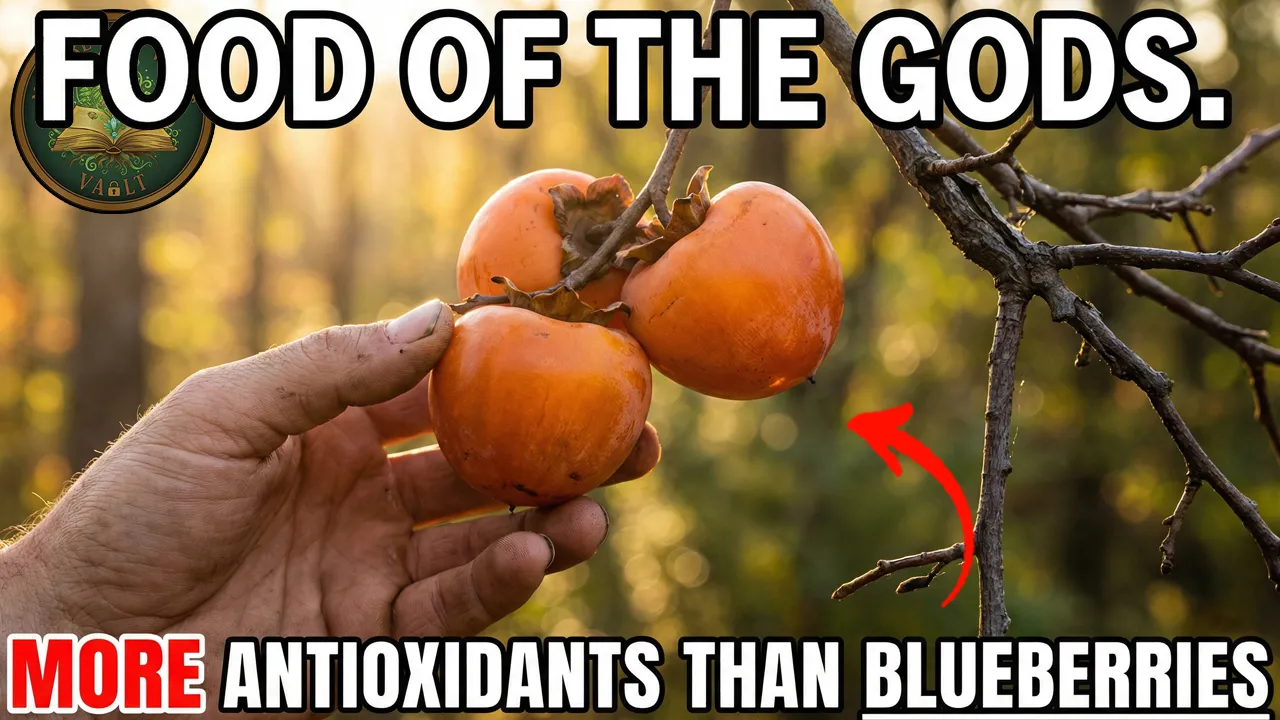
Table of Contents
- The Fruit Every Explorer Wrote Home About
- Pasimenan: A Continent Fed by One Tree
- Nine Times the Vitamin C of the Import
- 62 Years in the Pharmacopoeia, Then Silence
- The Japanese Import That Replaced It
- Betulinic Acid: What Is Not Proven
- The Civil War Tree
- A Thread Between Two Worlds
- When and How to Harvest
- Growing American Persimmon
Recommended: American Persimmon Trees & Seeds
View Persimmon Seedling View Persimmon SeedsAffiliate links - supports our channel
The Fruit Every Explorer Wrote Home About
In 1540, Hernando de Soto's army was marching through the Southeast searching for gold. What Native towns offered the Spaniards instead was bread: loaves "like bricks" made from the pulp of a fruit so sweet that the expedition's chronicler, the Gentleman of Elvas, wrote it down. John Smith described the same fruit at Jamestown in 1612. So did every explorer who followed. They all said the same thing: when ripe, it is as delicious as an apricot.
Then we replaced it with an import from Asia. And today, most Americans cannot even name it.
Pasimenan: A Continent Fed by One Tree
The archive opens with a word. Pasimenan. The English word persimmon comes from the Powhatan language of coastal Virginia, written down by colonists as pessemin and pasimenan, forms associated with dried fruit. Native communities across the continent had a brilliant technique. They picked these small orange globes in autumn and dried them slowly, drawing out the intense sweetness and pressing them into cakes that would last through the brutal winter. Cherokee families made bread from them. Rappahannock communities fermented them into beer. The Comanche and Seminole carried them on long journeys as concentrated trail food.
It was everywhere. It was completely free. It had a name in every language spoken east of the Mississippi.
The tree itself was extraordinary. Diospyros virginiana. In Greek, the name is often translated as "food of the gods." It grew without asking for anything. Sandy soil, heavy clay, flooded bottomlands, or dry ridgelines. It tolerated cold down to minus 20 degrees Fahrenheit and survived droughts without irrigation that killed everything around it. A single mature female tree dropped hundreds of pounds of fruit every autumn. Plant just one, and your grandchildren would still be harvesting from it.
Nine Times the Vitamin C of the Import
The fruit was a nutritional powerhouse. More than 30% natural sugar when ripe. Real fiber, carotenoids, and a striking amount of iron for a fruit. USDA figures put the ripe pulp at about 66 milligrams of vitamin C per 100 grams, against about 7.5 for the large Asian persimmon sold in supermarkets. Nearly nine times the vitamin C. Iron runs about 2.5 milligrams per 100 grams against 0.15 for the Asian fruit, more than sixteen times as much.
The fruit growing wild in millions of American backyards, climbing fence lines and roadside ditches from Connecticut to Texas, carries nearly nine times the vitamin C of the imported persimmon you pay for at the grocery store. It has always been there.
62 Years in the Pharmacopoeia, Then Silence
The fruit was officially listed in the United States Pharmacopoeia from 1820 to 1882. For 62 years, American medicine officially recognized it as a legitimate clinical treatment. The bark was used to treat fevers, gastrointestinal infections, and open wounds. Persimmon decoctions appeared in physician manuals across the South and Midwest.
Then, in 1882, it was quietly removed. No scandal. No study proving it ineffective. It simply disappeared from the official record. And within a decade, something arrived to take its place.
The Japanese Import That Replaced It
In 1856, ships returning from Commodore Matthew Perry's expedition to Japan carried persimmon seeds. Not the native American persimmon. A different species entirely. Diospyros kaki. It was larger, firmer, and could be picked before fully ripe, packed into wooden crates, and shipped across the country without bruising. It looked like something you could charge money for.
From 1870 onward, the U.S. Department of Agriculture imported grafted trees of improved Japanese cultivars and distributed them to California and the Southern states.
The native American persimmon received none of it. Research stations tested native varieties briefly in the 1890s. Then stopped. No breeding program. No federal investment. No extension support. The American persimmon, which grew freely across 26 states and could not be corralled into a commercial supply chain, was left to the roadsides.
Betulinic Acid: What Is Not Proven
Persimmons are often linked online to betulinic acid and melanoma research. The well-known laboratory work on betulinic acid and melanoma cells (Pisha et al., 1995) used the compound from a different plant, and no link between eating persimmon fruit and cancer outcomes has been shown. What the record does show is simpler: the Pharmacopoeia listed persimmon from 1820, and Native communities pressed it into bread and carried it through winter long before that.
Why does the fruit with nearly nine times the vitamin C of its imported cousin, with 62 years of official medical recognition, grow only in roadside ditches and forgotten fence lines? Because it cannot be owned.
The Civil War Tree
During the Civil War, when Union naval blockades cut off all imported goods, Confederate soldiers roasted and ground persimmon seeds as a coffee substitute so convincing that newspapers claimed experienced drinkers could not tell the difference. They cut the same seeds into uniform buttons. When everything else was gone, this tree provided everything.
That is exactly what made it dangerous to the system that replaced it. A tree that grows without irrigation, without purchase, without permission, that provides food, medicine, fuel, and clothing from a single planting, has no place in a market built around dependency.
A Thread Between Two Worlds
Enslaved Africans in the American South recognized the persimmon immediately. They knew it as a close relative of the West African ebony family. They adopted it into their diet and their medicine because it was already familiar. Persimmon beer, brewed across the South, is well documented. It was a thread connecting two worlds through a single native tree. That connection required no laboratory. It required patience.
When and How to Harvest
The American persimmon is ripe only when it falls. Not when it turns orange. Not when the first frost hits. Only when it releases from the branch and drops to the ground beneath the tree.
Eat it before that moment and the tannins will make your mouth pucker so hard you will not forget it for a week. But in those final days of ripening, those tannins convert entirely into pure sweetness. Caramel. Honey. Brown sugar and tangerine. People who taste a fully ripe wild American persimmon for the first time all say the same thing. They cannot believe this has been missing from their lives.
Finding it is not difficult. It grows wild in 26 states. Its bark is unmistakable, deeply furrowed into small rectangular blocks that look exactly like alligator skin or broken charcoal. Look at roadsides, woodland edges, and old fencerows. It prefers the edges of things, which is exactly where forgotten knowledge always hides.
Growing American Persimmon
Named cultivars are available for home planting. Early Golden. Prok. Meader, selected by Dr. Elwyn Meader at the University of New Hampshire in 1947, specifically bred to survive minus 25 degrees Fahrenheit and still produce sweet fruit through cool northern summers. These are not museum pieces. They are productive trees available from nurseries right now.
Plant one this fall. Come back in a few years. When the leaves drop and the bare branches hang with small orange globes in October, wait for the fruit to fall. Then taste what John Smith tasted. Taste what Hernando de Soto's men tasted in 1540.
The American persimmon never stopped being the food of the gods. We simply forgot what that meant the moment we decided that something free, powerful, and unshippable had no place in our modern market. Its vitamin C still runs nearly nine times that of the import. Its cold hardiness is still extraordinary. It asks for nothing. It is still there. Hanging in the October light. Waiting.
Explore More Survival Foods
Discover forgotten foods that sustained civilizations for millennia.
Browse Survival Foods Collection →