
More Antioxidants Than Blueberries, Acai & Goji Combined. They Couldn't Patent It.
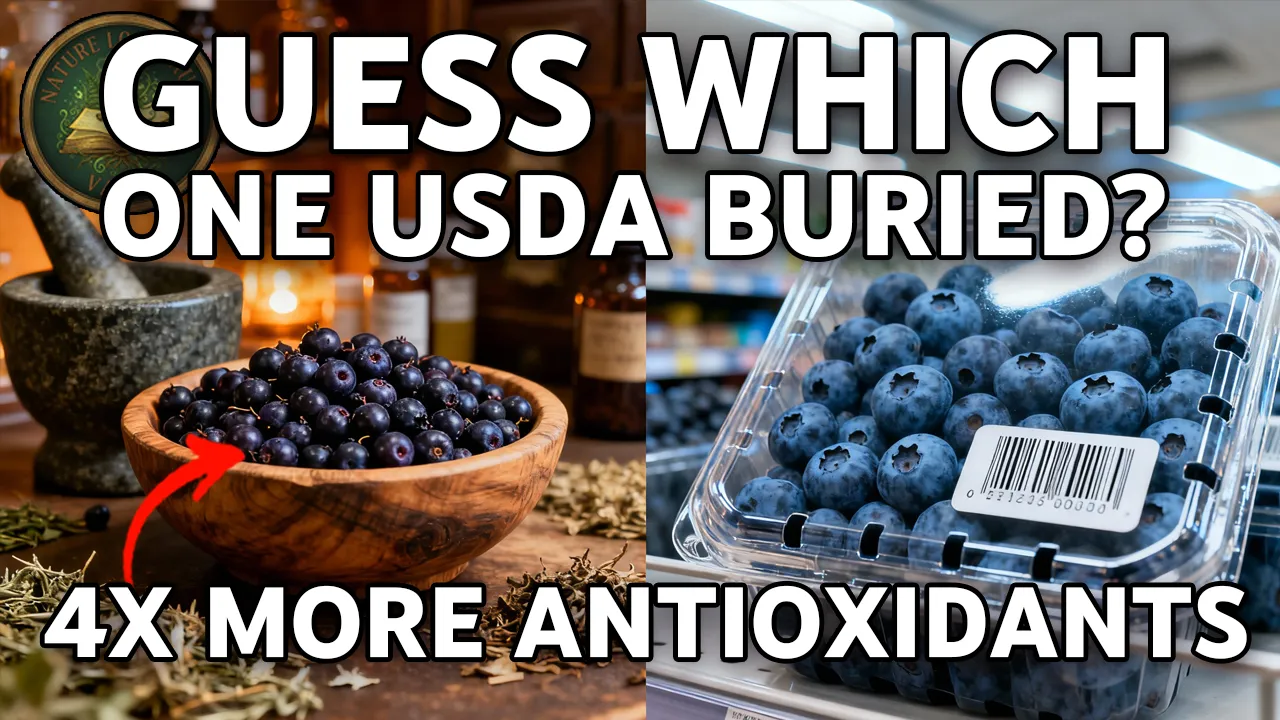
Table of Contents
Recommended Product: Aronia Berry seeds and growing supplies
View Aronia Berry OptionsAffiliate link - supports our channel
What is Aronia Berry?
There is a fruit native to North America that makes the blueberry look like a fraud. It grows wild from the Great Lakes to the Carolas. It contains four times the antioxidants of blueberries. In 2020, the USDA ranked it number one out of 276 foods for medicinal potency.
It creates its own medicine to survive pests, drought, and frost. And when we eat it, that medicine becomes ours. But you probably haven't heard of it. Or if you have, you know it by a name designed to make you hate it.
Settlers tasted it once, puckered their lips, and branded it choke berry. Because it wasn't sweet, they decided it was worthless. They cleared it from the land to plant crops that tasted like sugar. And in doing so, they erased the most powerful antioxidant factory in the temperate world.
This is the story of the berry we rejected because it was too strong for us. Welcome to Nature Lost Vault. The archive opens deep in the woodlands of eastern North America thousands of years before the first European arrived. To the Potoatomi, this berry was not a choke anything.
It was suquin. To the Abnaki, it was a staple of winter survival. To the Lakota, it was the secret ingredient in pemkin, a high energy survival food of dried meat and fat. The berries natural preservatives kept the meat from spoiling for years.
Indigenous peoples did not judge food by how sweet it was. They judged it by what it did. They knew that this dark purple black fruit was powerful medicine. The Cherokee brewed its bark to break fevers.
The Potterwati used the berries to cure colds that settled deep in the chest. They understood intuitively what modern science would take centuries to prove. The bitterness is not a flaw. The bitterness is the point.
Historical Context & Discovery
This is aronia (*Aronia melanocarpa*), the black chokeberry. In the 19th century, as settlers pushed west, they ignored the aronia bushes growing in the hedgerows. They wanted apples, pears, and peaches, fruits imported from Europe, bred for sweetness.
Aronia was pushed to the margins. But across the ocean, someone else was watching. In 1897, a Russian botonist named Ivan Maturin got his hands on this useless American berry. He didn't care about sugar.
He cared about survival. He was working in the harsh climate of the Al Thai Mountains, where delicate European fruits died in the frost. He saw Aronia's toughness. He saw that it thrived where everything else perished.
He began breeding it, crossing it with mountain ash to create larger, hardier fruits. He created Aronia miterini. While America was busy inventing soda and candy bars, the Soviet Union turned Aronia into a strategic crop. By 1946, it was an official fruit species of the USSR.
They planted it by the millions. They made juice, wine, and extracts for cosmonauts and soldiers. They recognized it as an adaptogen, a substance that helps the human body resist stress. Today, Poland grows 80% of the world's commercial aronia, 60,000 acres.
Meanwhile, in its homeland of North America, it was treated as a landscaping shrub, a decoration. Commercial cultivation in the United States didn't begin until 1997. We were a century late to our own superfood. So why did we ignore it?
Because we were seduced by a lie. The lie that healthy means delicious in the sugary sense. We have been trained to expect fruit to taste like candy. Strawberries, apples, and even modern blueberries have been bred for decades to be sweeter, larger, and waterier.
Scientific Research & Nutritional Benefits
In the process, they lost their medicine. Phytochemicals, the compounds that fight cancer, reduce inflammation, and protect the heart, are almost always bitter, astringent or sour. Tannins, polyphenols, anthsyanins. These are the plant's immune system.
When you taste that dry, puckering sensation in aronia, you are tasting the plants shield. In 2020, USDA scientists analyzed 276 foods using the OAC scale, oxygen radical absorbance capacity. It measures how well a food neutralizes free radicals, the molecules that cause aging and disease. Blueberries, the media darling, scored 4,600.
Aronia scored 16,000. Do the math. That is nearly four times the power. 30 Aronia berries deliver more protection than a massive bowl of supermarket blueberries.
And the specific compounds matter. Aronia is rich in pro-anthosanidins, the same compound found in red wine that supports heart health. But aronia has 10 times the concentration of grapes. In 2008, the Bulgarian Academy of Sciences ran a trial with diabetics.
After 90 days of drinking aronia juice, fasting blood glucose dropped by 17%. In 2017, the University of Illinois found it reduced insulin spikes. This berry is not just food. It is a metabolic regulator.
The agricultural industry does not like complex foods. It likes simple commodities. In 1948, the USDA launched massive subsidies for blueberry cultivation. They poured money into marketing, research, and breeding.
Why? Because blueberries are easy. You can snack on them by the handful. They fit the sweet profile.
They built a supply chain designed to ship watery, sweet blue orbs around the world. Aronia does not fit that model. You do not just pop a handful of raw Aronia berries. The tannins will dry your mouth out.
Aronia demands relationship. It demands processing. It wants to be cooked into a sauce, blended into a smoothie, fermented into wine, or dried for tea. It requires a culture that values preparation over instant gratification.
Industrial agriculture hates anything that slows down consumption, so they left it in the ditch. They denied it commodity status. While blueberry farmers get crop insurance and price supports, Aronia farmers are on their own. More than 50% of blueberries are sold through massive retail chains, but 34% of Aronia sales happen in person at farmers markets.
This keeps it small. This keeps it niche. But the erasia goes deeper than just economics. It touches on biopiracy.
Just like the wild rice of the Ojiway, Aronia faces the threat of theft. In 2022, biotech firms attempted to patent hybrid Aronia varieties using genetics taken from the wild without indigenous consent. They want to take the wildness out of it. They want to breed out the bitterness, patent the sweetness, and sell it back to us as a new superfood.
But resistance is growing and it is coming from the people who never forgot. In 2012, the Mesuaki Nation in Iowa launched a food sovereignty initiative. They are reclaiming Aronia not as a commodity but as a relative. They established Red Earth Gardens growing traditional foods to heal a community ravaged by diabetes and the legacy of boarding schools.
They are teaching their youth that medicine does not always taste like syrup. And then there is the commercial revival led not by corporations but by families. In 1997, the Pitts family in western Iowa looked at their heavy wet soil. It was useless for corn.
It would kill soy. So they planted the only thing that wanted to be there, aronia. They did not try to change the land to fit the crop. They changed the crop to fit the land.
They started the first commercial Aronia farm in the US. Today, there are hundreds of growers in the Midwest. The Iowa governor even declared September Aronia Berry Month, not because of lobbyists, but because of a grassroots movement. This revival proves something important.
We are tired of food that lies to us. We are tired of fruit that is bred for shelf life and sugar content but leaves us starving for nutrients. We are ready for the bitterness. Aronia breaks the rules of modern food.
It is perennial. You plant it once and it produces for 20 years. It requires zero nitrogen fertilizer. It has almost no natural pests in North America because it is native here.
It belongs here. While blueberry farmers are spraying fungicides and pumping groundwater to keep their bushes alive in climates they do not like, Aronia is growing in the roadside ditch, ignored, doing just fine. It produces 20 lb of fruit per bush. That is 30 cups of medicine every single year for free.
How to Identify, Grow & Use Aronia Berry
Compare that to the inputs required for a field of corn or a grove of almonds. Aronia is an exit strategy from industrial dependence. The story of Aronia is the story of our own pallet. We were taught to fear the choke.
We were taught to fear the dry, the bitter, the strong. But that dryness is the tannin binding to the proteins in your mouth. That bitterness is the antioxidant killing the inflammation in your blood. The plant is communicating with you.
It is telling you that it is strong enough to help you survive. We almost lost this berry, not because it went extinct, but because we forgot how to taste it. We let the Russians value our own heritage more than we did. We let the USDA convince us that only sweet things have value.
But the bushes are still there in the wetlands, in the forest edges, in the backyards of Iowa and the gardens of the messaki. They are waiting for us to grow up to realize that real food challenges us. Real food protects us. And sometimes cells, the best things in life, don't taste like candy.
They taste like the earth. This knowledge isn't lost. It is just ripening. If this vault opened something for you, subscribe to Nature Lost Vault and hit the bell.
Every like and every share helps preserve this wisdom. The next vault opens soon.
Frequently Asked Questions
How do aronia berries compare to blueberries?
Aronia berries contain 4x more antioxidants than blueberries, 3x more than acai, and more than goji berries. The USDA ranked aronia #1 out of 276 foods tested for medicinal potency based on antioxidant content.
What are the health benefits of aronia berries?
Aronia berries are extremely high in anthocyanins, which are linked to cardiovascular protection, anti-inflammatory effects, and blood sugar regulation. They also support immune function and have been studied for anti-cancer properties.
Why are aronia berries not more popular?
Aronia berries are extremely tart and bitter when eaten fresh, which limited commercial appeal. The blueberry industry received agricultural subsidies and marketing support, while aronia did not. Aronia cannot be patented since it grows wild across North America.
Explore More Medicinal Plants
Discover ancient healing plants backed by centuries of traditional use and modern science.
Browse Medicinal Plants Collection →