
The Hydraulic Ram Pump: The 1796 Invention That Pumps Water Uphill Forever
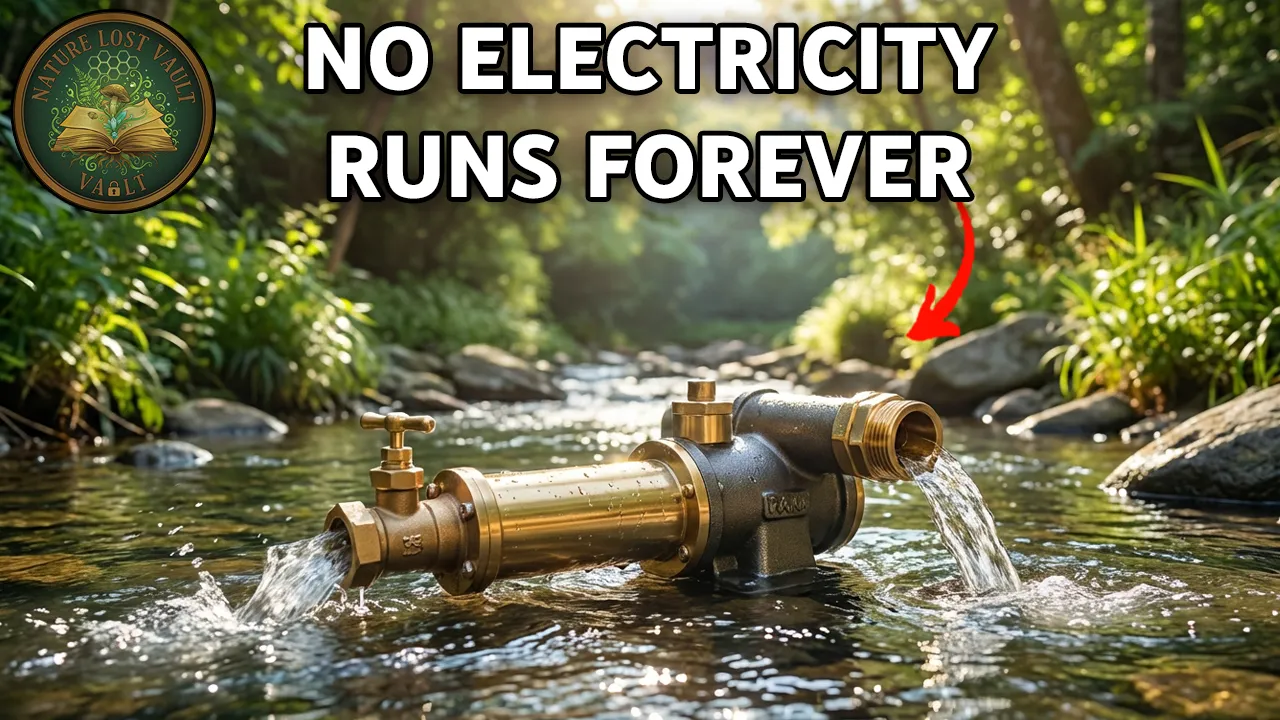

Table of Contents
The Man Who Gave Us the Sky and a Way to Survive
Joseph Michel Montgolfier was born in 1740, the 12th child of a French papermaker. One evening in 1782, he sat watching smoke curl toward the ceiling and asked himself what if a bag could be made large enough to catch that rising force and carry a man into the sky. On June 4th, 1783, Joseph and his brother Etienne launched the first hot air balloon ever to fly. The balloon rose to 3,000 feet and traveled over a mile.
But Joseph quietly went back to his paper mill. He had a more practical problem. The mill needed water. The river ran below in the valley, but the papermaking happened up above. He noticed something most people walked past every day. When flowing water is suddenly stopped by a shut valve, the momentum converts into a pressure spike so intense it travels back through the pipe like a shockwave. Plumbers called it water hammer. They considered it a nuisance. Joseph Montgolfier called it an engine.
In 1796, he built the world's first self-acting hydraulic ram, a device that weaponized the shockwave of water hammer to push a portion of water higher than it had any right to go. No electricity, no wind, no hands.
The Perpetual Pump of Portsmouth
Word traveled fast. Robert Fulton, who would later build the first practical steamboat, saw the device running in Paris in 1798 and described "a means of raising water from the beds of rivers by the simple movement of the stream without either pump or wheel. 40 feet high, two tubes, extremely simple." Matthew Boulton, partner to James Watt on the steam engine, took out a British patent on Montgolfier's behalf. Thomas Jefferson read about it and wanted one at Monticello.
In 1798, the people of Portsmouth, New Hampshire watched one run in their town water system and gave it a name: the perpetual pump. Newspapers reported it worked "by day and by night, at all times and in all seasons." A barrel of water every minute, endlessly, powered by nothing but gravity and flowing water.
How the Ram Pump Works
The mechanism is almost insultingly simple. Flowing water enters a drive pipe and runs downhill toward the pump. It picks up speed, rushing faster and faster until it escapes through a weighted valve at the bottom called the waste valve. As the water accelerates out, the drag becomes great enough to snap that valve shut.
That sudden shutdown of moving water creates a massive pressure spike. That shockwave forces open a second valve, driving a portion of the water up a delivery pipe much higher than the source. The shockwave passes, the second valve closes, the waste valve falls open again, and the cycle restarts. Click. Clack. Between 20 and 100 times a minute, every day, every year.
80 Years Underground at Heligan
By the late 1800s, hydraulic rams were everywhere. Josiah Easton's engineering firm supplied them to country houses, farms, and village water systems across the British Empire. One installation went into a grand estate in Cornwall called Heligan in 1880. Three ram pumps buried in an underground stone chamber pushed water continuously uphill to a 40,000-gallon reservoir. They ran for over 80 years without stopping.
In 1990, record producer Tim Smit was clearing the overgrown, abandoned gardens of Heligan. Eighteen feet underground, his crew found a stone doorway sealed with a century of mud. Inside were the three Easton pumps, perfectly intact. By 1994, the pipes were renewed and the century-old rams were overhauled. They were started and they ran. After more than 70 years of silence, the Victorian pumps pushed water back into the stone reservoir 24 hours a day without a single kilowatt of power.
How Electricity Erased It
The electric pump was faster and easier to install. You plugged it in and it worked anywhere. Rural electrification spread across America and a whole generation of mechanical wisdom was simply set aside. Not burned, just forgotten. But that simplicity was an illusion. The electric pump depends on a grid. The grid depends on utility companies, monthly bills, supply chains, and a system that can and does fail. The hydraulic ram depends on gravity. Gravity has never had a billing department.
By the 1960s, a technology that had supplied water to an empire had been reduced to an afterthought. The Easton Company, which once sold thousands of pumps a year, had shrunk to annual sales of just 1,500 pounds.
The Staggering Efficiency
For every one foot of fall from the source to the pump, a properly installed ram can lift water roughly 7 to 10 feet. With an 8-foot fall, you can push water 80 feet uphill. A modest stream with a 6-foot drop can deliver nearly 3,000 gallons of water per day to a tank on a hillside above your house. That is enough drinking water and irrigation for an entire off-grid homestead, running continuously without asking anything of anyone.
The trade-off is volume. The pump delivers between 10 and 30% of the water that drives it, while the rest spills harmlessly back into the stream. But that smaller volume pumps continuously around the clock, every day of the year.
How to Build One for Under $200
You need three things: a water source that flows at least two to three gallons per minute continuously, a drop in elevation of at least three feet from the source to the pump, and a destination where you want the water delivered.
You can build one from basic plumbing parts: a rigid drive pipe, a brass waste valve, a delivery check valve, and a pressure vessel made from a capped piece of PVC pipe with a bicycle inner tube inside to cushion the shockwave. Clemson University and North Carolina State agricultural engineers have documented the full build. Total parts cost under $200. No permits required in most jurisdictions because you are simply managing surface water on your own land.
Two Gifts in 13 Years
The same man who launched the first balloon, who showed humanity it could defy gravity and leave the ground, also invented a device that uses gravity to move water uphill forever. He gave us two gifts in 13 years. One took humanity into the sky. The other kept it alive on the ground. We remember the balloon. We teach it in schools. But the pump, which has moved more water and kept more communities alive than any balloon ever could, we quietly forgot.
You cannot sell electricity to a ram pump. You cannot bill its owner monthly. So it faded from agricultural schools, from engineering curricula, from the catalog of things worth knowing. But somewhere in a forgotten valley, a hydraulic ram pump is still thumping. Click. Clack. Day and night, at all times and in all seasons.
Explore More Building & Construction
Discover forgotten techniques that built civilizations for millennia.
Browse Collection →