
Hugelkultur: The Self-Watering Garden That Lasts 20 Years
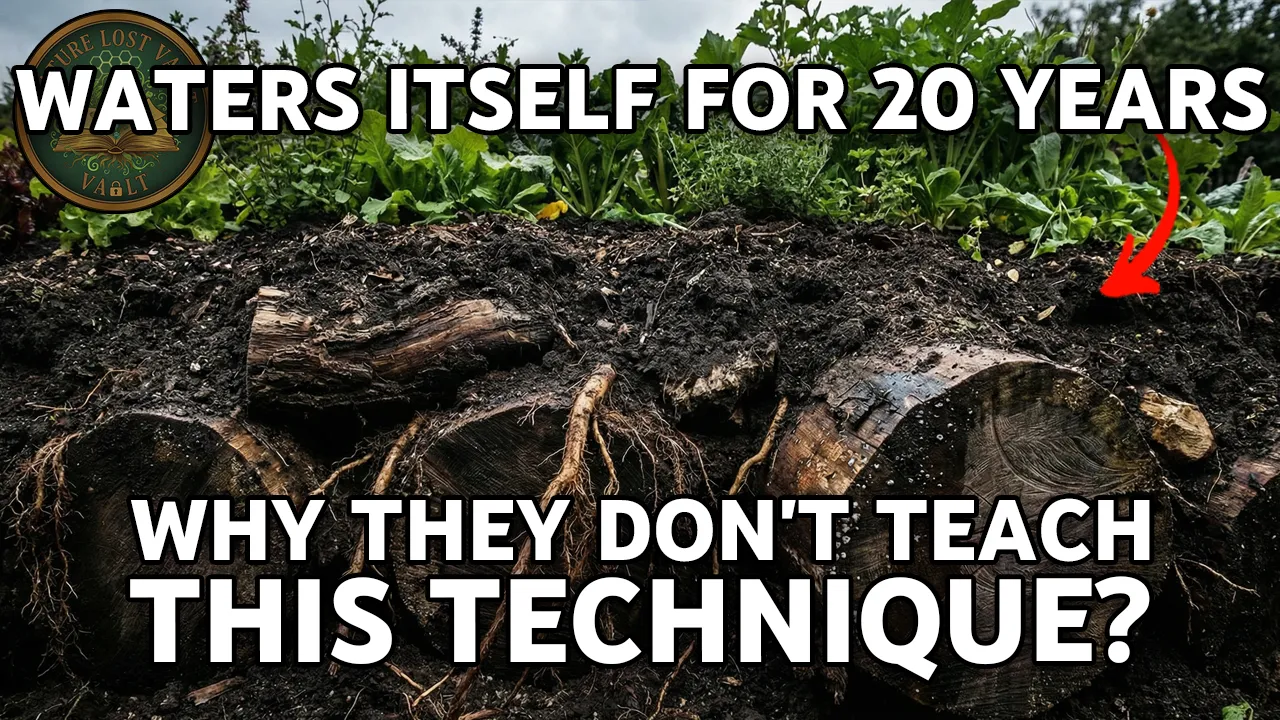

Table of Contents
- The Mound That Fed Medieval Europe
- Sepp Holzer: Lemons in the Snow
- The Science of Water Retention
- The Biological Heat Engine
- The Nitrogen Trap and the 20-Year Fertility Cycle
- Why Mechanization Buried It
- The Economics of a Buried Log
- How to Build a Hugelkultur Bed
- FAQ
The Mound That Fed Medieval Europe
In 1510, in the marshlands of Poland, peasants stood knee-deep in mud staring at land too wet to plow. Crops rotted before harvest. Animals sank into the ground. For generations, these wetlands had been starvation ground. Then an elder remembered an old technique passed down in whispers. Cut logs, lay them upon the marsh as if building a road. Pile mud and peat upon the logs, one or two spades deep. The logs keep feet dry and help soil drain freely.
They called it Hugel, the mound. Within months, the marsh bloomed. Root crops, beets, onions, radishes, and turnips erupted from soil that had never grown food before. Up to six harvests a year where nothing had grown at all. The technique spread across medieval Europe, through Germany, Eastern Europe, and the Alps, wherever waterlogged ground met desperate farmers.
The Codex Copernicus documented it explicitly: "Where land is too wet to be plowed, crops may still be grown. Dress gardens in autumn or after every crop. Cover the earth with rushes and weeds or gather leaves from the forest. These rot and make vegetable manure as good as cow dung." The instructions were precise, effective, and centuries old.
Sepp Holzer: Lemons in the Snow
In 1962, a farmer in the Austrian Alps took the technique to its extreme. Sepp Holzer inherited his parents' mountain farm, the Krameterhof, in the Lungau region of Austria. The elevation was 1,100 to 1,500 meters above sea level. The average annual temperature was 4 degrees Celsius. Winters reached minus 25 degrees. There were 170 frost days per year. Locals called it Austria's Siberia.
When Holzer tried conventional farming methods, they failed completely. So he went back to the book of nature. He began burying logs not just in marshes, but on steep alpine slopes, under terraces, and beneath every garden bed. He stacked oak and maple logs three feet high, packed them with branches and leaves, covered them with soil, and planted.
Within two years, something impossible happened. Lemons grew in the snow. Kiwis ripened at 1,500 meters. Grapes hung heavy on vines where neighbors could not even grow grass. Austrian agricultural authorities arrived with clipboards and fined him again and again. By the late 1980s, Holzer had been fined more times than any farmer in Austrian history. But his yields were undeniable. He harvested 45 hectares of forest gardens, 70 ponds, and thousands of fruit trees, all without fertilizer, irrigation, or pesticides. His farm produced ten times more food per acre than any conventional farm at that altitude.
The Science of Water Retention
Holzer understood something modern agriculture had forgotten: rotting wood is a sponge. In 2020, researchers at the Czarna Rosa Forest Reserve in Poland conducted water retention studies on decomposing wood. They tested five species across five stages of decay. The results were unambiguous. Heavily decomposed fir wood absorbed water equal to 500% of its dry weight. Fresh wood doubled its mass. Fully decomposed wood quintupled it.
The science explains what medieval peasants had observed. Wood's cellular structure, the lignin and cellulose, forms microscopic tunnels. As fungi and bacteria decompose the cell walls, these pathways widen. Water floods in. A 1996 study published in Geoderma found that decomposing wood increased water infiltration rates by 100 to 300% compared to surrounding soil.
Field measurements confirm it. Moisture probes driven into three-year-old hugelkultur beds in July during peak drought register 40 to 60% soil moisture, even when the surface cracks from heat. Six inches down, where the buried logs sit swollen with water, the soil is damp. One practitioner in the Pacific Northwest built a bed in 2019, stopped watering after the first year, and measured 35 to 45% moisture content even after six weeks without rain. She has not used a hose since.
The Biological Heat Engine
Hugelkultur is not just water storage. It is a biological heat engine. When microbes and fungi decompose wood, they release energy as heat. A decomposing log generates measurable warmth. In Holzer's alpine gardens, soil above buried logs registers several degrees warmer than surrounding ground. Seeds germinate earlier in spring. Frost passes harmlessly over mounds buffered by internal warmth. The growing season extends weeks beyond what the altitude should allow.
This is how Holzer grew lemons in the snow. He was not just farming the soil. He was farming the heat of decomposition. In temperate climates, this effect enables winter gardening. The decomposition heat keeps soil temperatures 5 to 10 degrees warmer than surrounding ground, the difference between frost-killed crops and a harvest in November.
The Nitrogen Trap and the 20-Year Fertility Cycle
Hardwood logs take 20 years to fully decompose. During that time, they release nitrogen, phosphorus, calcium, and potassium at a pace that matches plant growth. There is no flush and crash, no boom and bust, just steady, reliable nutrition for two decades.
But the nitrogen dynamics require understanding. Fresh wood is carbon-rich but nitrogen-poor. When you first bury a log, soil microbes need nitrogen to decompose it. If you do not add nitrogen-rich materials, the microbes will steal nitrogen from your plants. Your crops turn yellow. Growth stunts. This is called the nitrogen trap, and it is the most common hugelkultur mistake.
If you layer nitrogen-rich material with the wood, the system self-regulates. A 1993 study by Harvey and colleagues documented this in Pacific Northwest forests. Decomposing logs on the forest floor were not just releasing nitrogen, they were concentrating it. Free-living nitrogen-fixing bacteria colonized the rotting wood, pulling atmospheric nitrogen into the log and storing it there. By year three or four, the buried wood is actively fixing nitrogen from the air and feeding it to your plants for free for the next 20 years.
Why Mechanization Buried It
In 1920, agriculture mechanized. By 1915, 61 companies in the United States were manufacturing tractors. Production exploded. By 1930, tractors had replaced 24 million draft animals. The tractor required flat ground. Mounds slowed it down. Uneven terrain jammed plows. Buried logs were obstacles.
Farmers who had built hugelkultur mounds for generations faced a choice: keep the mounds and farm slowly, or level the ground and buy a tractor. In the 1890s, producing 100 bushels of wheat required 40 to 50 labor hours. By 1930 with a tractor, it took 15 to 20 hours. The speed advantage was insurmountable, but speed required sacrifice. Flat fields meant no water retention structures, no buried logs, no self-watering systems.
Instead, farmers needed irrigation. And when soil fertility depleted because the logs that had fed it were gone, they needed fertilizer. The global fertilizer market is now worth $27 billion. The irrigation equipment industry is $65 billion. Hugelkultur requires neither.
The Economics of a Buried Log
A $10 log buried in a trench produces vegetables for 20 years. Over its lifetime, it yields 5 to 10 pounds of produce per year. At retail prices of $3 to $5 per pound for organic vegetables, that is $300 to $1,000 of food from a $10 investment. Zero irrigation infrastructure. Zero fertilizer inputs. Zero annual costs.
A $100 investment in logs, manure, and soil produces two decades of vegetables. Compare that to industrial agriculture: the global irrigation market is $65 billion annually, fertilizer inputs are $27 billion per year. Hugelkultur requires neither.
You cannot patent a buried log. You cannot sell annual subscriptions to decomposition. You cannot make farmers dependent on your products when their garden waters and fertilizes itself for 20 years. That is not a product. That is a threat to $272 billion of annual revenue. So the technique was not banned, just quietly forgotten. Agricultural extension offices stopped teaching it. University programs focused on mechanized systems. Government subsidies flowed to tractor purchases and irrigation infrastructure. Within a single generation, a thousand-year-old technique disappeared from mainstream agriculture.
How to Build a Hugelkultur Bed
Mark out an area six feet by three feet. Dig a trench two feet deep. Some builders skip the trench entirely and just mound above ground. Both work. The trench matters most when you want stability.
Gather logs. Hardwoods are best: oak, maple, beech, birch. Choose logs 3 to 8 inches in diameter. Already rotting is better than fresh. Never use cedar, walnut, or treated lumber. These release compounds toxic to other plants and will poison the bed.
Stack the logs in the trench. Fill gaps with branches, twigs, and small wood. Pack it tight. Air pockets will become sinkholes later. Cover the wood with 4 to 6 inches of nitrogen-rich material: fresh grass clippings, composted manure, kitchen scraps, even urine diluted 10 to 1 with water. This step is not optional. Without nitrogen, the decomposing wood will steal it from your plants and your first-year crops will fail.
Cover the nitrogen layer with 12 to 18 inches of topsoil. Mulch heavily with straw, leaves, or wood chips. Water thoroughly for the first year while the logs saturate. Then wait 12 to 18 months. The logs absorb water. Fungi colonize. Bacteria tunnel. The wood swells. The system charges. By the second year, the bed is self-watering. By the third year, it is self-fertilizing. By the fifth year, it reaches peak productivity and continues for 20 years. Some growers report 30-year beds still producing.
Medieval peasants farmed marshes using logs laid across mud. They fed villages from wetlands that conventional farming could not touch. Sepp Holzer grew Mediterranean crops in alpine snow using nothing but buried wood and observation. The technique survived a thousand years. Then mechanization demanded flat fields and within decades, hugelkultur became something "weird people do" in backyard gardens. But the logs do not care about market share. They called it Hugel. The mound. Now you know why they tried to bury it.
Frequently Asked Questions
What is hugelkultur?
Hugelkultur is a raised garden bed built on a foundation of buried logs and branches. As the wood decomposes over 20 years, it acts like a sponge, absorbing rainwater and slowly releasing moisture to plant roots. After the first 1-2 years, the beds require little to no irrigation.
How long does a hugelkultur bed last?
A well-built hugelkultur bed produces food for up to 20 years. The buried wood decomposes slowly, continuously releasing nutrients and moisture. The bed actually improves over time as decomposition creates rich humus soil.
How do you build a hugelkultur bed?
Lay large logs on the ground, stack smaller branches on top, then cover with compost, leaves, and soil. The mound should be 3-6 feet tall. Use hardwoods like oak or maple for longest life. Avoid black walnut (allelopathic) and cedar (slow decomposition).
Explore More Building & Construction
Discover forgotten techniques that built civilizations for millennia.
Browse Collection →