
Self-Heal (Prunella vulgaris): The Lawn Weed Called Heal-All by Gerard in 1597 That a 2004 Study Showed Beats Acyclovir-Resistant Herpes
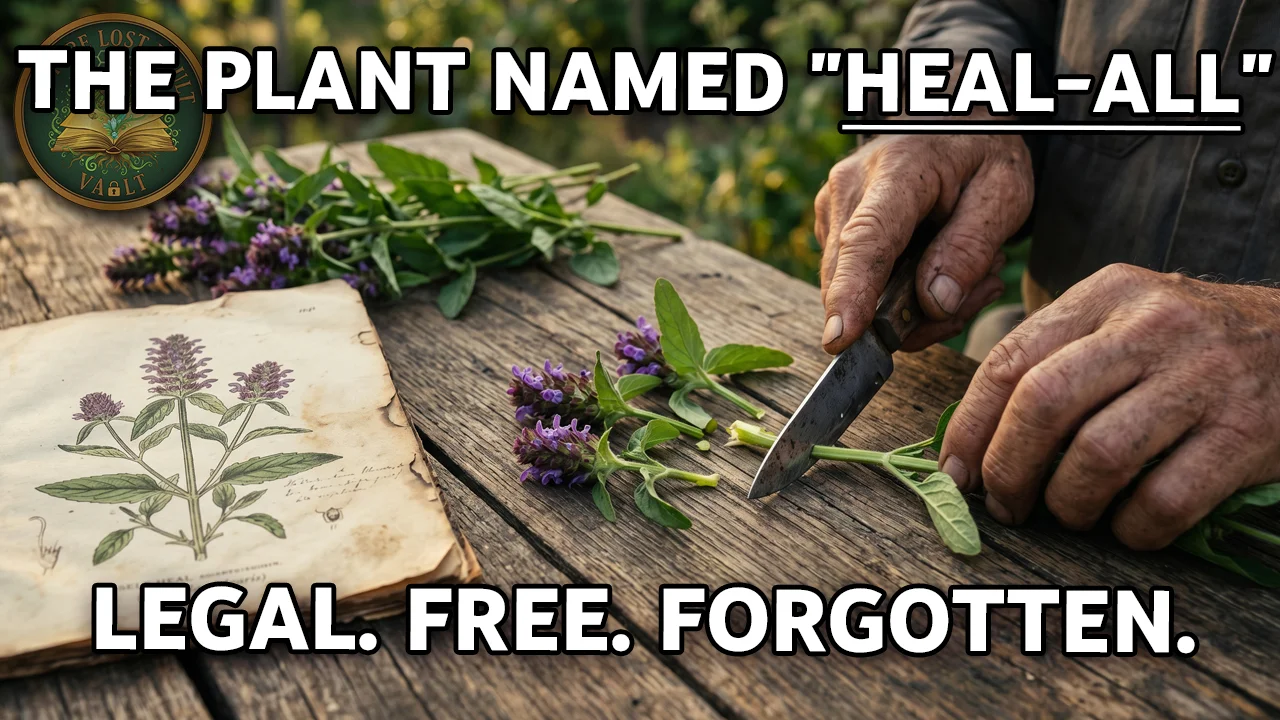
Table of Contents
What is Self-Heal?
In a laboratory today, it acts against strains of a virus that have outlasted the leading prescription drug. It was used as medicine on three continents for more than a thousand years. A Chinese pharmacy still fills prescriptions with it under a name older than the United States. The English gave it four names, and every single one of them is a promise. Self-heal. Heal-all. All-heal. Woundwort. And it is almost certainly growing in your lawn right now.
What almost no one in America knows is that a century ago, this plant, and nearly every plant like it, was written out of American medicine on purpose. Not by accident. By committee, on paper, with signatures. The schools that taught it were shut down. The textbooks that named it were shelved. The doctors who used it were relabeled as quacks. And within a single generation, a thousand years of human knowledge became a chore you pay a lawn service to handle.
The plant is Prunella vulgaris. A low perennial in the mint family (Lamiaceae) with a square stem, opposite leaves, and a short stubby spike of small purple hooded flowers. It turns up in lawns, along paths, and in the cracked edges of fields. Most people who see it call it a weed. Most people who have heard its name have no idea they are looking at it.
| Metric | Value |
|---|---|
| Scientific name | Prunella vulgaris |
| Family | Lamiaceae (mint family) |
| English common names | Self-heal, heal-all, all-heal, woundwort, carpenter's herb |
| Chinese name | Xia Ku Cao (still sold in modern Chinese pharmacies) |
| Etymology - genus | German "Braeune" - severe mouth and throat infection (the plant treated it) |
| Identifying features | Low, square stem, opposite leaves, stubby blunt spike of small purple hooded flowers all summer |
| Habitat | Lawns, paths, field edges, moist shaded woodland edges across most of the temperate world |
| Gerard 1597 (London) | "For healing wounds there is no better herb in the world" |
| King's American Dispensatory | Felter & Lloyd, 1898 - listed self-heal as standard Eclectic medicine |
| Three-continent record | European herbalists, Chinese physicians, Native peoples across North America |
| 2004 lab study | Journal of Ethnopharmacology - active vs herpes simplex types 1 & 2 in cells |
| 2004 IC50 (HSV inhibition) | ~20 micrograms per milliliter |
| Acyclovir-resistant strains | Self-heal fraction active against strains the standard prescription has stopped killing |
| 2024 mechanism paper | Chinese Medicine - blocks viral attachment + quiets inflammatory pathway |
| 2026 immune study | Journal of Integrative Medicine - activates the STING-TBK1-IRF3 antiviral pathway (cell study) |
| Flexner Report | 1910 - Abraham Flexner, Carnegie Foundation - reshaped American medical schools |
| AMA Council on Medical Education | Created 1904 - used Flexner Report as the standardizing weapon |
| Eclectic Medical Institute | Cincinnati - final class 1939, charter surrendered 1942 |
| Medical schools closed/merged | Nearly half of all American medical schools within a few decades after 1910 |
| Modern status in the US | Mowed, pulled, and sprayed as a lawn weed across all 50 states |
Gerard 1597, Xia Ku Cao & the King's American Dispensatory
London, 1597: "No Better Herb in the World"
London, fifteen ninety seven. The English botanist John Gerard sat down to write about the plants of his world. When he reached this one, he made a claim few herbs ever earned from him. For healing wounds, he wrote, there was no better herb in the world. He was not the first to say so, and he was nowhere near the last. Carpenters once kept it in the shop, pressing the crushed leaves onto the cuts they gave themselves with their own tools, which is why one of its oldest names is simply carpenter's herb. The botanical name, Prunella, comes from a German word for a brutal infection of the mouth and throat. The plant earned that title by being the thing people reached for when their throat closed up.
China: Xia Ku Cao
On the other side of the world, in the herb shops of China, the same plant has been weighed out and sold for centuries under the name Xia Ku Cao. The name translates roughly as "summer-dry-grass" - it is harvested in midsummer when the spike turns brown. It has been brewed into cooling teas, eaten as a green vegetable, and prescribed for liver heat, swollen lymph nodes, and inflamed eyes for more than a thousand years. Native peoples across North America used it too. Three continents, separated by vast oceans and languages, all looking at the same small purple flower and arriving at the same conclusion: this one matters.
1898: The King's American Dispensatory
The plant was not folklore in nineteenth-century America. It was official. Harvey Felter and John Uri Lloyd - the two most respected pharmacists of the era - included self-heal in the 1898 King's American Dispensatory, the massive reference that American physicians of the Eclectic school kept on their shelves. Thousands of US-trained doctors prescribed it as a routine wound-and-throat remedy. If the story had stopped in 1898, self-heal might still be in your doctor's bag today. But it did not stop there.
The 2004 Ethnopharmacology Study, the 2024 Mechanism & the 2026 Immune Study
2004: The Lawn Weed That Outlasted Acyclovir
For most of the twentieth century, that thousand-year record sat quietly, filed away as peasant folklore. Then the modern laboratories caught up. In 2004, a team of researchers publishing in the Journal of Ethnopharmacology took a fraction drawn from self-heal and tested it against herpes simplex, both type 1 and type 2, in infected cells. The plant compound cut the virus down. The amount needed to halve it was strikingly small - around 20 micrograms per milliliter. That alone was interesting. But here is the detail almost everyone missed.
The standard prescription drug for herpes is acyclovir. Over the years, certain strains of the virus have learned to survive it. Doctors call them acyclovir-resistant, and they are a real and growing problem, because when that drug stops working, the medicine cabinet runs out of answers. The self-heal extract worked on those resistant strains too. A plant from the lawn acted on the strains that have already beaten the pharmacy.
2024: How It Does This
In 2024, researchers writing in the journal Chinese Medicine traced how it does this. The plant compound appears to block the virus from latching onto the cell in the first place, and it quiets an inflammatory pathway the virus relies on to survive. It is not magic. It is cellular mechanism. The same kind of action that, in pharmaceutical practice, is hunted by an entire class of expensive prescription drugs.
2026: The Antiviral Alarm
In 2026, a team publishing in the Journal of Integrative Medicine traced how a self-heal polysaccharide complex protects cells against herpes simplex type 1. It activated the STING-TBK1-IRF3 pathway, the cell's built-in alarm system against viruses, which triggers interferons, the body's own antiviral signals. All of this is still cell and laboratory work; the plant is waiting for its first large Western trial in patients. You would think a lead like that would sit on every American researcher's desk. It does not. And the reason why is the real story of this archive.
Why It Stays Buried: The 1910 Flexner Report & the 1942 Charter Surrender
Cincinnati, Ohio. 1939.
Cincinnati, Ohio. Nineteen thirty nine. In a brick building that had trained American physicians for nearly a hundred years, the Eclectic Medical Institute graduated its final class. Three years later, in 1942, it surrendered its charter and locked its heavy doors for the last time. The Eclectics were not fringe. They were a serious American school of medicine built on botanical remedies, blending European folk practice with Native American knowledge. Their leading doctors compiled one of the most complete records of American plant medicine ever assembled - the massive 1898 King's American Dispensatory, which ran to thousands of plant entries. Self-heal lived inside that world.
The Flexner Report, 1910
So how does a hundred-year-old school of medicine simply die? It started with a single report. And at the time, it was sold to the public as a necessary reform. The Flexner Report, 1910. It was written by Abraham Flexner - an educator who had never practiced a day of medicine in his life - and it was funded by the Carnegie Foundation. Flexner traveled the country and inspected more than 150 medical schools, judging every one of them against a single rigid model: laboratory science, pharmaceuticals, and surgery. A school that taught plant medicine, or water cures, or homeopathy did not fit that model, and Flexner said so in plain, punishing language.
The AMA Council on Medical Education, 1904
He did not work alone. The American Medical Association had created its Council on Medical Education back in 1904. Historians who have studied the period have documented that the AMA had a clear financial reason to want fewer doctors competing for paying patients. The report gave the standardizing machinery exactly the weapon it needed. What followed was not subtle. Nearly half the medical schools in America closed or merged within a few decades. The botanical schools could not afford the expensive new requirements, and more to the point, they did not fit the new, officially sanctioned definition of medicine.
An Entire Pharmacopoeia Closed With Them
By the 1930s, only a handful were left. The Eclectic Institute in Cincinnati held on the longest. And then it too was gone. But this was never really about one school in Ohio. When those doors closed, an entire American pharmacopoeia closed with them. The plants were not disproven. They were delisted. Written out of the curriculum, out of the textbooks, and out of the training a young doctor would ever receive. It was not a smoky conspiracy with one villain in one room. It was something quieter, and far more permanent. A standard, written down in ink, that had no column for a wild plant. And here is where it reaches you directly. The forgetting was so complete that you finished the job yourselves. Self-heal still grows in American lawns from coast to coast. And every summer, millions of people mow it, pull it, and spray it as a nuisance. The plant the English literally called heal-all, you now pay a chemical service to remove.
How to Identify, Harvest & Use Self-Heal
Identification
So learn to see it. It grows low to the ground, usually under six inches tall in a mowed lawn (taller, six to twelve inches, in an unmowed edge). The stem is square, because the plant belongs to the mint family - you can feel the four edges if you roll a piece of stem between your fingers. The leaves grow in opposite pairs, lance-shaped to oval, with small rounded teeth on the margins. And the flowers gather into a short, blunt cylindrical spike at the tip of the stem all through the summer; each individual flower is small and purple with a hood. Once you have really looked at that flower spike, you will never again mistake it for grass. It turns up in lawns, along paths, in the cracked edges of fields, and at the moist shaded edges of woods - across nearly every state.
Harvest & Storage
The traditional use is simple. The leaves, stems, and flowers are gathered in summer when the flower spikes are open and the plant is at its highest concentration of active compounds. Cut the upper third of the stem with the flower spike attached, gather small loose bundles, and hang them upside down in a dry shaded place for about two weeks until the stems snap. Then strip the dried plant material into clean glass jars and keep them out of light. They will hold their potency through the winter. The same way people kept any common medicine before the pharmacy existed.
Tea & Throat Gargle
For tea: 1 to 2 teaspoons of dried self-heal in a cup of hot water, steeped 10 minutes, once or twice daily. This is the cooling daily preparation that Chinese herb shops have sold for centuries as Xia Ku Cao. For a sore-throat gargle: a stronger steep - 1 tablespoon per cup, 15 minutes, cooled - swished and gargled three or four times a day. This is the use that gave the plant its oldest folk names. For topical wound use (the carpenter's-herb application), bruise a handful of fresh leaves between clean palms and press the green pulp directly onto a clean superficial cut or scrape; cover lightly.
Safety
One honest caution. Self-heal draws up whatever is in the soil it grows in, so gather it only from clean ground that has never been sprayed with herbicide, fungicide, or insecticide. Public roadside lawns, golf-course turf, and chemically maintained suburban yards are not safe sources. Otherwise the plant has a very long traditional safety record across European, Chinese, and Native American medicine. Two further cautions: avoid in pregnancy without a clinician's guidance, and check for interactions if you take prescription anticoagulants or immunosuppressants. For a herpes outbreak, self-heal is supportive but not a substitute for medical evaluation of severe or ocular infections. You do not need a prescription to walk into your own front yard. You do not need anyone's permission to learn the name of a plant that has been standing there the whole time, in plain sight, while the report that wrote it out of the textbooks gathers dust.
Frequently Asked Questions
What is self-heal (Prunella vulgaris) and what is it used for?
Self-heal (Prunella vulgaris) is a low-growing perennial in the mint family (Lamiaceae) with a square stem, opposite leaves, and a stubby blunt spike of small purple hooded flowers. It grows in lawns, along paths, and at the cracked edges of fields across most of the temperate world. The English alone gave it four names that are each a promise of what it does: self-heal, heal-all, all-heal, and woundwort. Carpenters carried sprigs in their shops to press onto cuts they gave themselves with their own tools, which is why one of its oldest folk names is carpenter's herb. The genus name "Prunella" comes from the German word for a brutal mouth-and-throat infection. Three continents - European herbalists, Chinese physicians (who still prescribe it as Xia Ku Cao), and Native peoples across North America - independently used the same plant for wounds, sore throats, fevers, swollen glands, and inflamed eyes. Modern research has confirmed antiviral and anti-inflammatory activity, with documented effects against herpes simplex including acyclovir-resistant strains.
Does self-heal really work against herpes?
Yes, and that is the part doctors are not taught. In 2004 a team publishing in the Journal of Ethnopharmacology tested a fraction drawn from self-heal against herpes simplex types 1 and 2 in infected cells. The plant compound cut the virus down at a strikingly small dose - around 20 micrograms per milliliter to halve viral replication. More importantly, the self-heal fraction was active against acyclovir-resistant strains - the strains of the virus that have already learned to survive the standard prescription drug. In 2024 a paper in the journal Chinese Medicine traced the mechanism: the plant compound appears to block the virus from latching onto the host cell in the first place and to quiet the inflammatory pathway the virus relies on to survive. These are cell-culture results, not yet a trial in patients. In 2026 a study in the Journal of Integrative Medicine found a self-heal polysaccharide complex protects cells against herpes simplex type 1 by switching on the STING-TBK1-IRF3 pathway, the cell's built-in antiviral alarm.
Why isn't self-heal taught in American medical schools?
Because in 1910 it was written out of the curriculum by committee. The Flexner Report, written by Abraham Flexner - an educator who had never practiced medicine a day in his life - and funded by the Carnegie Foundation, traveled the country, inspected more than 150 medical schools, and judged each one against a single rigid model: laboratory science, pharmaceuticals, and surgery. Schools that taught plant medicine, water cures, or homeopathy did not fit that model and Flexner said so in plain, punishing language. The American Medical Association's Council on Medical Education (created 1904) used the report as the regulatory weapon. Within a few decades nearly half of American medical schools had closed or merged - and the botanical Eclectic schools, which had compiled the 1898 King's American Dispensatory and prescribed self-heal as standard medicine, could not afford the new requirements and did not fit the new official definition. The Eclectic Medical Institute of Cincinnati graduated its final class in 1939 and surrendered its charter in 1942. The plants were not disproven. They were delisted.
How do you identify self-heal in your lawn?
Four features taken together identify self-heal quickly. First, the plant grows low to the ground, usually under six inches tall in a mowed lawn (taller, six to twelve inches, in an unmowed edge). Second, the stem is square in cross section - you can feel the four edges if you roll a piece of stem between your fingers - which is the signature of the mint family. Third, the leaves are attached opposite each other on the stem, lance-shaped to oval, with small rounded teeth on the margins. Fourth, and most distinctive, the flowers gather into a short blunt cylindrical spike at the tip of the stem all through the summer; each individual flower is small and purple with a hood. Once you have really looked at that flower spike, you will never again mistake it for grass. It turns up in lawns, along paths, in the cracked edges of fields, and at the moist shaded edges of woods - across nearly every state in the United States.
How do you use self-heal, and is it safe?
Traditionally the leaves, stems, and flower spikes are gathered in summer when the spikes are open, dried in a shaded place for about two weeks, and stored whole in a glass jar. For tea: 1 to 2 teaspoons of dried plant material in a cup of hot water, steeped 10 minutes, once or twice daily. For a sore-throat gargle: a stronger steep (1 tablespoon per cup, 15 minutes), cooled, swished and gargled three or four times a day - this is the use that gave the plant its oldest names. The plant has a very long traditional safety record across European, Chinese, and Native American medicine, and it is mild enough that Chinese herb shops have sold it as a daily cooling tea for centuries. Two cautions. First, self-heal draws up whatever is in the soil it grows in, so gather only from clean ground that has never been sprayed or treated with herbicide or fungicide. Second, as with any plant medicine, avoid in pregnancy without a clinician's guidance, and check for interactions if you take prescription anticoagulants or immunosuppressants. For a herpes outbreak, the plant is supportive but not a substitute for medical evaluation of severe or ocular infections.
Explore More Medicinal Plants
Discover ancient healing plants backed by centuries of traditional use and modern science.
Browse Medicinal Plants Collection →