
450 Lbs of Food Per Year, Zero Effort: Why they weaponized this Slave Food
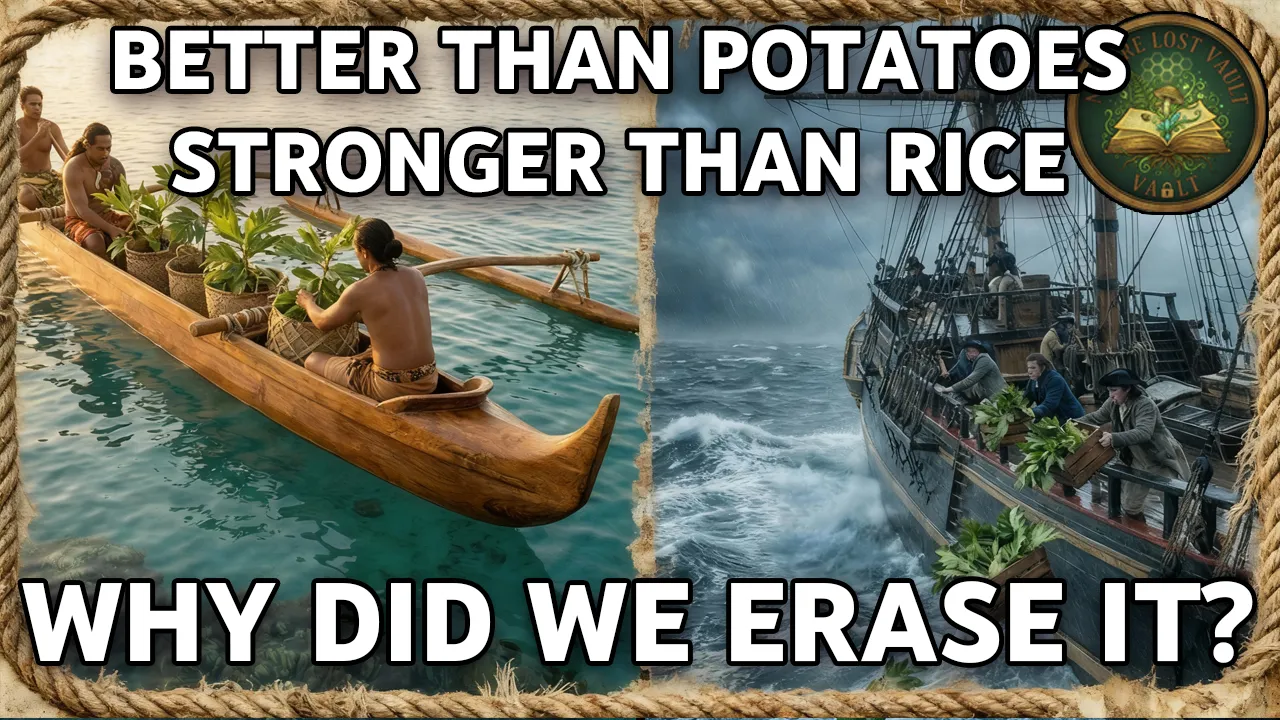
Table of Contents
Recommended Product: Breadfruit seeds and growing supplies
View Breadfruit OptionsAffiliate link - supports our channel
What is Breadfruit?
There is a tree that produces 450 lbs of food per year. It lives forever. Plant it once and harvest for 70 years. It survives storms that destroy corn and drought that kills wheat.
For 3,000 years, it fed entire civilizations without replanting. Then they weaponized it. They turned a gift of nature into cheap rations for the enslaved. It became a symbol of oppression, but the tree refused to be a tool of control.
The enslaved rejected it for 40 years. They fed it to pigs. This is the story of the tree they tried to weaponized just before we needed it most. Welcome to Nature Lost Vault.
The archive opens 3,000 years ago in the Bismar archipelago. a culture known as Laapita, the first people to sail into remote Oceanania. They traveled in outrigger canoes, crossing thousands of miles of open ocean without maps, without compasses, guided only by stars and waves. They carried with them the foundation of survival.
Pigs, chickens, dogs, tarot, yams, and a tree that would feed their descendants for millennia. Archaeological evidence from Easter Island reveals obsidian tools dated to 1,000 CE. Those tools were covered in starch residue. People were processing this fruit long before they carved the Moai statues.
The Lapita people spread it from the Solomon Islands across Polynesia from Melanesia to Micronesia. They knew what industrial agriculture forgot. This is the breadfruit (*Artocarpus altilis*), engineered by nature for one purpose: to feed continuously.
A single tree produces 450 lb of fruit per season. 14,000 lb per acre without irrigation. In calories per acre, bread fruit delivers 8.3 million calories. That is more than potatoes.
It nearly matches corn, the world's most important grain. One tree can sustain two adults for an entire year. The Polynesians called it ulu, the staff of life. They stored fermented bread fruit in leaf lined pits for 20 years.
Historical Context & Discovery
Some pits were reported to have edible contents after more than 20 years of burial. Families ate fresh bread fruit roasted, boiled, or baked. They ground dried breadf fruit into flour. They built houses from breadfruit wood.
They carved canoes from breadf fruit timber. The tree grew to 85 ft tall. Its massive leaves provided shade. Its wood resisted termites and shipworms.
No planting, no tilling, no fertilizer, just harvest. For 3,000 years, this was normal. Pacific Islanders thrived. No one went hungry.
Then Europeans arrived and they saw something different. Not a gift from nature, but cheap food for slaves. In 1769, British Captain James Cook arrived in Tahiti with botonist Joseph Banks. Their mission was to observe the transit of Venus, but Banks was distracted by a tree with massive fruits hanging from tall branches.
The Tahesians ate them daily. Banks tasted roasted bread fruit. The texture reminded him of fresh bread. The flavor was mild, starchy, filling.
Banks calculated that one tree produced enough food to feed a family. He returned to England with an idea. The British West Indies were starving. Between 1780 and 1787, Jamaica suffered alternating huracans and droughts.
Slave provision grounds were destroyed. The American Revolution had cut off food supplies from North America. 200,000 enslaved people died of starvation in 7 years. Plantation owners were desperate.
They needed cheap calories to keep their labor force alive. Banks proposed bread fruit abundant in Tahiti, nutritious, easy to grow and free. King George III commissioned an expedition in 1787, the ship HMS Bounty. The commander was Lieutenant William Bllye.
Scientific Research & Nutritional Benefits
His mission was singular. Transport breadf fruit from Tahiti to the Caribbean to feed it to enslaved Africans working sugar plantations. The Bounty sailed from Spithead on December 23rd, 1787. Bllye spent 5 months in Tahiti and converted the ship's great cabin into a floating greenhouse.
He collected 1,15 breadf fruit plants in wooden pots. The deck was covered with greenery. The crew called it a floating forest. On April 4th, 1789, the Bounty sailed west toward Jamaica.
3 weeks later, Fletcher Christian led a mutiny. The reasons remain debated, but the result was clear. Christian and 22 men seized the ship. They forced Bllye and 18 loyal men into a 23 ft open boat, and they threw every bread plant into the ocean.
1,5 trees were gone. The mutineers returned to Tahiti. Bllye navigated 3,600 m to Teour in an open boat. His mission was a failure, but the empire was relentless.
By 1791, Bllye was sent back to Tahiti, this time with two ships, more men, and more security. He collected 2,126 plants. The voyage was brutal with flies, salt spray, cold, and rationed water. 678 plants survived the journey to the Caribbean.
On February 5th, 1793, HMS Providence arrived in Jamaica. Bllye delivered bread fruit to Bath Botanical Gardens and distributed specimens to every parish. The trees flourished in Jamaican soil, dark volcanic earth, in a tropical climate with high rainfall. Within 2 years, breadfruit trees were springing up across every parish, fast growing and high yielding, requiring almost no care.
The plantation owners celebrated. The enslaved people would finally have cheap, abundant food. But there was one problem. The enslaved people refused to eat it.
They called it strange fruit, tainted by slavery, a symbol of their oppression. food forced upon them as cheap rations. It was not the taste. Bread fruit could be roasted, fried, boiled, turned into flour.
The texture was similar to potato. The flavor was mild and adaptable. It was the intention. Food cannot nourish when it represents bondage.
For 40 years, bread fruit was fed to pigs. Reports from the late 19th century confirmed that the fruit was not greatly favored and was given mostly to livestock. Only after slavery was abolished in 1834 did bread fruit slowly enter the Jamaican diet. Two generations had passed.
The association with slavery began to fade. Jamaicans began experimenting. Roasted bread fruit with butter and black pepper. Fried bread fruit for breakfast.
Boiled bread fruit in soups and stews. Breadf fruit chips. Breadf fruit porridge. Breadf fruit turned into flour for baking.
The descendants of those who rejected it as slave food transformed it into the soul of Jamaican cuisine. But the damage was done. Breadfruit carried the stain of colonialism across the entire Caribbean. Time could not change what bread fruit is.
It is high in complex carbohydrates, has more protein than rice, and more fiber than potatoes. It is rich in potassium, magnesium, iron, copper, and vitamin C. One tree produces 450 lbs of fruit per season and 14,000 lb per acre. Unlike wheat or corn which must be replanted annually, breadf fruit trees produce for 70 years.
No tilling, no fertilizer, no pesticides, and no irrigation in areas with adequate rainfall. The trees regenerate from root suckers after hurricanes. Breadfruit is climate resilient and drought tolerant once established. A single tree at 30ft spacing can sustain two adults for a year with carbohydrates alone.
In terms of pure productivity, bread fruit rivals the most efficient modern crops and it does so without destroying the soil. But bread fruit remains underutilized. Industrial agriculture demands uniformity. Breadfruit fruits mature at different times and they cannot be harvested by machine.
Fresh bread fruit spoils within days unless refrigerated or processed. The tree does not fit the model of modern farming. Monoculture, mechanization, annual planting, chemical inputs. Breadf fruit refuses to cooperate.
You cannot sell someone breadf fruit seeds every year. The tree propagates from root cutings. You cannot patent a tree that has existed for 3,000 years. You cannot require fertilizer for a plant that thrives in poor soil.
You cannot tax someone for gathering fruit from their own tree. A perennial food system that regenerates itself is a threat to an economy built on scarcity. So bread fruit is called invasive in some regions. The word we use for plants that succeed without permission.
But a few people refused to accept that bread fruit was obsolete. In 2003, botonist Dr. Diane Ragon founded the Breadfruit Institute at the National Tropical Botanical Garden in Hawaii. She had spent 20 years traveling to 50 Pacific islands, collecting breadf fruit varieties, and documenting indigenous knowledge.
How to Identify, Grow & Use Breadfruit
She gathered material from more than 600 trees. The Breadfruit Institute now conserves 150 varieties, the world's largest bread fruit collection. Since 2008, the institute has distributed more than 100,000 trees to over 40 countries, including the Caribbean, Central America, Africa, Asia, and Pacific Islands. Trees are planted in yards, community gardens, small farms, schools, churches, and public housing, supporting food security, agricultural sustainability, and cultural preservation.
Climate models warn that over 30% of global crop yields could fall by 2,50 because of rising heat. Yet, bread fruit has already lived through worse. It thrives in tropical heat, tolerates drought once established, regenerates after hurricanes, grows in poor soil, fixes nitrogen, and sequesters carbon. Scientists now see bread fruit as critical for food security in regions facing climate instability.
The irony is profound. The tree that was introduced to feed the enslaved became the symbol of their freedom. The crop that was rejected as strange fruit became the soul of a culture. Today we spend billions engineering climate resistant seeds.
Yet the answer has been waiting in the Pacific for three millennia. A tree that feeds £450 per year, lives for 70 years, and survives storms that flatten corn and droughts that wither wheat. This knowledge isn't lost. It lives in the soil in every root sucker and every seedling in every farmer who plants one tree and harvests for a lifetime.
If this vault opened something for you, please subscribe to Naturelost Vault and hit the bell. Every like and every share helps preserve this wisdom. The next vault opens soon.
Frequently Asked Questions
How much food does a breadfruit tree produce?
A single breadfruit tree produces approximately 450 lbs of food per year and lives for 70+ years. Once planted, it requires zero replanting, minimal care, and produces more calories per acre than wheat, rice, or corn.
What does breadfruit taste like?
Breadfruit has a starchy, bread-like texture when cooked, similar to fresh-baked bread or potato. It can be roasted, baked, fried, or boiled. When ripe, it becomes sweeter and can be used in desserts.
Where does breadfruit grow?
Breadfruit (Artocarpus altilis) grows in tropical and subtropical climates. It originated in the Pacific Islands and has been cultivated there for 3,000 years. Today it grows across the Caribbean, Central America, Africa, and Southeast Asia.
Explore More Survival Foods
Discover ancient plants that sustained civilizations through drought, famine, and extreme conditions.
Browse Survival Foods Collection →