California Poppy (Eschscholzia californica): The Non-Addictive Painkiller Parke-Davis Sold in 1890 Until the 1910 Flexner Report Erased It
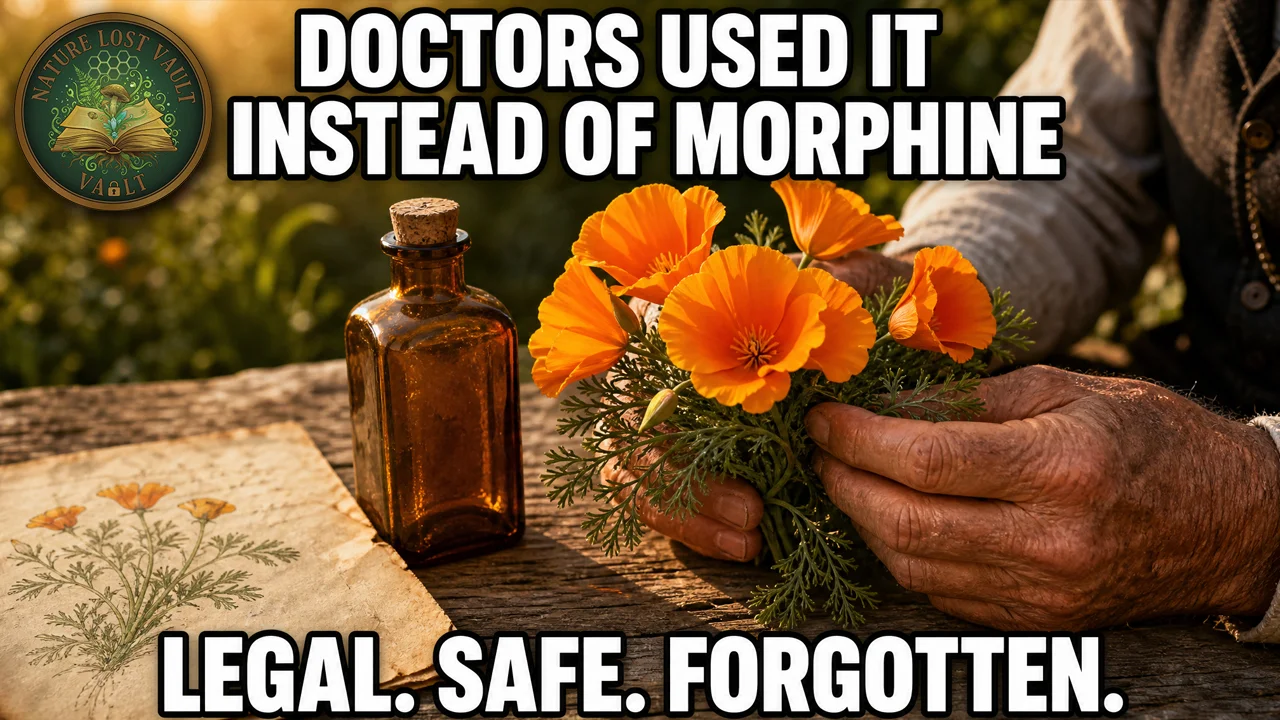
Table of Contents
- What is California Poppy?
- Copa de Oro, Parke-Davis 1890 & the King's American Dispensatory
- The 1991 Planta Medica Study, the GABA Mechanism & the 2004 Anxiety Trial
- Why It Stays Buried: The 1910 Flexner Report & "You Cannot Patent a Wildflower"
- How to Consume California Poppy (Tea, Tincture, Capsules & Sleep Blends)
- How to Source California Poppy (Grow, Forage & Buy)
- Frequently Asked Questions
What is California Poppy?
It belongs to the same botanical family as the flower that gives the world morphine and heroin. And yet, you could steep it into a tea, drink a cup before bed, and wake the next morning with no craving, no physical dependence, and nothing to taper off of. It dulls pain. It settles a racing mind. It eases you down into sleep, and then it lets you go, without demanding more the next night.
For a pivotal stretch of American history, one of the largest drug companies in the country sold it under almost that exact description. As a sleep aid and a pain reliever. And above all, a harmless one. What almost no one remembers now is why it ever left the pharmacy shelf. It was not because it stopped working. It was because no one could own it.
This is the California poppy (Eschscholzia californica). The flower that sets the state's hillsides on fire every spring. The one children pick without a second thought. The same plant that careful doctors once reached for when morphine was simply too dangerous to give.
| Metric | Value |
|---|---|
| Scientific name | Eschscholzia californica |
| Family | Papaveraceae (poppy family - same as opium poppy) |
| Common names | California poppy, copa de oro ("cup of gold"), golden poppy, flame flower |
| Latin namesake | Johann Friedrich von Eschscholtz - Russian-expedition naturalist, early 1800s |
| Native range | California, Oregon, Baja California, Arizona, New Mexico (introduced worldwide) |
| Identifying feature | Brilliant orange (sometimes yellow) cup-shaped 4-petal flower; feathery blue-green leaves |
| Indigenous use | Whole-plant remedy by California native tribes - pain, restless children, sleep |
| Active compounds | Isoquinoline alkaloids: californidine, eschscholtzine, protopine, allocryptopine |
| Mechanism | GABA system / benzodiazepine receptor binding (NOT opioid receptors) |
| Morphine / codeine content | Zero - none of the opium-poppy alkaloids |
| Dependence / withdrawal | None reported in traditional or clinical use |
| Parke-Davis catalog | 1890 - "an excellent soporific and analgesic, and above all, harmless" |
| King's American Dispensatory | 1898 - Felter & Lloyd: "analgesic and soporific without the dangers attending opiates" |
| Official state flower | California, since 1903 |
| 1991 lab study | Planta Medica - French researchers confirmed sedative + anxiolytic activity |
| 2004 clinical trial | Current Medical Research and Opinion - 264 patients, double-blind, placebo-controlled - California poppy + hawthorn + magnesium beat placebo at 3 months |
| Flexner Report | 1910 - Abraham Flexner, Carnegie Foundation - reshaped American medical education |
| Last Eclectic medical college | Eclectic Medical Institute of Cincinnati - final class 1939 |
| Modern regulatory recognition | Health Canada permits a California-poppy product as a mild sedative and chronic-pain aid |
Copa de Oro, Parke-Davis 1890 & the King's American Dispensatory
Cup of Gold: Indigenous Use & the Russian Expedition
Long before it had an English name, the native peoples of what is now California already knew this flower intimately. Tribes across the region used the whole plant - root, leaf, and petal - to ease pain, to soothe restless children, and to bring on sleep. When Spanish settlers arrived and saw entire hillsides glowing orange in the afternoon light, they called it copa de oro. Cup of gold. The name we use today came from a ship: in the early 1800s, a Russian expedition sailed down the California coast carrying a young surgeon and naturalist named Johann von Eschscholtz. A botanist on board named the bright little flower in his honor, and the tongue-twisting Latin label stuck: Eschscholzia californica.
The Botanical Cousin That Carries No Morphine
Here is the part that still surprises people. This cheerful roadside flower belongs to the poppy family. The very same family as Papaver somniferum, the opium poppy. They are botanical cousins. But they are not the same. The opium poppy carries morphine and codeine inside it. The California poppy does not. Not a trace. What it carries instead is a set of gentler plant compounds (isoquinoline alkaloids - californidine, eschscholtzine, protopine) that work on the human body in a much softer register. They calm. They soothe. They loosen the physical grip of pain and worry. And they do it without the chemical hook that makes opium so dangerous. You do not build a habit. You do not chase a higher dose. That single difference is the entire story of what happened next.
1890: Parke-Davis Puts Its Name Behind the Plant
For a while, mainstream American medicine completely agreed. In 1890, the California poppy was proudly listed in the catalog of Parke-Davis, then one of the most powerful pharmaceutical houses in the world. Their own entry called it an excellent soporific and analgesic, and above all, harmless. A sleep aid and a painkiller you did not have to fear. That was not a fringe herbalist talking. That was a major drug company putting its corporate name behind the plant.
1898: Felter & Lloyd, King's American Dispensatory
And it had serious backing from the doctors of the day. There was an entire branch of American medicine built around plants like this one - the Eclectic physicians, not quacks, who ran fully accredited medical colleges, trained thousands of doctors, and wrote the definitive reference books those doctors carried in their leather bags. Two of the most respected, Harvey Wickes Felter and John Uri Lloyd, co-wrote King's American Dispensatory, one of the great medical texts of the era. They described California poppy as an analgesic and soporific without the dangers attending opiates. It quieted pain, they wrote, and brought on a calm sleep.
Think about what that meant in practice. When a patient was in real pain but could not tolerate opium - or when a doctor was afraid of what opium might do to them - this was the plant they reached for instead. A genuine pain reliever that would not enslave the person taking it. It was respectable. It was documented. It sat on pharmacy shelves right next to everything else. And for a brief moment, it looked like American medicine had found something profoundly rare: a safe answer to one of its oldest problems. That position seemed absolutely secure. It was not.
The 1991 Planta Medica Study, the GABA Mechanism & the 2004 Anxiety Trial
The Laboratory Circles Back
For decades, that was the end of it. The poppy went back to being just a pretty flower by the roadside, and the science confidently moved on. Then, slowly, the laboratory circled back.
1991: Planta Medica Confirms the Old Doctors
In 1991, a team of French researchers published a study in the journal Planta Medica, testing what the old doctors had claimed. They found that an extract of the California poppy did, in fact, have measurable sedative and calming effects. Later work helped explain why. The plant's natural compounds appear to act on the same calming system in the brain that modern anti-anxiety drugs target - the GABA system - and on the specific receptor that benzodiazepine sedatives bind to. The old folk remedy, it turned out, had a real biological mechanism.
2004: The 264-Patient Anxiety Trial
In 2004, researchers ran a rigorous clinical trial, published in the journal Current Medical Research and Opinion. 264 patients with mild to moderate anxiety took part in a double-blind, placebo-controlled study. Here the detail matters, and it is worth being precise: the treatment was not California poppy alone. It was a fixed botanical combination of California poppy, hawthorn, and magnesium. That combination beat the placebo at easing anxiety over three months. So the poppy was one part of a team in that trial, not a solo act. But it earned its place on the team.
Health Canada Today
The medical recognition is now official in at least one country. Health Canada permits a California-poppy product to be sold specifically as a mild sedative and an aid for managing chronic pain. A modern government health authority, signing off on the same use a pharmacy catalog described back in 1890.
One honest caution before any of the practical sections below. Because the plant works on that same calming system as prescription sedatives and anxiety medication, anyone already taking those should talk with their own doctor before adding it. This is gentle, but it is not weightless.
Why It Stays Buried: The 1910 Flexner Report & "You Cannot Patent a Wildflower"
1910: The Flexner Report
The California poppy did not lose its medicine. It lost the people who stood behind it. In 1910, an educator named Abraham Flexner published a heavily funded report on American medical education. On its own terms, the Flexner Report did real good. It demanded that medical schools have laboratories, and it shut down a lot of genuine diploma mills. But it drew a hard, permanent line. Medicine, it argued, should rest exclusively on what could be measured in a lab and manufactured in a factory. The plant-based traditions, the ones built on bedside experience rather than the test tube, were judged to have no future.
State Licensing Falls in Line
The states agreed. Licensing boards fell in line with the new standards. And those standards systematically favored one kind of medicine over another. They favored the patentable pharmaceutical - the compound a company could synthesize, bottle, and legally own - over the botanical extract that anyone could grow in a field.
You Cannot Patent a Wildflower
And that is the absolute center of this whole story. You cannot patent a wildflower. The California poppy grows for free on the side of the road. No company could corner it, brand it, or set its price. A laboratory molecule, on the other hand, could be owned outright and sold for whatever the market would bear. So the money, the research, and the prestige all flowed toward the molecules. The plants were left behind for one simple reason. There was nothing in them to sell.
1939: The Last Eclectic Medical College Closes
By 1934, the head of the Eclectic physicians' own association admitted, almost mournfully, that they faced a stark choice: be absorbed by the dominant corporate system, or fold. In 1939, the last Eclectic medical school in Cincinnati graduated its final class and closed its doors. The medical tradition that had vouched for the California poppy simply ceased to exist. The plant did not disappear. The highly trained people who knew how to use it did.
The Strange, Poetic Justice
While the institutions that vouched for the California poppy were closing their doors, the plant itself was being honored by the very state it was named for. In 1903, California named it the official state flower. It has held that title for more than a century. Every April it still puts on the same show it put on for the native peoples who first used it. Whole hillsides go brilliant gold. In places like the Antelope Valley California Poppy Reserve north of Los Angeles, the bloom is so vast that people drive for hours just to stand in an endless field of orange and look at it. The patented laboratory molecules that were supposed to replace it have their own long history now, including a devastating opioid crisis that has touched nearly every family in this country. And the gentle flower that careful doctors once reached for instead, the one no corporation could ever own, never went anywhere at all.
How to Consume California Poppy (Tea, Tincture, Capsules & Sleep Blends)
The medicinal parts are the aerial parts of the plant - leaves, stems, and flowers - harvested when the plant is fully flowering. (The fresh root is used in some traditional preparations, but the dried aerial parts are the standard for tea, tincture, and capsule.) Below are the four common ways to take it.
1. Tea (the gentlest entry point)
Place 1 to 2 teaspoons of dried California poppy aerial parts into a cup. Pour over just-boiled water. Cover and steep 10 to 15 minutes (the longer steep matters - the alkaloids take time to release). Strain. The tea is mild, slightly bitter, and a clean herbal flavor; many people add a small spoon of honey.
When to take it: 30 to 60 minutes before bed for sleep, or in the late afternoon for daytime calm. Start with one cup; some people work up to two.
2. Tincture (the strongest, most reliable preparation)
A tincture is an alcohol extract that pulls out the alkaloids more completely than water and stores for years on a shelf. This is the form most modern Western herbalists prefer for California poppy because the dose is precise and the activity is reliable.
Typical adult dose: 20 to 40 drops (approximately 1 to 2 ml) dropped into a small glass of water or juice, 1 to 3 times daily. The largest dose goes 30 to 60 minutes before bed. Start at the low end of the range for a week to judge your response.
3. Capsules (the easiest dose)
For people who do not want to brew or measure, dried-herb capsules give a consistent dose. Typical strength is 400 to 500 mg per capsule; the usual approach is 1 to 2 capsules at bedtime, with water. Many products combine California poppy with valerian or passionflower in a single capsule for a slightly stronger sleep effect.
4. Sleep Blends & Combinations
This is the form closest to the 2004 clinical trial, which combined California poppy + hawthorn + magnesium. Many commercial sleep teas and sleep capsules now include California poppy alongside passionflower, hops, valerian, or magnesium - and these blends often outperform any single herb taken on its own. If your main goal is sleep or daytime anxiety, a well-formulated blend is often the most practical starting point.
Honest Safety Notes
- Do not combine with prescription sedatives or benzodiazepines (Xanax, Ativan, Valium, Klonopin) or with sleep medications (Ambien, Lunesta), SSRIs, or opioids without your doctor's guidance - California poppy acts on the same GABA pathway as these drugs, so the effects can compound.
- Avoid during pregnancy and breastfeeding, as safety data is limited.
- Do not drive or operate machinery after a sleep-aid dose; this is gentle but it does sedate.
- Start low. Take a single low dose for several days before scaling up to learn how your own body responds.
- Stop and consult a clinician for any unusual reaction.
How to Source California Poppy (Grow, Forage & Buy)
1. Grow Your Own (the cheapest, most rewarding route)
California poppy is one of the easiest medicinal plants you can grow. It does not even ask for fertilizer - it actually prefers poor, sandy, well-drained soil and full sun, and over-fertilizing reduces its alkaloid content. Direct-sow seeds outdoors in autumn or early spring (it does not transplant well - the long taproot resents being moved). Scatter the seeds on prepared soil, press them gently in, and water lightly. They germinate in 1 to 3 weeks, flower in 8 to 12 weeks, and self-seed for years afterward. One small patch (4 to 6 square feet) easily supplies a year's home tea and tincture.
Harvest: Cut the upper aerial parts (leaves, stems, flowers) once the plant is in full bloom, mid-morning after the dew has dried. Hang small loose bundles upside down in a dry, shaded, well-ventilated place for about two weeks, until the stems snap rather than bend. Then strip the dried plant material into clean glass jars and store out of direct light. It holds its potency for about a year.
2. Forage Carefully
If you live in California, Oregon, Arizona, New Mexico, or anywhere in the species' native and naturalized range, California poppy grows wild on roadsides and in meadows. Two rules, no exceptions:
- Do not pick from protected reserves or state parks. California poppy is the official state flower (since 1903); commercial collection on state-owned land is prohibited, and the Antelope Valley California Poppy Reserve is strictly look-only.
- Do not gather from sprayed roadsides or chemically maintained edges. Roadside vegetation is routinely treated with herbicide; gather only from clean ground you know has not been sprayed.
Where foraging is appropriate, harvest the same way you would from a garden: cut the upper aerial parts at full bloom, leave the root and lower stem to regrow and self-seed, and never strip a population - take a small share and move on.
3. Buy Online (the practical route for most people)
For anyone outside the species' native range, or anyone who simply wants the finished preparation, reputable online herb suppliers and major marketplaces stock all four forms. What to look for on a label:
- The Latin name Eschscholzia californica spelled out.
- The plant part used - aerial parts (or "herb"), not just "powder."
- For tinctures: the herb-to-alcohol ratio (typically 1:5) and the alcohol percentage (typically 40-60%).
- For capsules: the milligram dose per capsule (typically 400-500 mg) and the suggested daily use.
- Organic or wildcrafted certification if you can find it.
» California Poppy seeds (for growing your own)
» California Poppy extract / tincture (strongest preparation)
» California Poppy sleeping tea (gentlest entry point)
» California Poppy capsules (easiest dose)
Frequently Asked Questions
What is California poppy and what is it used for?
California poppy (Eschscholzia californica) is the bright orange wildflower that carpets California hillsides every April - the official state flower since 1903. It belongs to the same botanical family as Papaver somniferum, the opium poppy, but carries no morphine or codeine. Instead it contains a different set of gentler isoquinoline alkaloids (californidine, eschscholtzine, protopine) that act on the GABA calming system in the brain and on the benzodiazepine receptor site that prescription sedatives target. Native peoples across California used the whole plant - root, leaf, petal - to ease pain, settle restless children, and bring on sleep. Spanish settlers called it copa de oro, "cup of gold." In 1890 the major American drug company Parke-Davis sold it as "an excellent soporific and analgesic, and above all, harmless," and Felter and Lloyd's 1898 King's American Dispensatory described it as an analgesic and soporific without the dangers attending opiates. It is used as a mild sedative, gentle pain reliever, and sleep aid that does not produce physical dependence.
Is California poppy addictive like the opium poppy?
No. California poppy is botanically a cousin of the opium poppy but contains none of the morphine, codeine, or thebaine alkaloids that make opium so dangerous. The active compounds in California poppy are a different chemical class - isoquinoline alkaloids like californidine, eschscholtzine, and protopine - that act on the GABA system and the benzodiazepine receptor site rather than on the opioid receptors. You do not build a habit, you do not develop tolerance, you do not chase a higher dose, and there is no withdrawal to taper off of. That single mechanistic difference is exactly why careful 19th-century American physicians reached for it when they needed to relieve pain in a patient who could not tolerate opium. Health Canada permits a California-poppy product specifically as a mild sedative and an aid for managing chronic pain. The honest caution is that because it works on the same GABA system as prescription benzodiazepines and anxiolytics, anyone already taking those medications should consult their physician before adding California poppy.
How do you consume California poppy?
Four common preparations. (1) Tea: 1 to 2 teaspoons of dried aerial parts (leaves, stems, petals) per cup of just-boiled water, steeped 10 to 15 minutes, taken 30 to 60 minutes before bed for sleep, or in the late afternoon for daytime calm. (2) Tincture (alcohol extract): the strongest and most reliable preparation - 20 to 40 drops (approximately 1 to 2 ml) in a little water, 1 to 3 times daily, with the largest dose 30 to 60 minutes before bed. Tincture has a long shelf life and is the form most modern herbalists prefer. (3) Capsules: standardized dried-herb capsules (typically 400 to 500 mg), 1 to 2 capsules at bedtime, are the easiest entry point for people who do not want to brew or measure. (4) Sleep blend tea bags: pre-blended formulas that combine California poppy with passionflower, chamomile, or lemon balm work well for general anxiety and sleep. Start with the lowest suggested dose, take it for at least a week to judge how your body responds, and never combine it with prescription sedatives or anti-anxiety medication without your doctor's guidance.
Where can you source California poppy?
Three reliable routes. (1) Grow your own. California poppy is the easiest medicinal you can plant - direct-sow seeds outdoors in autumn or early spring in full sun, well-drained soil, no fertilizer needed; it germinates in 1 to 3 weeks and self-seeds for years. Harvest the aerial parts (leaves, stems, flowers) once the plant is fully flowering, hang upside down in small bundles in a dry shaded place for two weeks, then store in clean glass jars out of light. One small patch easily provides a year's home supply. (2) Forage carefully. If you live in California or the Southwest, the plant grows wild on roadsides and in meadows - but do not pick from official preserves (it remains the protected state flower in places like the Antelope Valley California Poppy Reserve), and do not gather from roadsides that may have been sprayed with herbicide. (3) Buy. Reputable online herb companies sell dried California poppy aerial parts, alcohol tinctures, standardized capsules, and pre-blended sleep teas; Amazon stocks all four forms. Look for products that specify the Latin name Eschscholzia californica and that list the part used (aerial parts or whole herb).
Why isn't California poppy sold by major pharmaceutical companies?
Because you cannot patent a wildflower. In 1890 Parke-Davis - then one of the most powerful drug companies in the United States - sold California poppy in its catalog as a soporific and analgesic. The plant had serious medical backing from the Eclectic physicians who ran fully accredited medical colleges and wrote the King's American Dispensatory. Then in 1910 Abraham Flexner published a heavily Carnegie-funded report arguing that medicine should rest exclusively on what could be measured in a lab and manufactured in a factory. State licensing boards fell in line. The new standards systematically favored the patentable molecule a company could legally own over the botanical extract anyone could grow in a field. The money, the research, and the prestige all flowed toward the molecules. By 1934 the head of the Eclectic physicians' own association admitted they faced a stark choice: be absorbed by the dominant corporate system or fold. In 1939 the last Eclectic medical school in Cincinnati graduated its final class. The medical tradition that vouched for California poppy ceased to exist. The plant did not disappear. The trained physicians who knew how to use it did.
Explore More Medicinal Plants
Discover ancient healing plants backed by centuries of traditional use and modern science.
Browse Medicinal Plants Collection →