Table of Contents
Chapter One
Acorn
Quercus spp.
.webp)
“One Tree Fed Us For 32,000 Years -Then Came 1848.”
The 32,000-Year-Old Grindstone
The archive opens 32,000 years ago in a cave in southern Italy. Someone sat there and ground a seed into flour. We know this because archaeologists found the stone. It was pale brown, not much bigger than a hand, and worn smooth on one end from decades of grinding.
It is the oldest food processing tool ever found in Europe.
Jump forward to 12,000 years ago in the caves of Morocco. People there ate so much of this food that their teeth rotted. 51% of adults had cavities -the same rate as early farmers who ate grain and honey. But these people were not farmers. They were foragers living in a green Sahara. The shells filled the cave floor. Thousands of pounds.
Before wheat, before barley, before rice, before anyone thought to plant a seed in the ground -food fell from the sky.
This is the story of the acorn.
The 9,000-Year Oak Orchards
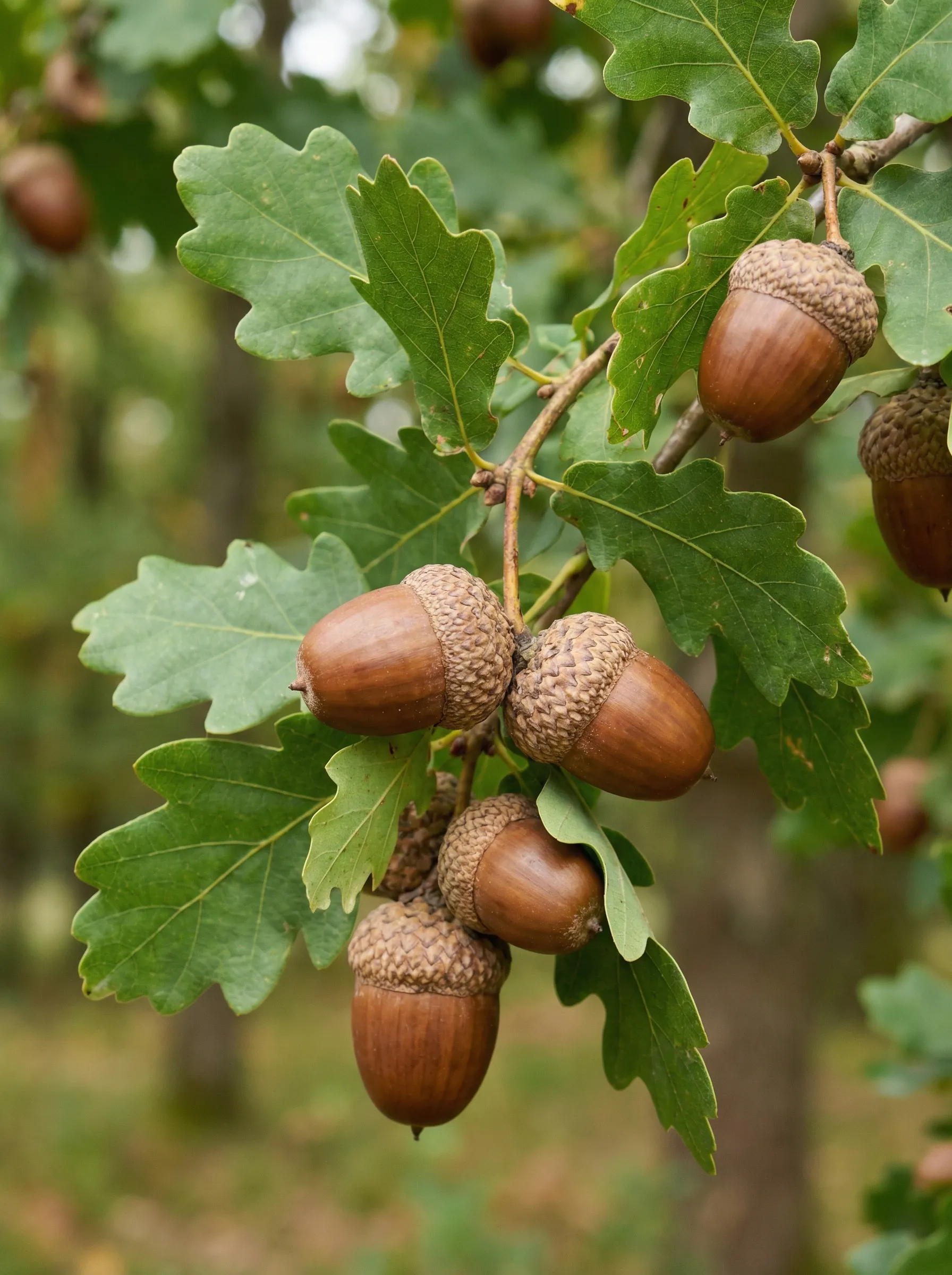
In California, acorns were found in greater quantities than any other food at archaeological sites. They were used continuously for 9,000 years. 75% of California's indigenous people relied on acorns as a primary food.
But they did not just gather acorns. They farmed them.
When European settlers arrived in California, they noticed something strange: the oak groves grew in perfect rows. They assumed that pattern was natural. It was not. Native Americans had planted and tended those trees. They used controlled burns to clear the undergrowth and promote oak growth. They managed these forests the way modern farmers manage corn fields.
Certain trees belonged to certain families. Certain groves belonged to villages. Gathering acorns from another village's grove could be grounds for war. This was not primitive food. This was civilization.
The Global Staple
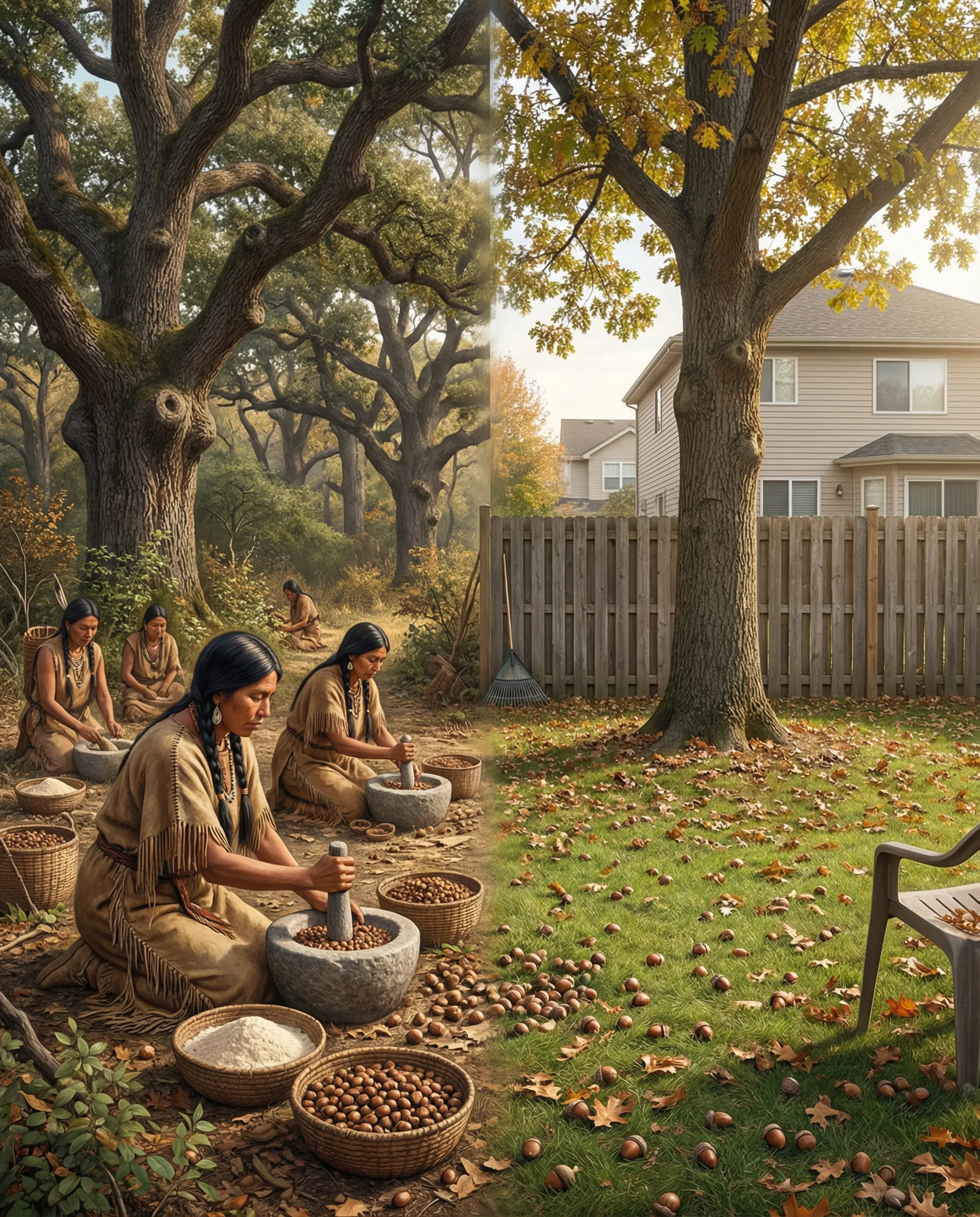
Nutritionally, acorns dwarf our modern staples. An acorn contains more calories per serving than wheat or corn -18% fat, 6% protein, 68% carbohydrate. Modern wheat and corn have 2% fat. Acorns have 9 times more fat than grain. They are rich in vitamin A, vitamin C, essential amino acids, potassium, and magnesium. When dried, they can be stored for up to 10 years without spoiling.
The Tree That Never Asks
A mature oak tree produces 1,000 pounds of acorns per year. Some produce a full ton. An acre of oak forest can yield 6,000 pounds of food. An acre of corn yields about the same -but corn requires plowing, planting, fertilizing, irrigating, and spraying every single year. Oaks require nothing.
Plant it once, and your great-great-grandchildren harvest from it. A single oak tree was an entire food system.
In 1929, agricultural scientist J. Russell Smith asked: “Why has the oak not already become a great crop? That is one of the puzzles of history.”
But it is not a puzzle. It is a tragedy.
The 1848 Gold Rush
In 1848, gold was discovered at Sutter's Mill in California. Within a year, 90,000 fortune seekers flooded the state. Before the Gold Rush, 150,000 Native Americans lived in California. By 1873, 30,000 remained. 80% of the population was wiped out in 20 years.
This was not an accident. This was policy.
In 1851, California's first governor, Peter Burnett, addressed the state legislature: “A war of extermination will continue to be waged between the races until the Indian race becomes extinct.”
But militias did not just kill people. They targeted the food system. Diary entries from 1851 describe militias “hunting families and burning their acorn granaries to starve the survivors out of the foothills.”
The state made it illegal for Native Americans to practice controlled burns -the very technique that had maintained the oak forests for 9,000 years. Federal officials negotiated 18 treaties guaranteeing 7.5 million acres of land. The U.S. Senate rejected every single one.
The Science They Buried
An oak tree does not require you to buy seeds every year. It does not require fertilizer or pesticides. It does not even require you to own the land. Oaks grow wild.
You cannot easily tax someone for gathering acorns from a forest -but you can tax someone for buying seed corn. Annual crops require ownership, cultivation, dependency. Acorns required none of that.
A perennial food system that feeds people for free is a threat to an economy based on scarcity.
The Quiet Return
Today, the cracks in the industrial system are showing -and the acorn is returning. In South Korea, acorn jelly (dotorimuk) remains a beloved staple. In Martinez, California, a modern mill is processing acorns into flour for bakeries. On the Greek island of Kasos, the Chammatha Acorn Initiative is crowdfunding solar dehydrators.
The Choice
A tree that feeds your family for 10 generations without degrading the soil is not primitive. It is the most advanced agriculture humans ever invented.
The trees are still here. They are growing in our forests, in our parks, in our driveways. Most oak trees in America still drop thousands of pounds of food every fall. And we rake them up, put them in plastic bags, and pay to have them hauled away.
A Coast Miwok elder said it best: “It was life to them in the earlier years, and it is still life to many of us who want to learn the ways. We should not lose the old way.”
The old way fed us for 32,000 years. The new way has fed us for 200 -and it is already failing.
Chapter Two
Cattail
Typha latifolia
.webp)
“It Produces More Food Than Corn -So They Called It a Problem.”
The Plant That Destroys Famine
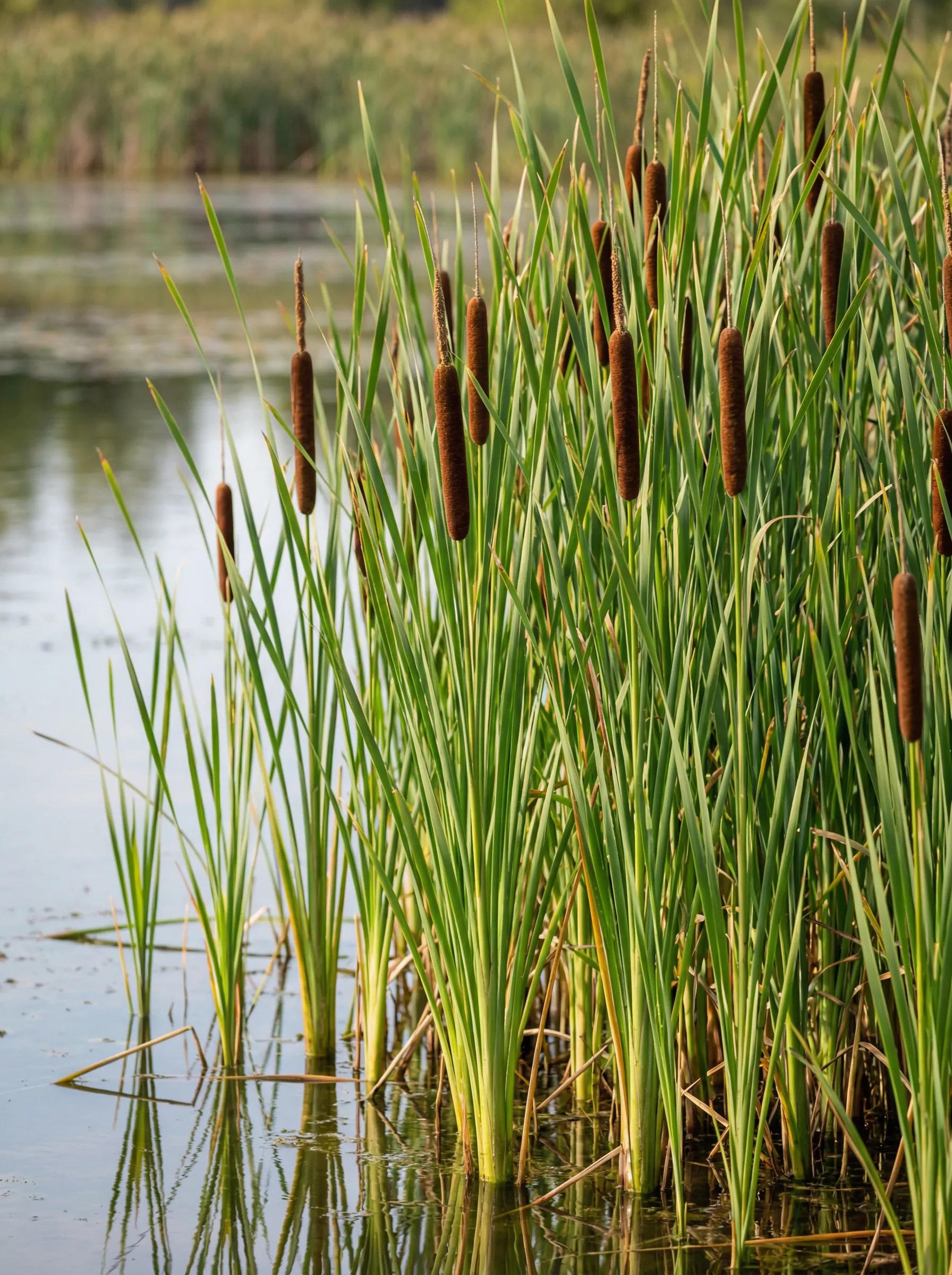
There is a plant that destroys the concept of famine. It produces food 12 months a year. Root, shoot, pollen, seed -every single part is edible. It grows in every climate where water touches land.
It produces 10 times the starch of potatoes per acre. And it does it without a single drop of fertilizer, without tilling, and without planting. For 30,000 years, this was humanity's grocery store.
Then we drained the grocery store.
The Four-Season Harvest
Most crops give you one harvest a year. The cattail gives you four.
In early spring, the young shoots emerge from the mud. You peel away the outer leaves to reveal a crisp white core. It tastes like cucumber. When Europeans first tasted it in Russia, they called it “Cossack asparagus.”
In early summer, the green flowerheads appear. Before they pollinate, you harvest them and boil them. They taste like corn on the cob.
In midsummer, the male flowers release their pollen -high-protein flour ready to harvest. Indigenous peoples mixed it with water to make bright yellow cakes and breads.
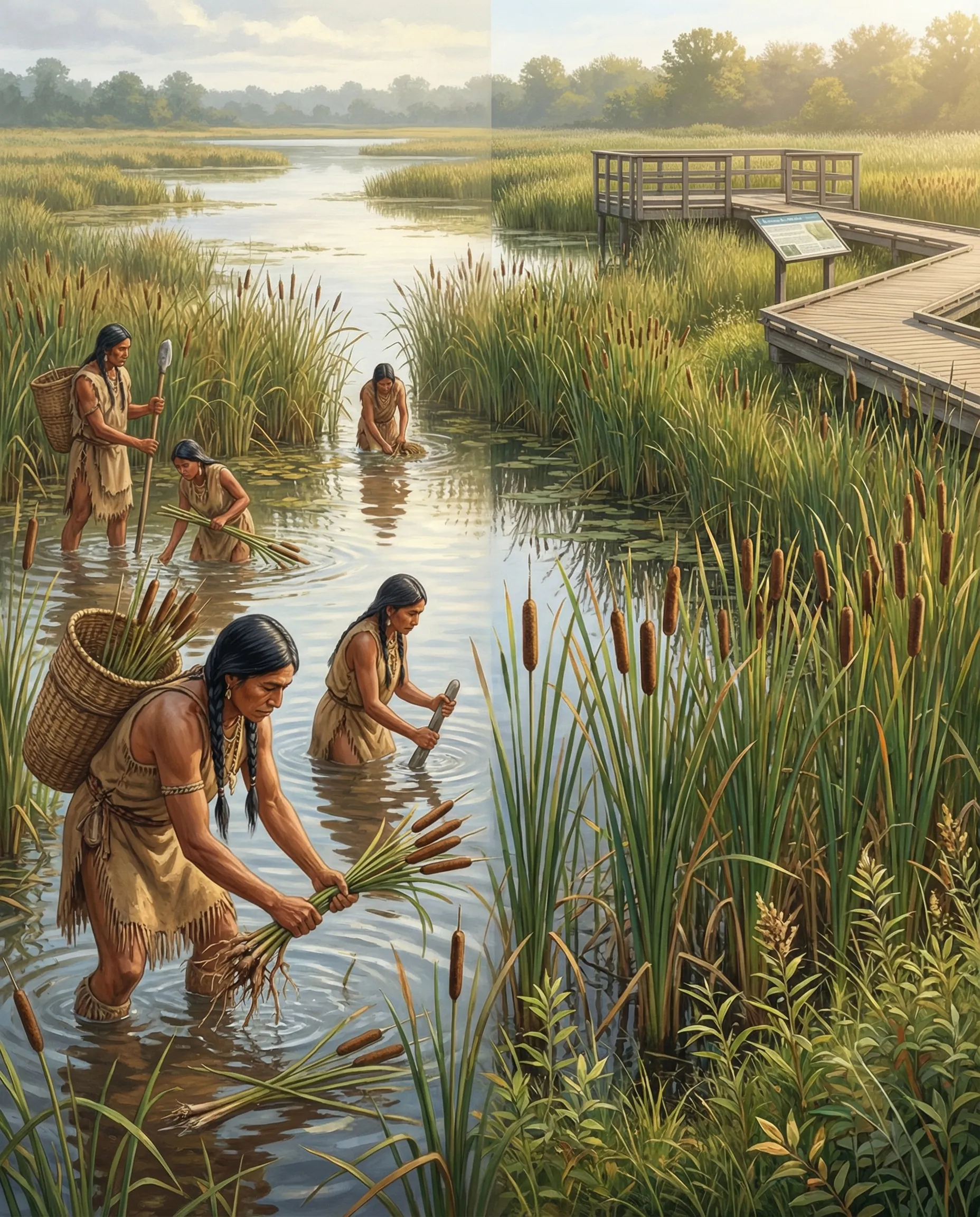
In winter, the real treasure is waiting underground. You dig the rhizomes. They are packed with 30–46% starch by weight.
One acre of cattails can produce 6,400 pounds of flour. That is more than wheat, more than corn, more than rye. And you never planted a seed.
The Cattail People
The Paiute people had a clan called “the Cattail Eaters.” The Kawaiisu called themselves “the Cattail People.” Daniel Moerman's massive ethnobotanical database catalogs Native American plant use. The entry on cattails is one of the longest in the book.
It was not just food. It was technology. They wove the leaves into waterproof mats. They twisted fibers into cordage stronger than hemp. They used the fluff to insulate moccasins against the freezing snow. The jelly between the young leaves is a potent antiseptic. One plant provided food, medicine, shelter, and clothing.
For 30,000 years, this was the definition of wealth. So how did a food system this abundant vanish? It was not nature that killed it. It was policy.
The Swamp Land Act
The erasure began in 1849. The United States Congress passed the first Swamp Land Act. It gave millions of acres of federal wetlands to the states on one condition: drain them.
A geological dictionary from 1822 defined a swamp as “a piece of land with wet miry soil. Such land is unprofitable or even a nuisance until it be drained.” Nuisance -that was the word they used for the ecosystem that fed the continent.
Of the 221 million acres of wetlands that once existed in the lower 48 states, only 103 million remain. More than half gone. And with them, the cattails.
We traded a perennial, self-sustaining food system for annual crops that require billions of dollars in fertilizer, pesticides, and diesel fuel. Cattails had a fatal flaw: they could not be controlled. You cannot sell someone cattail seeds -every year they replant themselves. You cannot patent a plant that spreads across 3 acres from a single root.
The Science They Buried
Modern research on cattails began in the 1980s. Scientists in Minnesota discovered that cattails produce 22 tons of biomass per acre. Then researchers found something even more important.
Cattails are the kidneys of the earth. They absorb nitrogen and phosphorus from polluted water. The fertilizers we spread on our corn fields run off into the water, causing toxic algae blooms. Planting cattails soaks up that pollution. Harvesting 250 acres of cattails removes 5 tons of phosphorus from the ecosystem. When you burn that biomass for fuel, the ash is pure fertilizer. It is a closed loop.
The Manitoba Model
The International Institute for Sustainable Development in Manitoba has been harvesting cattails commercially since 2012. They harvest 15–20 tons per acre. Each ton sequesters over a ton of carbon dioxide. And because cattails are perennial, you harvest them like a lawn. No plowing, no planting, no erosion.
The Choice
The plant that fed humanity 12 months a year -that clothed us, healed us, sheltered us -is still here. It grows in every marsh, every riverbank, every pond edge.
We drained 118 million acres of wetlands because standing water was “unprofitable.” We replaced a perennial food system that produced 6,400 pounds of flour per acre with annual crops that poison our water and erode our soil.
But the cattail never surrendered. It waited -in the ditches we dug, in the margins we ignored. And now, as climate change breaks records and food systems collapse, the plant we threw away is offering its gifts again.
The supermarket of the swamp is still open. It never closed.
Chapter Three
Stinging Nettle
Urtica dioica
.webp)
“The Weed That Heals -Why Did We Erase This Ancient Superfood?”
The Fire in the Garden
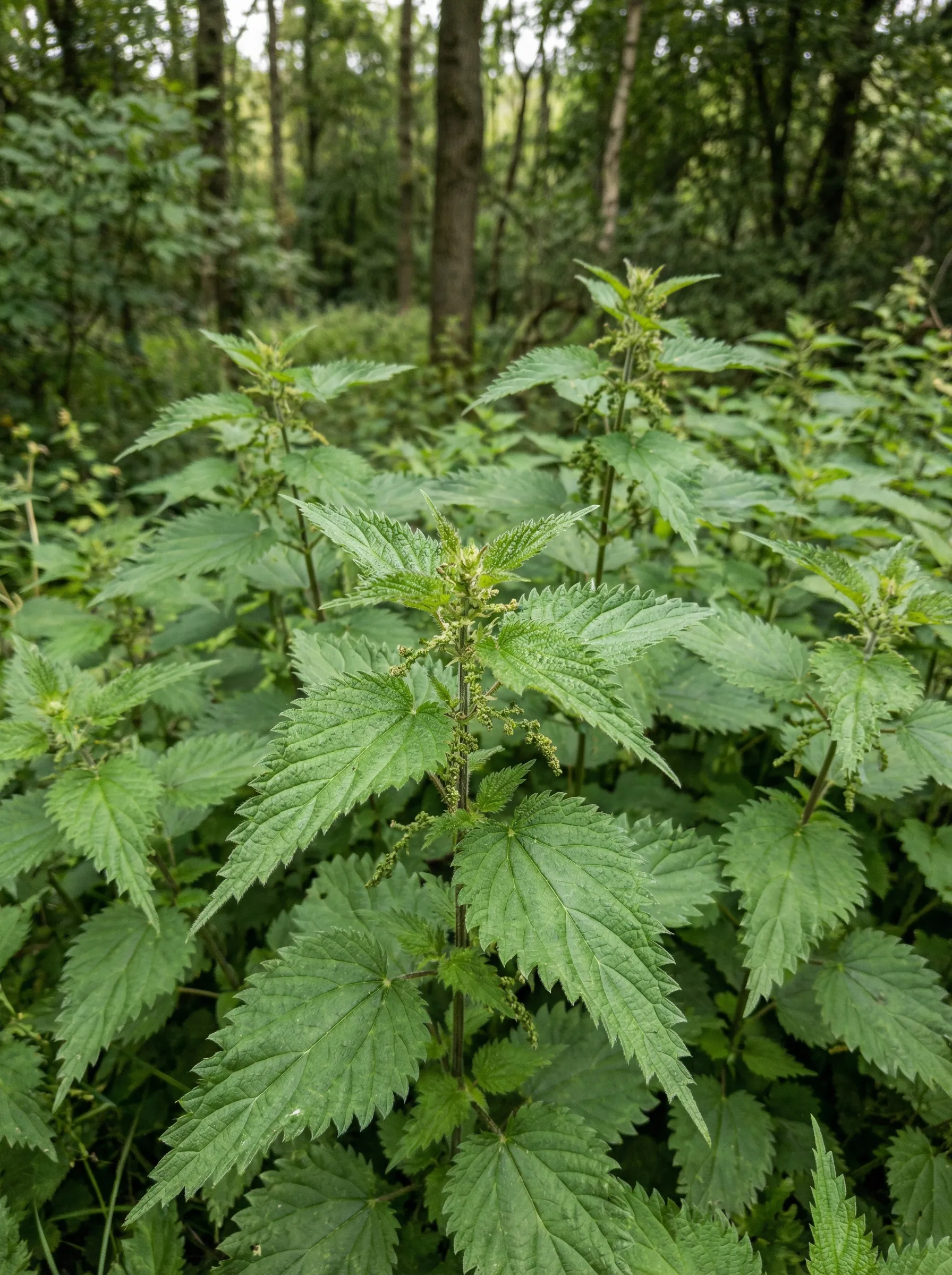
There is a plant we have been taught to despise. It is the fire in the weeds. The agony in the garden. We pull it with thick gloves. We spray it with chemicals. We curse it for daring to grow near our homes.
And in doing so, we have erased one of the most powerful plants in human history.
For thousands of years, stinging nettle was not a weed. It was a free superfood that appeared every spring when winter stores ran dry. It was a potent medicine that treated everything from joint pain to allergies. It was the fiber that clothed Roman legions and Bronze Age civilizations.
Herbalists called it “Doctor Nettle” -a true panacea. Then, in less than a century, we declared war on it.
The Bronze Age Shroud
The archive opens in a 3,000-year-old Bronze Age grave. Archaeologists uncovered a burial shroud, perfectly preserved. The fabric was not wool. It was not linen. It was woven from the fibers of stinging nettle. The weave was fine, tight, and durable -sophisticated enough to serve as burial cloth for someone who mattered.
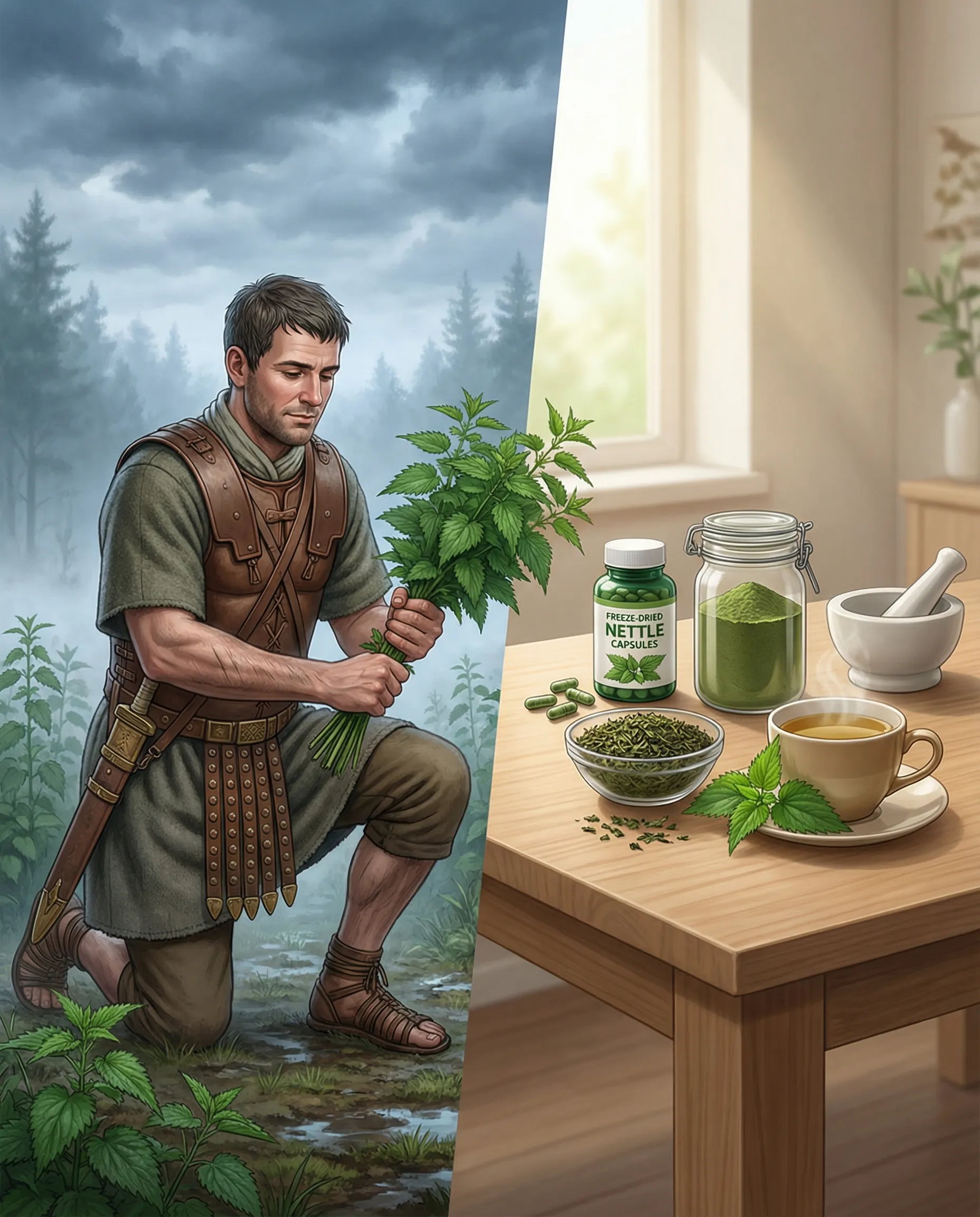
Jump forward to the first century A.D. Roman legionaries stationed in Britain were lashing their own arms and legs with bunches of nettles. Pliny the Elder recorded this practice -urtication -the act of intentionally stinging oneself. The Romans believed it kept them warm and treated the crippling joint pain from marching in cold climates.
They were right. The sting itself was the medicine.
The Chemical Delivery System
That sting is not a simple defense. It is a complex chemical delivery system. The plant's hairs -called trichomes -are microscopic hypodermic needles tipped with silica, injecting a cocktail of formic acid, histamine, acetylcholine, and serotonin.
For thousands of years, people with arthritis, gout, and rheumatism intentionally stung themselves. The acute burning pain provided days of relief from chronic inflammation.
The First Green of Spring
Before spinach was cultivated, nettle was the first green of spring -a vital free superfood picked to replenish bodies starved of vitamins after a long winter. Medieval monasteries grew it in their physic gardens. Peasants foraged it from the edges of fields.
By the 18th century, industrial looms and colonial trade made cotton cheap. Nettle fiber was abandoned. Then, in the 20th century, modern chemical herbicides arrived. The nettle became a symbol -a sign of a messy garden, of neglect.
The Science They Buried
By the 1970s, ecologists began to look past the pain. Nettle was not just growing in rich soil -it was a sign of it. Where nettle thrives, the soil is high in phosphate and nitrogen. It is an indicator of fertility and a bio-accumulator, mining minerals from deep subsoil and enriching the topsoil for other plants.
It is also a critical nursery. The red admiral and peacock butterflies lay their eggs only on stinging nettle. Eradicate the nettle, and you eradicate the butterflies.
The Superfood We Forgot
When cooked, dried, or tinctured, the sting is completely neutralized -leaving only the medicine.
Freeze-dried nettle leaf has been shown in clinical trials to be a powerful natural antihistamine. It is also a vasodilator that helps lower blood pressure and decrease fasting blood glucose levels.
The leaf (harvested in spring) is for allergies and nutrition. The root (harvested in fall) helps alleviate symptoms of an enlarged prostate. The seed is medicine for distressed kidneys.
The Fiber Returns
Nettle fiber is stronger than linen, requires far less water than cotton, and grows without pesticides. High-end sustainable fashion is now creating jeans and shirts from this ancient weed. The plant that once clothed our ancestors is still here.
The Choice
Touch it wrong and it burns. Touch it right and it feeds you. That's the lesson nettle teaches. Not everything valuable is convenient. Not everything worthwhile is safe to ignore.
Nettle doesn't wait for permission. It appears in fertile soil, signals health, feeds more people per acre than most cultivated greens, and contains compounds that calm inflammation while providing complete nutrition.
Some food requires nothing but money. Some food requires attention. One makes you a consumer. The other makes you competent.
Chapter Four
Dandelion
Taraxacum officinale
.webp)
“The Wild Medicine in Your Garden They Don't Want You to Know.”
The Enemy in the Lawn
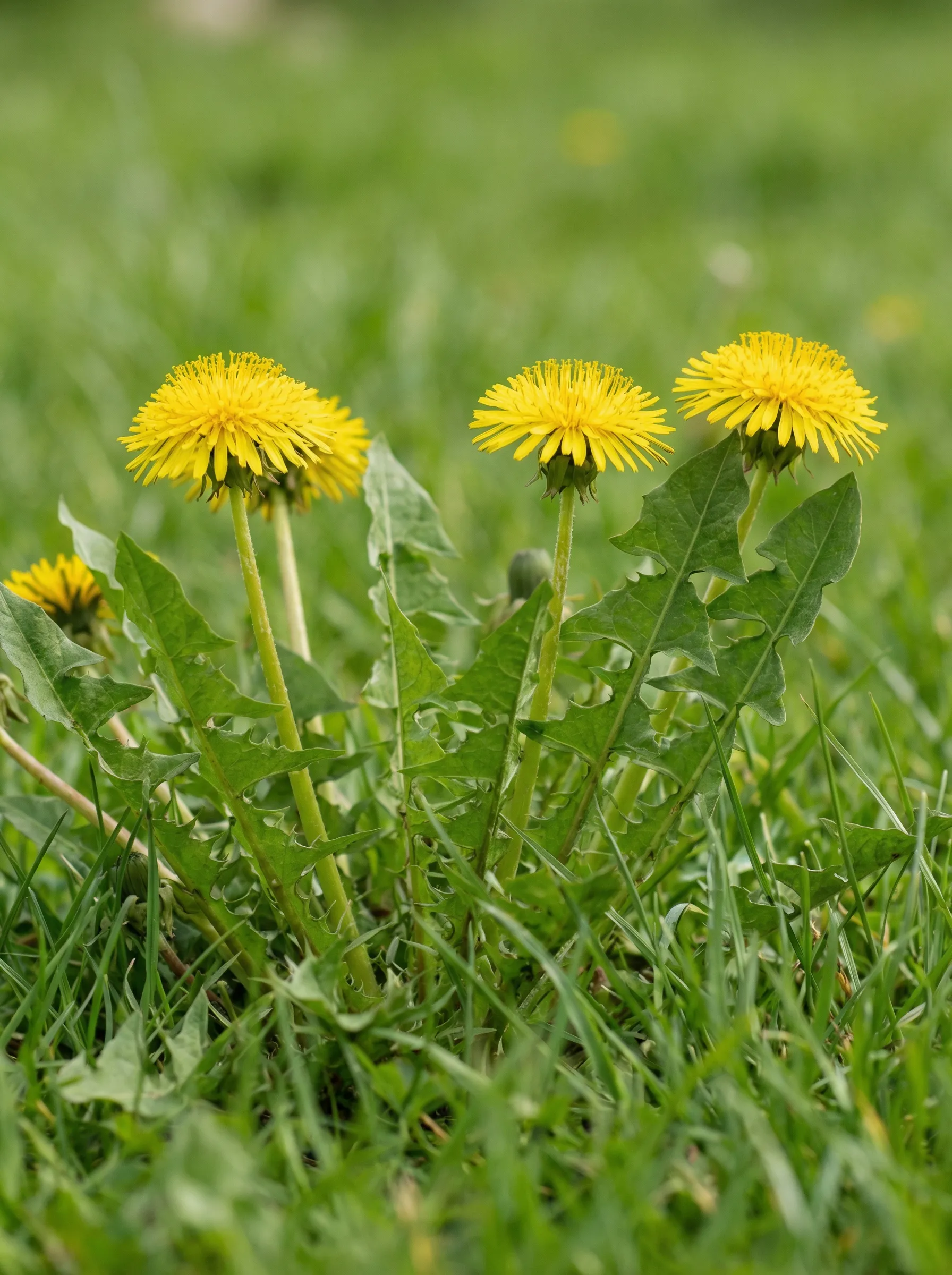
There is a plant that most gardeners have been told to kill for years. We spray it with chemicals. We tear it from the soil. Yet for thousands of years, this same plant healed the liver, cleansed the blood, and fed civilizations through famine.
It survives fire. It survives drought. It survives frost. And buried in its roots is a compound that modern scientists are now studying for its ability to make cancer cells commit suicide.
It is not a weed. It is one of humanity's oldest medicines.
When Dandelion Was Essential
The archive opens in a desert library sealed for centuries -Dunhuang, China, along the ancient Silk Road. Among the manuscripts were medical texts from the Tang Dynasty, describing a yellow flower called pu gong ying. Physicians wrote that it cooled inflamed organs, purified the blood, and healed infections.
In Egypt, healers brewed its roots to calm fevers. In Greece, it was prescribed for liver congestion. Arab medical scholars called it tarakhshaqun -the bitter herb that opens blocked pathways inside the body.
When the Pilgrims sailed to the New World on the Mayflower, they brought sacks of dandelion seeds. To them, it was not a weed. It was a pharmacy they could not leave behind.
Every culture that touched this plant arrived at the same truth. Dandelion greens contain more vitamin A than spinach, more vitamin C than tomatoes, more iron than kale.
The Perfect Lawn and the Chemical Weapon
The erasure began in the 20th century. In the post-war boom of the 1940s, a new cultural ideal appeared: the perfect lawn.
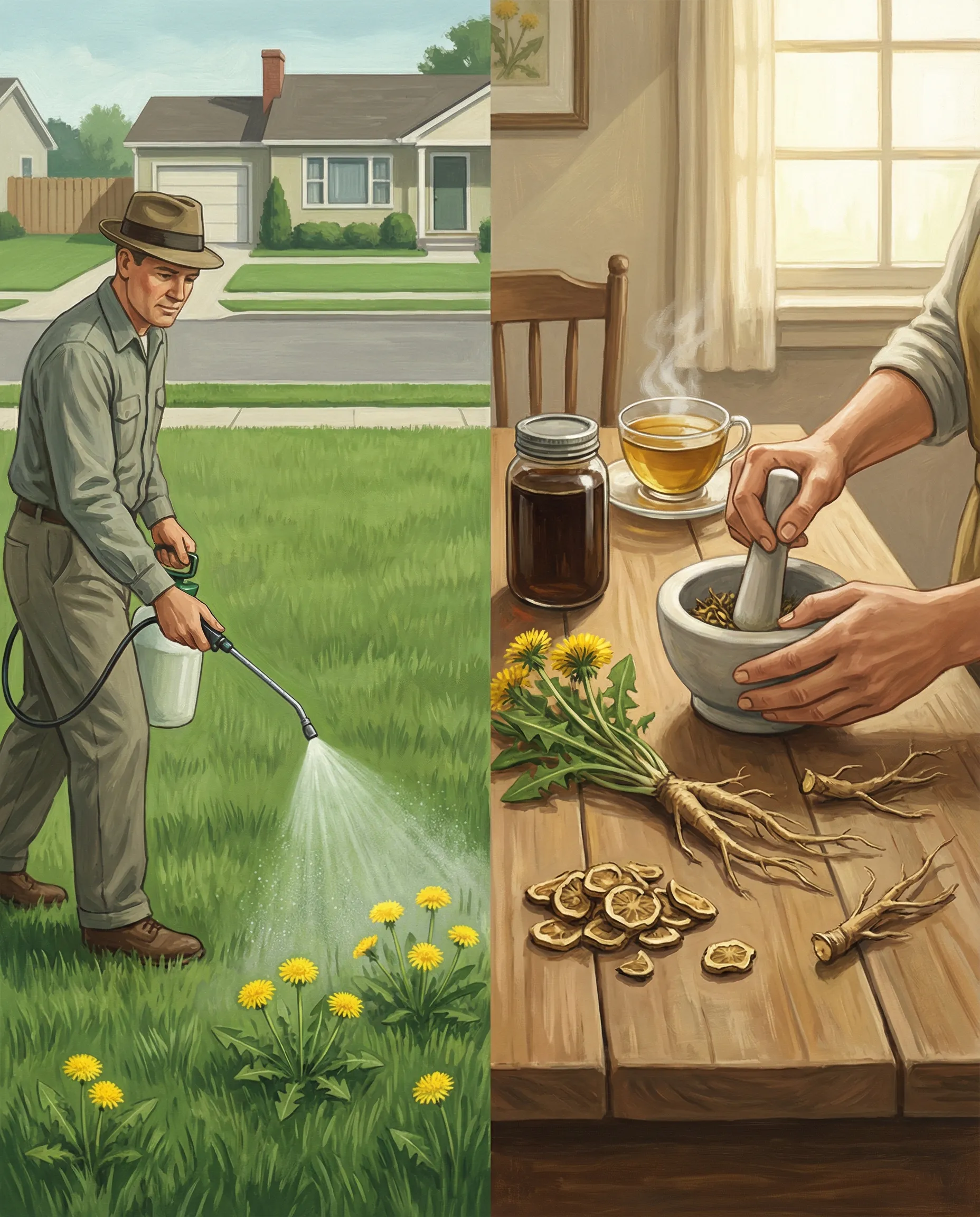
Chemical companies needed a product to sell. They found it in 2,4-D (2,4-Dichlorophenoxyacetic acid) -originally researched during World War II as a potential biological weapon to destroy enemy crops. After the war, it was repurposed as a “miracle weed killer.” It killed broadleaf plants -like dandelions -but left grass alive.
To sell the chemical, they needed a villain. They chose the bright yellow flower. Magazines mocked homeowners who allowed dandelions to appear. A plant that had fed generations became a symbol of failure, laziness, and poverty.
The global lawn care industry is now worth over $99 billion annually. We traded a free pharmacy for a green carpet.
The Science They Buried
The roots contain inulin, a prebiotic fiber that feeds beneficial gut bacteria -Bifidobacterium and Lactobacillus species that protect the gut lining, produce vitamins, and regulate the immune system.
The Cancer Research Breakthrough
At the University of Windsor in Canada, biochemist Dr. Siyaram Pandey made a startling discovery. His team found that dandelion root extract could induce apoptosis -programmed cell suicide -in certain aggressive cancer cells.
In laboratory tests, the extract signaled leukemia and melanoma cells to disintegrate -while leaving healthy cells untouched. It did not poison the body like chemotherapy. It simply reminded the cancer cells how to die.
The Rubber Revolution
During World War II, when rubber supplies from Asia were cut off, the Soviet Union turned to the Russian dandelion (Taraxacum kok-saghyz). Its roots contain high-quality natural latex. Today, companies like Continental Tire and Ford are growing thousands of acres of these dandelions, producing the first sustainable, high-performance tires made entirely from a weed.
The Choice
The dandelion never needed our approval. It needed our memory.
For thousands of years, it fed, healed, and sustained communities. For one century, we tried to erase it for the sake of aesthetics. But the plant that endured ice ages and wildfires does not bow to marketing trends.
This is not the story of a weed. It is the story of a plant humans once relied on completely -a plant erased not because it failed us, but because it was free.
Knowledge like this was never lost -only buried beneath grass and forgotten habits. And like the dandelion pushing through winter ground, it returns when the world needs it most.
Chapter Five
Moringa
Moringa oleifera
.webp)
“The Tree That Makes Multivitamins Obsolete -But the $50 Billion Vitamin Industry Won't Let You Plant It.”
The 4,000-Year-Old Pharmacy
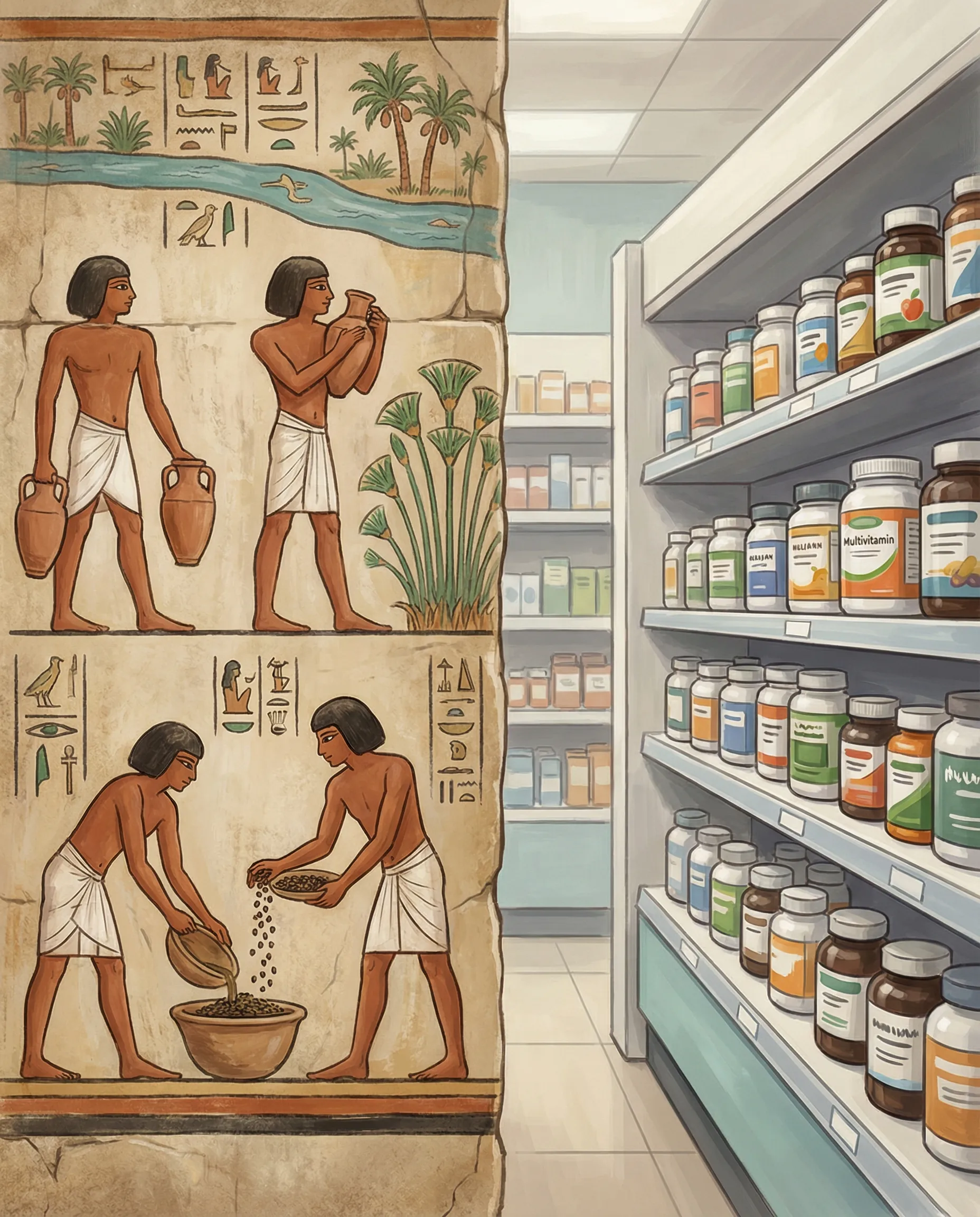
There is a tree so nutritionally complete that ancient warriors drank its juice before battle to endure impossible pain. A plant so valued by Egyptian royalty that jars of its oil were buried in Pharaoh's tombs to preserve their youth in the afterlife.
For over 4,000 years, it sustained entire civilizations through famine, disease, and war. One tree could provide complete nutrition for a family.
Then in 1913, Western scientists discovered they could isolate individual nutrients from food. They called them vitamins. And within 30 years, pharmaceutical companies built billion-dollar empires by selling back to humanity what nature had already provided for free.
The Biological Anomaly
Moringa is not a vegetable. It is not a supplement. It is a biological anomaly that breaks every rule of modern nutrition science.
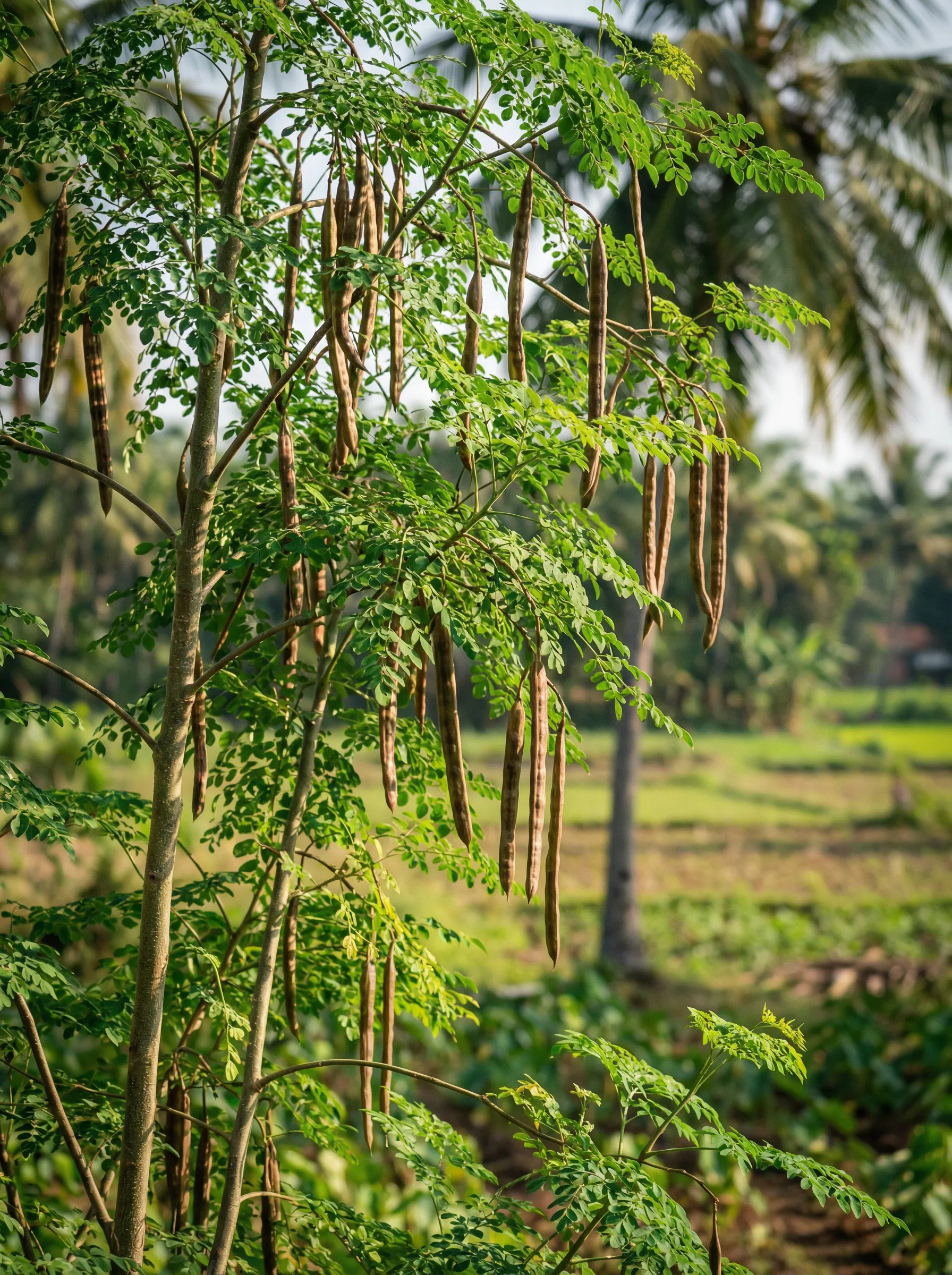
Most plants excel at one thing. You build a balanced diet by combining dozens of different crops. Moringa refuses to play that game. A single tree produces leaves that contain all nine essential amino acids -the complete protein profile.
In 2017, researchers at Bangladesh Agricultural University published a comprehensive analysis. Fresh moringa leaves contain up to 29% protein by dry weight. Spinach contains less than 3%. Moringa has 10 times the protein density.
Vitamin C ranges from 188–279mg per 100g. Oranges contain only 53mg. Moringa has roughly 5 times more. Beta-carotene measures triple the concentration of carrots. Calcium is denser than milk.
The tree grows 18 feet in 6 months. It thrives in drought. It survives in poor soil. It requires no fertilizer, no pesticides, no industrial infrastructure. You plant it once and it feeds you for decades.
The 4,000-Year History
Moringa was cultivated in the sub-Himalayan regions of India, revered in Ayurvedic medicine. Ayurvedic texts describe moringa as a treatment for more than 300 different ailments.
By 2000 BCE, moringa had spread to ancient Egypt. The Egyptians extracted a golden oil they called “ben oil” -used for anti-aging creams and perfumes. Jars of moringa oil were placed in the tombs of pharaohs.
The ancient Mauryan warriors of India were fed extracts of moringa leaves before battle. Modern research has confirmed moringa contains powerful anti-inflammatory compounds and complete nutrition that supports endurance. The warriors were biochemically correct.
The 1913 Turning Point
That year, biochemists Elmer McCollum and Marguerite Davis isolated the first vitamin from butter and cod liver oil. This should have confirmed that traditional foods like moringa contained powerful nutrients naturally.
Instead, it became the foundation of a new industry. Western science made a choice: instead of preserving the food plants that contained these nutrients naturally, they decided to isolate the nutrients and sell them back.
By 1920, Park-Davis launched Metagen. In 1927, Merck and Bayer released Vigantol. In 1933, Roche synthesized vitamin C. These companies did not discover vitamins to help humanity. They discovered how to own nutrition.
The Science They Buried
Moringa was the greatest threat to their business model. Roche spent decades synthesizing vitamin C. Moringa leaves naturally contain 5 times more. Merck built an empire on synthetic vitamin D. Moringa leaves are loaded with it. Pfizer synthesized iron supplements. Moringa has more iron than spinach.
The entire vitamin industry is built on the premise of scarcity -that you cannot get complete nutrition from food. Moringa obliterates that premise. One tree, complete nutrition, no prescription, no patent, no profit margin.
The Five Suppression Tactics
The suppression of moringa was not a conspiracy. It was economics.
1. The Patent Problem: You cannot patent a tree. Pharmaceutical companies built fortunes on patents -exclusive rights to sell a molecule for 20 years at monopoly prices.
2. The Processing Problem: Moringa leaves degrade rapidly after harvest, making them incompatible with industrial food systems that prioritize shelf life.
3. The Standardization Problem: A pill has a standardized dose. Moringa is a whole food -nutrient content varies by soil and season.
4. The Revenue Problem: You buy a moringa tree once. It grows for 20 years. You never need to buy it again. A vitamin pill must be purchased forever.
5. The Fortification Fraud: Food processing stripped nutrients from the food supply. The pharmaceutical industry responded not by preserving traditional whole foods, but by synthesizing the missing nutrients and selling them back. Moringa could have solved this. Instead, we got fortified breakfast cereal and multivitamin pills.
The Choice
A tree that purifies contaminated water while it grows. Leaves with seven times the vitamin C of oranges. Seeds that clean water better than chemical treatments.
NASA looked at it for space agriculture. The UN distributes it in famine zones. And in tropical villages, people simply plant it. Harvest it. Use it. The way they always have.
Moringa doesn't need scientists to explain why it works. It just keeps working. Some solutions are engineered over decades. Some have been standing in the sun the entire time.
Selected Sources & References
Expand each section to view the academic sources behind these stories.
Acorn (Quercus spp.)
Anderson, M. Kat. Tending the Wild: Native American Knowledge and the Management of California's Natural Resources. Berkeley: University of California Press, 2005.
Baumhoff, Martin A. “Ecological Determinants of Aboriginal California Populations.” University of California Publications in American Archaeology and Ethnology 49, no. 2 (1963): 155–236.
Koenig, Walter D., and Jill M. H. Knops. “Patterns of Annual Seed Production by Northern Hemisphere Trees: A Global Perspective.” The American Naturalist 155, no. 1 (2000): 59–69.
McCarthy, H. “Managing Oaks and the Acorn Crop.” In Before the Wilderness: Environmental Management by Native Californians. Los Osos, CA: Ballena Press, 1993.
Ortiz, Beverly R. “Contemporary California Indian Acorn Preparation.” In Before the Wilderness: Environmental Management by Native Californians. Los Osos, CA: Ballena Press, 1993.
Wolf, Eric R. Europe and the People Without History. Berkeley: University of California Press, 1982.
California State Archives. Records on Indigenous Displacement and Violence in California, 1848–1873. Sacramento: California State Archives.
Indigenous Food Sovereignty Movement. Acorn Restoration and Food Revitalization Program Documentation. Minneapolis, MN.
Cattail (Typha latifolia)
Duke, James A. Handbook of Edible Weeds. Boca Raton, FL: CRC Press, 1992.
International Institute for Sustainable Development. Commercial Cattail Biomass Harvesting Research. Winnipeg: IISD.
Moerman, Daniel E. Native American Ethnobotany. Portland, OR: Timber Press, 1998.
United States Department of Agriculture, Natural Resources Conservation Service. Wetland Drainage History and Impact Studies. Washington, DC: USDA NRCS.
University of Minnesota Extension. Perennial Crop Productivity Research. St. Paul: University of Minnesota Extension.
Stinging Nettle (Urtica dioica)
Barker, M. S., and Z. Murrell. “Phylogenetic and Morphological Implications of a Unique Population of Urtica.” Systematic Botany 33, no. 1 (2008): 61–74.
Konrad, L., H. H. Müller, C. Lenz, H. Laubinger, G. Aumüller, and J. J. Lichius. “Antiproliferative Effect on Human Prostate Cancer Cells by a Stinging Nettle Root Extract.” Planta Medica 66, no. 1 (2000): 44–47.
Kregiel, D., E. Pawlikowska, and H. Antolak. “Urtica spp.: Ordinary Plants with Extraordinary Properties.” Molecules 23, no. 7 (2018): 1664.
Mittman, P. “Randomized, Double-Blind Study of Freeze-Dried Urtica dioica in the Treatment of Allergic Rhinitis.” Planta Medica 56, no. 1 (1990): 44–47.
Pliny the Elder. Natural History. Rome, 77 CE.
European Archaeological Site Reports. Bronze Age Nettle Textile Evidence and Fiber Use Documentation. Europe.
Dandelion (Taraxacum officinale)
González-Castejón, Marta, Francesco Visioli, and Ana Rodriguez-Casado. “Diverse Biological Activities of Dandelion.” Nutrition Reviews 70, no. 9 (2012): 534–547.
Martinez, Mauricio, et al. “Taraxacum officinale and Related Species: An Ethnopharmacological Review and Its Potential as a Commercial Medicinal Plant.” Journal of Ethnopharmacology 169 (2015): 244–262.
Petlevski, Radovan, et al. “Effect of ‘Antidiabetis’ Herbal Preparation on Serum Glucose and Fructosamine in NOD Mice.” Journal of Ethnopharmacology 85, no. 1 (2003): 107–112.
Schütz, Kerstin, Reinhold Carle, and Achim Schieber. “Taraxacum: A Review on Its Phytochemical and Pharmacological Profile.” Journal of Ethnopharmacology 107, no. 3 (2006): 313–323.
Wirngo, Florence E., Michael N. Lambert, and Peter B. Jeppesen. “The Physiological Effects of Dandelion (Taraxacum officinale) in Type 2 Diabetes.” Review of Diabetic Studies 13, nos. 2–3 (2016): 113–131.
United States Lawn and Herbicide Industry Records. Marketing Campaign Documentation Targeting Dandelions, 1950s–present. United States.
Moringa (Moringa oleifera)
Fahey, Jed W. “Moringa oleifera: A Review of the Medical Evidence for Its Nutritional, Therapeutic, and Prophylactic Properties.” Trees for Life Journal 1 (2005): 5.
Fuglie, Lowell J. The Miracle Tree: Moringa oleifera, Natural Nutrition for the Tropics. Dakar: Church World Service, 2001.
Gopalakrishnan, L., K. Doriya, and D. S. Kumar. “Moringa oleifera: A Review on Nutritive Importance and Its Medicinal Application.” Food Science and Human Wellness 5, no. 2 (2016): 49–56.
Leone, A., et al. “Cultivation, Genetics, Ethnopharmacology, Phytochemistry and Pharmacology of Moringa oleifera Leaves.” International Journal of Molecular Sciences 16, no. 6 (2015): 12791–12835.
National Research Council. “Moringa.” In Lost Crops of Africa: Volume II, Vegetables. Washington, DC: National Academies Press, 2006.
Rockwood, J. L., et al. “Potential Uses of Moringa oleifera and an Examination of Antibiotic Efficacy Conferred by Seed and Leaf Extracts.” Alternative and Integrative Medicine 2 (2013): 112.
United States Department of Agriculture, Foreign Agricultural Service. Global Moringa Production and Trade Data. Washington, DC: USDA FAS, 2020.
See these plants in the wild
We're building a YouTube series that takes you into the field -showing you exactly where these plants grow, how to identify them, and how to use them. Each episode goes deeper than the page ever could.
Watch the Series on YouTubeThe full book is out now. Get your copy →