
The Most Nutritious Plant on Earth. Confirmed by the CDC. Why Don't You Know About It?
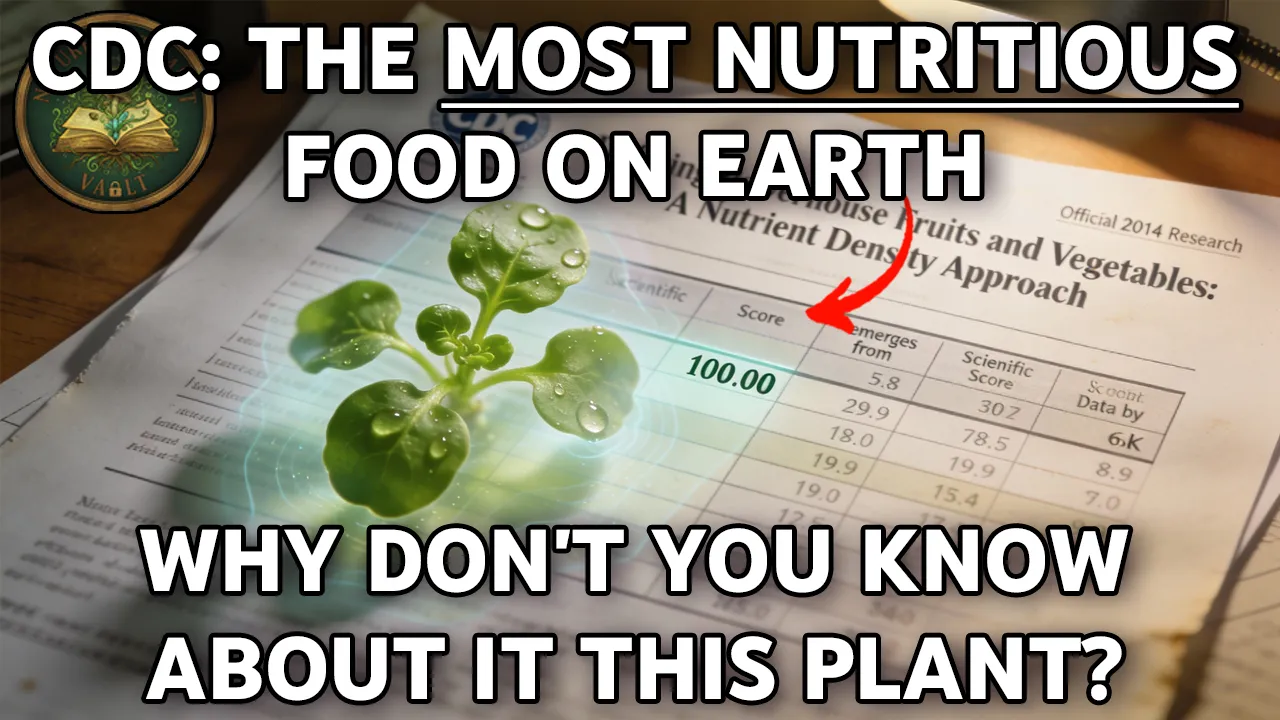
Table of Contents
Recommended Product: Watercress seeds and growing supplies
View Watercress OptionsAffiliate link - supports our channel
| Metric | Value |
|---|---|
| Botanical name | Nasturtium officinale |
| Family | Brassicaceae (mustard family) |
| CDC nutrient-density score | 100 / 100 (rank #1 of 47) |
| Spinach comparison | 86 / 100 |
| Kale comparison | 49 / 100 |
| Iceberg lettuce comparison | 7 / 100 |
| Signature compound | Phenethyl isothiocyanate (PEITC) |
| Water content | ~93% |
| Shelf life (refrigerated) | 2–5 days |
| Historical UK market (1850s) | "Poor man's bread" sold on London streets for 1 penny |
| Growing requirement | Cold, clean, flowing water |
| Watercress Line railway | Operated Hampshire → London until 1963 |
What is Watercress?
In June 2014, a team of researchers at the Centers for Disease Control and Prevention embarked on a massive project. They wanted to answer a simple but elusive question: What is the single healthiest food on the planet? They were not looking for opinions. They were not looking for trends. They were looking for hard data. The answer: watercress (*Nasturtium officinale*).
They took 47 of the most common superfoods, fruits and vegetables we are told to eat every day and they measured exactly how much potassium, fiber, protein, calcium, iron, thiamin, riboflavin, niacin, folate, zinc, and vitamin A, vitamin B6, vitamin B12, vitamin C, vitamin D, vitamin E, and vitamin K each food delivered per 100 calories.
The results were shocking. Kale, the darling of every health food store in America, scored 49 out of 100. Spinach, the legendary muscle builder, did much better. It scored 86. Blueberries, praised as the ultimate antioxidant superfood, scored 11.
But at the very top of the list, standing alone with a perfect score of 100 out of 100, sat a plant that most modern Americans have never tasted. It was not an exotic berry from the Amazon. It was not a root from the high Andes. It was a humble peppery green leaf that grows in cold, shallow streams across the northern hemisphere.
Watercress. According to the most rigorous scientific analysis ever conducted by the US government, watercress is the most nutrient-dense food on Earth.
And yet, if you walk into a typical American supermarket today, you will likely not find it. You will see walls of kale. You will see pyramids of apples. But the king of nutrition? It is invisible. Why? The answer is not a conspiracy. The answer is far more interesting and far more tragic.
Historical Context & Victorian England
To understand what we lost, you have to go back to a time when this plant was not a ghost. You have to go back to the foggy coal-stained streets of Victorian London. In the mid-1800s, London was the beating heart of the industrial revolution. But it was a brutal place to be poor.
The working class lived on bread, sugary tea, and cheap grease. Malnutrition was rampant. Scurvy, caused by vitamin C deficiency, was a constant threat in the slums. The Victorians had a secret weapon. They called it "poor man's bread."
Every morning, long before the sun rose over the Thames, hundreds of street sellers would fan out across the city. They were often children, some as young as five or six, barefoot in the cold, carrying wicker baskets stacked high with fresh green bunches of watercress.
The cry of "Fresh creases! Fresh watercresses!" was the soundtrack of the London morning. It echoed off the brick walls of factories and tenements. For a single penny, a factory worker could buy a large bunch. And in that one bunch, they got more iron than a serving of spinach, more calcium than a glass of milk, and more vitamin C than an orange. It was a nutritional miracle.
The Watercress Infrastructure
The Victorians valued watercress so highly they built infrastructure just to keep the city fed. In Hampshire, 50 miles away, vast networks of gravel beds were dug into the chalk streams. These were not muddy swamps. They were sophisticated crystal-clear aquatic farms.
The water had to be constantly moving, bubbling up from deep underground aquifers rich in minerals, flowing through the beds to keep the plants crisp and sweet. They even built a railway line, the Midhants Railway, specifically to rush this perishable green from the streams to the city. It was known locally as the "watercress line."
Imagine that. A society that valued a vegetable so highly they built a railroad just to move it. The system was efficient. The crop was cut at 4:00 a.m., loaded onto the steam train by 6, and sold on the streets of London by 8. From the cold stream to the worker's sandwich in 4 hours. It was the original farm-to-table system.
The CDC Study & Nutritional Science
In 2014, the CDC published their landmark study on nutrient density. Using a rigorous scoring system, they measured 47 common fruits and vegetables. Watercress scored a perfect 100 out of 100. Here's how other "superfoods" compared:
- Watercress: 100/100
- Spinach: 86/100
- Kale: 49/100
- Blueberries: 11/100
- Iceberg Lettuce: 7/100
Watercress is rich in a compound called phenethyl isothiocyanate. It gives the plant its peppery bite. In laboratory studies, this compound has been shown to suppress the development of cancer cells. It is a powerful medicine. Iceberg lettuce has none of this. It is safe. It is bland. It is empty.
Why Iceberg Won
As the 20th century dawned, populations exploded. Cities grew outward, sprawling away from the train lines. The local food systems that had fed humanity for thousands of years began to strain. We needed a new way to feed millions of people who lived hundreds, sometimes thousands of miles from the nearest farm.
In 1894, the Burpee Seed Company gave us one. They released a new variety of lettuce derived from French Batavia. It was dense. It was pale. It formed a tight, hard ball of leaves that looked more like a cabbage than a lettuce.
They noticed something remarkable. You could throw it in a crate, cover it with crushed ice, and ship it in a rail car from California to New York. And when it arrived a week later, it looked exactly the same as the day it was picked. Because it was shipped under mounds of crushed ice, they called it iceberg.
Iceberg lettuce was a technological marvel. It was the first vegetable that acted like a manufactured product. It did not wilt. It did not bruise. It stacked perfectly in boxes. It was uniform, predictable, and durable.
In 1919, Americans consumed 4.1 lbs of lettuce per person per year. By the mid-1950s, consumption rose to 14 lbs per capita. Iceberg had become America's most consumed vegetable.
The Shelf Life Problem
Watercress is 93% water. Its stems are hollow. It is an aquatic plant that relies on the pressure of water to stay upright. The moment you cut it from the stream, it begins to die. It starts to wilt within hours. Even with the best refrigeration, it has a shelf life of perhaps 2 to 3 days, maybe five if you're lucky.
Iceberg lettuce, with modified atmosphere packaging and vacuum cooling technology developed in the 1950s-60s, could stay fresh for up to 28 days. That's not a small difference. That's a 10x difference in shelf life for a food distribution system built around centralized warehouses.
In the new world of long-haul trucking and centralized distribution centers, watercress was a liability. It couldn't survive the journey. It wilted in the back of 18-wheelers. It turned to mush under the fluorescent lights of grocery store display cases.
Why We Lost It & How to Reclaim It
When the Watercress Railway closed in 1963 under the Beeching cuts, watercress couldn't make the journey from Hampshire to London anymore. Road transport took longer. Refrigerated trucks helped, but watercress still arrived wilted around the edges. Iceberg thrived. It shipped from California to New York without complaint. It stacked perfectly. It looked fresh for weeks.
So, the system made a choice. It didn't choose based on flavor. It didn't choose based on health. It chose based on logistics. We replaced the vegetable that scored 100 out of 100 with a vegetable that scored seven.
The Cost of Convenience
By the 1980s, 90% of Britain's watercress growers had quit. The 1,000 acres that fed Victorian England shrank to 150 acres. In the United States, watercress never even stood a chance. It was relegated to a garnish, a sprig of green on a fancy plate that you pushed aside to get to the steak.
We traded nutrition for shelf life. We traded the most chemically complex food in nature for a biological shipping container. And the cost of that trade is only now becoming clear.
When we talk about the modern diet, we usually talk about sugar and fat, but we rarely talk about the absence of density. We are eating more calories than ever, but we are starving for nutrients. We have filled our plates with foods that have been bred for durability, size, and sweetness, but stripped of the bitter complex compounds that our bodies evolved to crave.
What the Victorians Knew
When the CDC published that study in 2014, journalists rushed to find the few remaining watercress farmers left in the world. One farmer whose family had been growing watercress in the same chalk streams for generations just laughed. "We have been telling people this for years. Nobody listens."
The Victorian working class did not need a CDC study. They knew watercress kept their children healthy. A bunch for breakfast delivered more nutrition than any other food they could afford.
Victorian England had railways that moved watercress from Hampshire to London in 4 hours. Modern America has warehouses that hold produce for 2 weeks before it reaches a store. The system changed, and watercress did not.
How to Find & Use Watercress Today
The tragedy is not that we stopped eating watercress. The tragedy is that we forgot why we ate it. The Victorians did not have mass spectrometers. They did not have government studies, but they had a connection to the land. They knew that when they felt weak, when their children looked pale, when winter dragged on too long, they needed the "poor man's bread." They felt the effect in their bodies.
But it is not extinct. The streams are still there. The plant is still growing quietly in the wild, wet places of the world. You can still find it at farmers markets or in the specialty corners of high-end grocery stores. It does not look like much. It is usually a small expensive bunch wrapped in a rubber band, looking a little tired.
It costs $4 while the head of iceberg next to it costs $2. But look past the price tag. Look past the wilting leaves. That humble plant is a survivor. It is a reminder that the best food is not the one that looks prettiest on Instagram or the one that stays fresh the longest in your fridge. The best food is the one that fights to stay alive.
The Wrong Metrics
Systems optimize for what they measure, not for what matters. We measured shelf life. We measured transportability. We measured cost per pound. We forgot to measure nutrition.
The vegetable that scores 100 out of 100 became a specialty item hidden in corner bins at farmers markets. The vegetable that scores seven out of 100 became America's most consumed green, stacked in pyramids at every grocery store.
That is not a failure of watercress. That is a failure of the metrics we chose to optimize. Watercress did not disappear because it was inferior. It disappeared because the system we built was measuring the wrong things.
Next time you're in the produce aisle, walk past the pyramids of shiny apples. Walk past the walls of plastic-wrapped iceberg. Go to the corner, find the watercress. It might not last for a month in your fridge. It might wilt if you don't eat it quickly. But that is the point. It is alive, and it is waiting to help you feel alive, too.
Frequently Asked Questions
Is watercress really the most nutritious plant?
Yes, according to the US Centers for Disease Control and Prevention. In a 2014 CDC nutrient-density study published in Preventing Chronic Disease, researchers tested 47 common fruits and vegetables for concentration of 17 key nutrients per 100 calories. Watercress (Nasturtium officinale) scored a perfect 100 out of 100, ranking #1. Spinach scored 86, kale scored 49, blueberries scored 11, and iceberg lettuce, which replaced watercress commercially, scored only 7.
What nutrients are in watercress?
Watercress is extremely dense in vitamin K (over 250% of the daily value per cup), vitamin C (more than oranges per serving), vitamin A, calcium (more than milk per gram), iron, folate, manganese and the antioxidant group known as glucosinolates. Its signature compound is phenethyl isothiocyanate (PEITC), which gives the plant its peppery bite and has been studied for cancer-cell suppression in vitro. All of this is packed into fewer calories than almost any other food on the CDC list.
Why was watercress replaced by iceberg lettuce?
Logistics, not nutrition. Watercress is 93% water with hollow stems. Once cut, it wilts within hours and has a shelf life of only 2 to 5 days even with refrigeration. Iceberg lettuce, released in 1894 and packaged under crushed ice for rail shipment, stays fresh for up to 28 days. In the centralized warehouse and long-haul trucking system that emerged after 1950, watercress could not make the journey. Iceberg became America's most consumed vegetable by the mid-1950s at 14 lbs per person per year. The system optimized for shelf life, not nutrient density.
How do you grow watercress at home?
Watercress can be grown at home with a few simple setups:
- In a shallow pond or stream with clean cold flowing water and gravel substrate, the same conditions used by Victorian Hampshire growers.
- In a pot sitting in a tray of water that is changed every 2 to 3 days to prevent stagnation, kept in partial shade.
- Hydroponically with running water or regular flushing.
Seeds germinate in 3 to 7 days. First harvest possible in 3 to 4 weeks. Do not harvest wild watercress from streams downstream of livestock or farmland, which can carry liver fluke parasites; cultivated or cooked wild watercress is safe.
What does watercress taste like?
Watercress has a sharp, peppery bite somewhere between arugula and horseradish, followed by a slightly mustardy finish. The bite comes from phenethyl isothiocyanate (PEITC), a glucosinolate compound released when the leaves are chewed or cut. Younger leaves are milder; older leaves bordering on flowering become stronger. Traditional Victorian uses were as a fresh bunch eaten with bread, in sandwiches, as a soup ingredient, and as a garnish for roasted meats. It wilts quickly so is best eaten raw or added to hot dishes at the last moment.
Explore More Medicinal Plants
Discover ancient healing plants backed by centuries of traditional use and modern science.
Browse Medicinal Plants Collection →