
The Ancient Self-Watering System Drip Irrigation Companies Don't Want You to Know
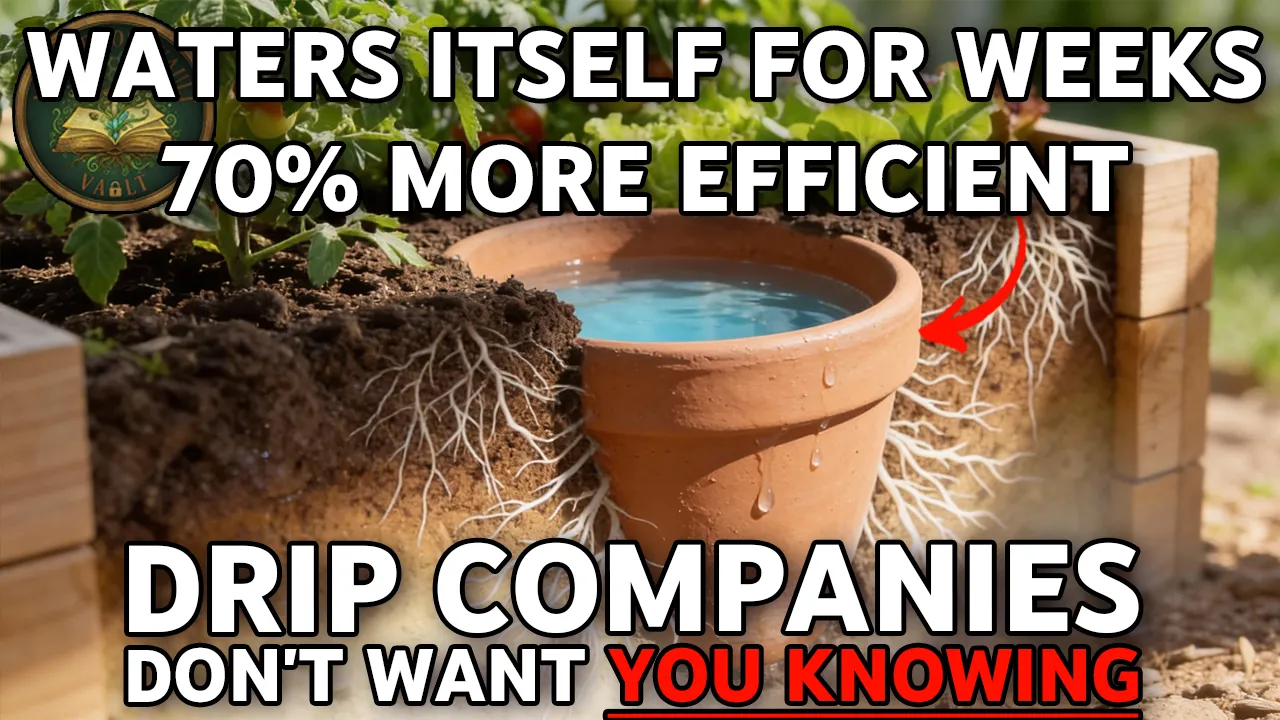

Table of Contents
Recommended Product: Unglazed terra cotta pots for buried jar irrigation
View Clay Pot OptionsAffiliate link - supports our channel
What is Buried Jar Irrigation?
In ancient China over 2,000 years ago, farmers documented a watering method so efficient it required filling a vessel once every 7 days to sustain an entire growing season. The technique appeared in one of the first agricultural texts ever written. It described burying unglazed clay jars in the earth and letting the soil decide when plants needed water.
No pumps, no timers, no daily labor—just pottery and physics.
The method spread across continents. Persian engineers refined it. Native American tribes in the desert southwest perfected it. Early American homesteaders used it to survive droughts that killed conventional farms. Then in the 1960s, it vanished.
When modern drip irrigation systems entered the market, the buried jar method quietly disappeared from agricultural extension bulletins and university textbooks. It was not erased because it failed. It was erased because the clay pot business model had a fatal flaw: You only had to buy it once.
We have been sold a narrative that modern irrigation requires complex infrastructure, ongoing maintenance contracts, and technical expertise. But what if the most efficient watering system ever developed costs less than a dinner plate, requires zero electricity, and works better the longer you ignore it?
Historical Context & Global Use
The earliest written record of this technology appears in the Fan Sheng Xi Shu, a Chinese agricultural manual compiled during the Han Dynasty more than 2 millennia ago. The instructions are remarkably specific:
- Make 530 pits per hectare
- Bury an earthen jar holding 6 liters in the center of each pit
- Let the jar mouth be level with the ground
- Fill the jar with water
The text does not explain why this works. It simply documents that it does. Farmers across ancient China followed these instructions for centuries, not because they understood the capillary physics, but because the harvests proved the method.
The jars watered crops through the driest months. They reduced labor to a single refill per week. They prevented the disease pressures that came from surface moisture.
A Global Survival Strategy
This was not just a Chinese secret. It was a global survival strategy. By the time this knowledge reached the Mediterranean, Persian engineers had adapted the technique for arid climates. Archaeological evidence shows buried irrigation vessels throughout ancient Mesopotamia.
In pre-Columbian America, the Hohokam people of what is now Arizona developed sophisticated buried pot networks that supported agriculture in one of the harshest environments on Earth. When Spanish colonists arrived in the 1500s, they did not find struggling subsistence farmers. They found irrigation systems that had sustained populations for a thousand years without modern technology.
It was standard practice. Where water meant survival, the buried jar was king.
The Science & Efficiency Data
The science behind the method is deceptively simple. It relies on a force called soil moisture tension. Unglazed terra cotta clay is porous. At a microscopic level, the wall of the pot is a semi-permeable membrane. When you bury it and fill it with water, you create a hydraulic system that operates on demand.
The Critical Mechanism
When the soil around the jar is dry, moisture tension increases. That pressure pulls water through the clay walls. But as the soil becomes saturated, the tension decreases. The seepage slows down. When the ground is fully wet from rain, the seepage stops completely.
The system is self-regulating. It responds to actual plant need, not human guesswork or a pre-programmed timer.
Plant roots figure this out quickly. If you dig up a buried jar after a growing season, you will find a dense mat of roots wrapping around the clay surface. The plants are not passively receiving irrigation. They are actively drawing it out through root pressure.
It is the only irrigation system in the world that adapts to weather, crop size, and time of day without a single microchip.
Staggering Efficiency Data
Research by David Bainbridge at the University of California, Riverside, quantified what farmers had known for millennia:
- Water efficiency: 50-70% better than traditional surface watering
- Evaporation loss: Zero (water is released below surface)
- Runoff: Zero
- Weed suppression: 87% reduction in weed biomass
The University of Arizona confirmed these findings in controlled trials. In sandy soils with high drainage, water savings reached 70% compared to surface irrigation.
But the most surprising data comes from a study in India measuring weed pressure. Weeds need surface water to germinate. In fields using surface irrigation, researchers measured 465 kg of weed biomass per hectare. In the buried pot plots, only 62 kg.
Surface watering feeds weeds. Subsurface delivery feeds only the crop. By every objective metric—water conservation, weed suppression, and yield—the ancient jar wins.
And that was the problem.
Why Modern Industry Suppressed It
By the 1960s, a shift occurred that had nothing to do with science and everything to do with economics. Drip irrigation emerged from Israeli research. It was genuinely innovative technology—plastic tubing with precision emitters. But unlike the clay pot, drip irrigation came with a business model.
Drip systems require installation. They require maintenance. Emitters clog. Filters need replacement. Tubing degrades in sunlight. The system works beautifully, but maintenance is not optional. It is a revenue stream.
Companies like Netafim, Rainbird, and Toro built global empires on this model. The drip irrigation market in 2024 is valued at nearly $7 billion.
Cost Comparison
- Basic drip irrigation setup: $200-$500 (plus annual replacement parts)
- Buried clay jar: Less than $10 (one-time purchase)
A buried clay jar costs less than $10. You buy it once, you bury it once. There are no filters to clean, no emitters to clog, no electricity to supply. For a manufacturer, this is a nightmare. It is a dead-end product. Once the customer buys it, they never come back.
So, agricultural extension services began emphasizing modern irrigation. Drip systems became the gold standard in universities. Buried pot irrigation was reframed as a quaint historical curiosity. The implication was clear: Professionals use technology. Amateurs use clay.
This was not a conspiracy. It was structural suppression. Industries built on recurring revenue cannot afford to promote methods that eliminate recurring revenue.
How to Implement This Ancient Method
Reclaiming this technology is almost absurdly simple. It does not require a specialized supplier. It requires a garden center.
Step-by-Step Instructions
1. Choose the Vessel: Standard unglazed terra cotta, the kind you find in any backyard supply store. You must avoid glazed ceramics because the glaze seals the pores. The system relies on the clay's ability to breathe.
2. Plug the Drainage Hole: A wine cork pressed firmly into the bottom works perfectly, or a dab of food-grade silicone. The goal is a watertight floor with porous walls.
3. Bury the Pot: Dig a hole and bury the pot up to its neck, keeping the rim slightly above the soil level so dirt does not wash in. You backfill the soil firmly against the clay. That contact is critical for the tension to work.
4. Cover the Opening: Use a matching saucer or a flat stone to stop evaporation from the top.
5. Fill and Plant: Fill it with water. Plant your crops around the perimeter and walk away.
Performance Guidelines
- A 1-liter pot will water a 2-foot circle
- Tomatoes, melons, and beans will find the source within days
- In the heat of summer, check it once a week
- If the water is high, leave it. If it is low, refill it
- There is no overwatering—the soil will never take what it does not need
What You've Just Built
What you have just built is a sensor-based irrigation system that runs on 0 volts. It is the only irrigation system in the world that adapts to weather, crop size, and time of day without a single microchip.
The Choice Is Yours
The disappearance of buried jar irrigation from modern agriculture was not the result of better science proving it obsolete. It was the result of economic incentives shaping what we are taught.
Drip irrigation is not inferior technology. It is necessary for industrial monocultures where scale matters more than simplicity. But for the home gardener, the small farmer, and the person who wants to grow food without fighting their equipment, the ancient way is superior.
The knowledge was not lost. It was made inconvenient to an industry that could not monetize it. But the clay pots do not care about market dynamics. They do not care about patent protection. They work the same way they did 2,000 years ago.
Fill them with water, bury them in soil, let physics and biology do the rest. You have a choice. You can invest in a system that feeds an industry, or you can bury a clay pot and feed your garden.
The ancient farmers who wrote the first instructions did not have modern materials, but they understood something we forgot: The best technology is the one that requires the least intervention.
The jars are still waiting. The technique still works. What you do with that knowledge is up to you.
Buried Jar Irrigation FAQ
What is buried jar irrigation and how does it work?
Buried jar irrigation (also called buried pot irrigation or olla irrigation) uses unglazed terra cotta clay pots buried in the soil next to plants. Water seeps through the porous clay walls when surrounding soil is dry, and stops seeping when soil is wet. The system is completely self-regulating, requiring no pumps, timers, or electricity. First documented in China over 2,000 years ago.
How efficient is buried clay pot irrigation compared to drip irrigation?
Research by David Bainbridge at UC Riverside found buried jar irrigation is 50-70% more efficient than traditional surface watering. It produces zero evaporation loss, zero runoff, and 87% fewer weeds. A buried clay pot costs under $10 as a one-time purchase, compared to $200-500 for drip irrigation plus annual replacement parts.
Why do Amish bury clay pots in their gardens?
The Amish and other traditional communities bury unglazed clay pots as a zero-electricity irrigation method. The porous clay acts as a self-regulating water delivery system: soil moisture tension pulls water through the clay walls when plants need it and stops when they do not. It requires only weekly refilling and eliminates the need for pumps, hoses, or timers.
What is a zero irrigation planting system?
A zero irrigation planting system minimizes or eliminates the need for active watering. Buried jar irrigation is the oldest known example: unglazed clay pots buried at root level deliver water on demand through soil moisture tension. Combined with mulching and drought-tolerant plants, it can sustain a garden on a single weekly refill per pot, with no hoses, timers, or electricity.
Explore More Survival Foods
Discover ancient plants that sustained civilizations through drought, famine, and extreme conditions.
Browse Survival Foods Collection →