
The Vegetable That Replants Itself for 20+ Years. Why Did Seed Catalogs Erase It?
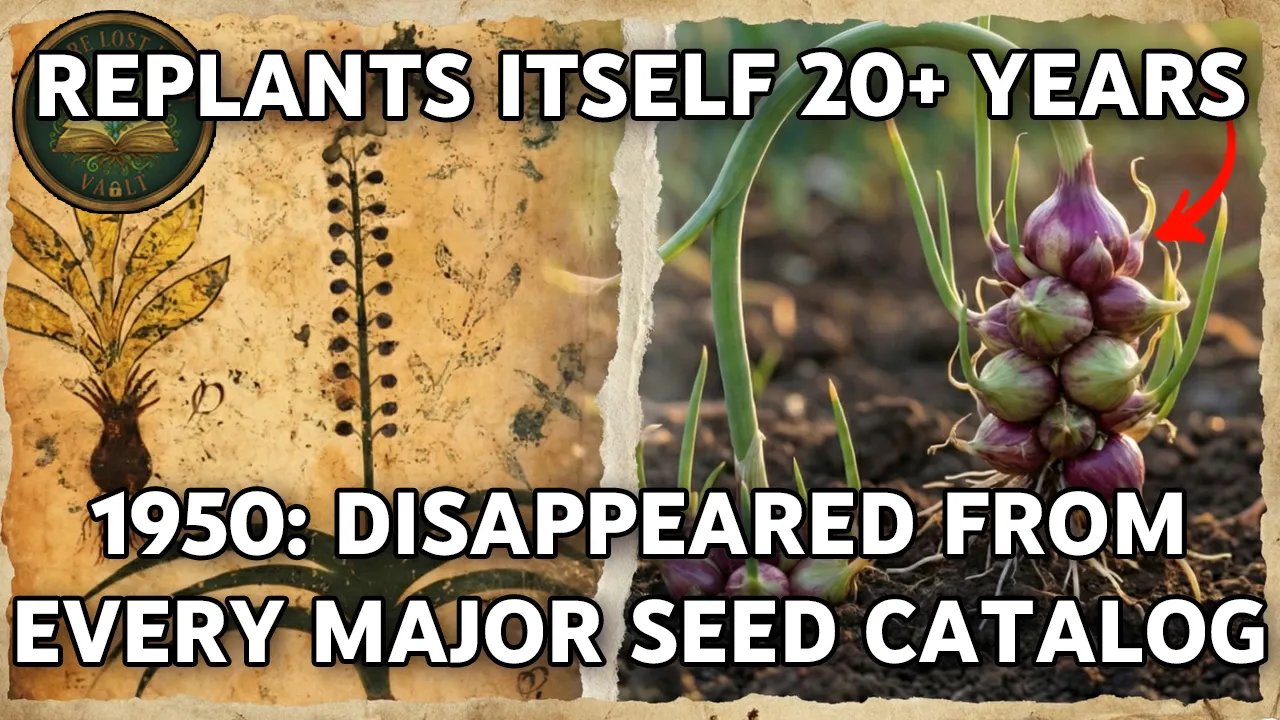
Table of Contents
Recommended Product: Tree Onion bulblets and growing supplies
View Tree Onion OptionsAffiliate link - supports our channel
What is Tree Onion?
In 1406, a Ming dynasty prince named Zhu Su published a book designed to save an empire from starvation. It was called the famine relief herbal, a survival manual for when the crops failed, for when the grain stores ran out, for when the government collapsed. Gardening histories trace the earliest written record of one plant, the tree onion (Allium × proliferum), to that book.
Not because it had the most calories, not because it stored the longest, but because it did something that biology says a vegetable should not do. It walked.
In China it is still called louzi cong, "the tiered onion," named for bulbs stacked like the stories of a building. This plant did not wait to be harvested. It did not wait to be replanted. It replanted itself every year forever.
For 600 years, it fed families through civil wars, famines, and agricultural collapse. It required no annual purchase, no permission. But today, you will not find it in a single grocery store. You will not find it in industrial farm fields.
Because in the 20th century, we built a food system that views free food as a problem to be solved. Welcome to Nature's Lost Vault. Today, we are opening the file on the tree onion, the plant that literally walks across your garden, and why an industry built on annual seed sales has no use for it.
Historical Context & Ancient Wisdom
To understand why we lost this plant, you first have to understand how it breaks the rules. Think about the onions you buy at the supermarket. They grow a bulb underground. They send up a flower stalk. They make seeds. You harvest the seeds, store them, and plant them again next spring. It is an annual cycle. Purchase, plant, harvest, repeat.
The tree onion, Allium proliferum, does not play that game. Instead of a flower, the stalk pushes up a cluster of tiny marble-sized bulblets. They grow in tiers, one on top of the other, sometimes three tiers high.
But as they swell with energy, they get heavy. The stalk begins to bend under the weight. It arches over 2 feet, 3 feet, until snap—it touches the ground. The moment those baby bulbs hit the soil, they send down roots immediately. And just like that, you have a new patch of onions a meter away from where you started.
Next spring, those new plants stand up. They fruit, they fall, and they step another meter forward. It literally walks across your garden, without asking permission, without requiring a seed catalog, without needing you at all.
Its chromosomes reveal its origin. In 1998, Nikolai Friesen and Manfred Klaas showed that it is a natural hybrid of the common bulb onion (Allium cepa) and the Welsh onion (Allium fistulosum), whose wild ranges overlap in northwestern China, where botanists place its birth. It travelled west, and by the nineteenth century it was standard in European and American kitchen gardens; the French seed house Vilmorin-Andrieux listed the "tree or Egyptian onion." And there it stayed.
The underground bulbs are edible. The green shoots are edible. The aerial bulblets are edible. You can harvest it in March, in May, in October. All parts, all seasons, for decades. One purchase, infinite onions.
Why Industrial Agriculture Erased It
So ask yourself: if this plant has been feeding families for six centuries, why is it gone? The answer is not biological. It is mechanical.
In 1900, commercial onion farming began to industrialize. Farmers stopped planting for people and started planting for machines. They needed equipment that could handle massive fields, harvesting onions by the ton. Mechanical harvesters, grading equipment, toppers that could slice foliage in seconds.
But machines are stupid. They have very specific requirements. They need uniformity. Every bulb must be the same size to fit through a grading machine designed for 3-inch standards. They need predictability. The harvest must happen on one specific day so the crews can be scheduled and the equipment can move to the next field.
Most importantly, they need a top that stands up straight so a mechanical field topper can slice off the foliage in one pass. The tree onion fails every single test.
Its bulbs are different sizes, marble-sized, 0.5 to 3 cm in diameter. Too small for commercial grading machines built for uniform 3-inch bulbs. Its harvest time is continuous. You pick shoots in spring, bulblets in summer, underground bulbs in fall. There is no single harvest day when a mechanical harvester can roll through and collect everything at once.
And the tops do not stand up. They bend over. They root. They walk. A mechanical field topper designed to slice tops at a uniform height would destroy half the crop.
From the 1950s onward, specialized onion harvesters that could lift, top, and load onions in one operation spread through commercial fields. But they only worked on one kind of onion: the annual. The one that stays put. The one that cooperates.
In time the industry mechanized field toppers, windrowers, and harvesters with GPS guidance. In the language of industrial agriculture, the tree onion was not just inefficient, it was incompatible. So they were never farmed commercially.
The Seed Industry Economics
But machines are only half the story. The real killer is the money. In 1925, a University of California plant breeder named Henry A. Jones found an onion in a planting of 'Italian Red' that could not make viable pollen. Jones and his colleagues proved that this male sterility passed through the cytoplasm and could be controlled, which made hybrid onion seed possible on a commercial scale. Jones and A. E. Clarke published the genetics in 1943, and in 1944 Jones released California Hybrid Red No. 1, the first commercial hybrid cultivar in any crop made this way.
Hybrids brought real gains: vigor, uniformity, disease resistance, bulbs that matured together for the machine. And one more feature the seed companies loved.
When you save seeds from a hybrid plant, they do not grow true. The genetics scramble. The next year's crop will be weak, unpredictable, inconsistent. This forces the farmer to return to the seed company every spring, wallet in hand, to buy the next batch. It is the perfect business model. Recurring revenue, the foundation of the modern onion seed industry.
Now consider the tree onion. You buy a bundle of bulblets once, or get a handful from a neighbor. You plant them. They multiply underground. They produce top sets. Those top sets fall and root. Within 2 years, you have 50 plants. Within 5 years, you have hundreds. You never buy again.
For a seed company, this is not a product. This is a system failure. A customer who never returns is not a customer. They are a lost revenue stream.
And it gets worse. Tree onions rarely produce seed. They propagate through clones, through bulblets. This means they cannot be bred into hybrids. There is no proprietary seed that farmers must buy from you every year.
The plant reproduces freely. It spreads from gardener to gardener, generation to generation, completely outside the commercial seed system. In the economics of modern agriculture, this makes tree onions worthless. Not because they do not feed people, but because they do not generate profit for shareholders.
How to Grow & Use Tree Onions
By the 1950s, industrial onion production had become a science. Hybrid varieties with disease resistance, mechanical harvesters with precision guidance, storage facilities with climate control. Grocery stores stocked the onions that shipped well and stored for months. Seed catalogs sold the onions that needed annual repurchase.
And we accepted a system where we traded planting once for paying forever. Annual onions became cheaper, more uniform, and more available than at any point in history. Restaurants could rely on consistent supply. Supermarkets could stock onions year-round.
And in that flood of cheap, uniform, mechanized onions, the tree onion disappeared—not because it failed, but because it succeeded in the wrong way. It succeeded at being perennial, at propagating itself, at requiring no industrial input. And those are not features in a system designed around annual purchases.
What We Actually Lost
But look at what we actually lost. We lost a perennial food source. Annual onions require tilling the soil every year, destroying the microbial life, releasing carbon, and causing erosion. They require synthetic fertilizers because their shallow roots cannot reach deep nutrients.
Tree onions are perennial. Once established, a bed stays for years. The clumps thicken and spread, nobody turns the soil each spring, and something edible comes off the plant for most of the growing season. Less tillage, less erosion, less labor.
We are spending billions of dollars today trying to engineer climate-resilient crops. Meanwhile, a plant that has survived famines for 600 years is growing in ditches, forgotten.
Zhu Su knew this in 1406. He compiled the famine relief herbal because famines were common in Ming dynasty China. Grain stores failed. Trade routes collapsed. Armies burned fields. The plants that saved people were not the ones that required complex supply chains, annual replanting, or purchased seeds. They were the ones that came back on their own.
Tree onions do not care if you forget to replant them. They do not need you to buy seeds. They do not require industrial infrastructure. They just walk—slowly, persistently, across gardens, across centuries, asking nothing. And we classified that as a problem.
The Return of Tree Onions
Today the rules are changing. The system we built—annual monocultures, hybrid dependency, and mechanical uniformity—is showing cracks. Soil is eroding. Water is scarce. Fertilizer costs are rising. Farmers are trapped in debt cycles, forced to purchase seeds, chemicals, and equipment every year just to stay operational.
And in the middle of that crisis, the tree onion is walking back into the spotlight. Because the characteristics we bred out of our food system, permanent coverage and self-sufficiency, suddenly look less like inefficiency and more like survival.
You can buy them online today from small nurseries, and Seed Savers Exchange, a nonprofit dedicated to heirloom seeds, keeps them in circulation. They are often labeled as novelties or curiosities for adventurous gardeners.
Do not believe that framing. These are not novelties. They are 600-year-old survival technology. They fed Chinese peasants through dynastic collapse. They fed English cottages through the industrial revolution. They fed American homesteaders when the seed wagons did not show up. They were not specialty crops. They were staples.
And the only reason they feel strange now is because we spent a century designing agriculture around machines and quarterly profits instead of resilience and permanence.
Plant the Future
It will not be the industry that brings this plant back. The hybrid onion seed industry has no incentive to promote a plant that eliminates recurring revenue. It will come from you. From gardeners, from homesteaders, from people who plant 10 bulblets this spring and wake up 5 years later with a patch that feeds them forever.
From people who realize that the most advanced agricultural technology is not precision farming or genetic modification or GPS-guided tractors. It is a plant that takes care of itself.
If you plant tree onions this spring, they will return next year and the year after that and the year after that. Your children will eat from them. Maybe your grandchildren. Not because you kept replanting, but because the plant never asked you to.
The Ming dynasty fell. Empires rose and collapsed. The industrial revolution mechanized the world. And through all of it, the tree onion kept walking: slowly, persistently, feeding anyone who let it stay.
One purchase, infinite onions, forever. That is not a product. That is a promise written in roots that refuse to die.
If this story changed how you see the onions in your grocery store, subscribe to Nature's Lost Vault. We are digging up the survival technology they tried to mechanize out of existence. Some plants wait for permission. Some just walk. Plant the future. The next vault opens soon.
Frequently Asked Questions
What is a tree onion?
A tree onion (Allium x proliferum), also called Egyptian walking onion, is a perennial onion that grows small bulbils on top of its stalk instead of flowers. These bulbils fall over and root themselves, causing the plant to 'walk' across your garden and replant itself indefinitely.
How long does a tree onion produce?
Tree onions produce for 20+ years from a single planting with zero maintenance. They replant themselves through top-set bulbils, creating an ever-expanding patch of onions that requires no seed purchases, no replanting, and no annual inputs.
Why don't stores sell tree onions?
Tree onions replant themselves, eliminating the need for annual seed purchases. Commercial onion growing runs on hybrid seed bought every season and on uniform bulbs harvested by machine. A perennial onion that rarely makes seed, cannot be bred into hybrids, and drops bulblets of mixed sizes at different times fits neither, so commercial agriculture has no incentive to promote it.
Explore More Survival Foods
Discover ancient plants that sustained civilizations through drought, famine, and extreme conditions.
Browse Survival Foods Collection →