
Plant Once, Feed Your Family Forever: Why Don't You Know About It?
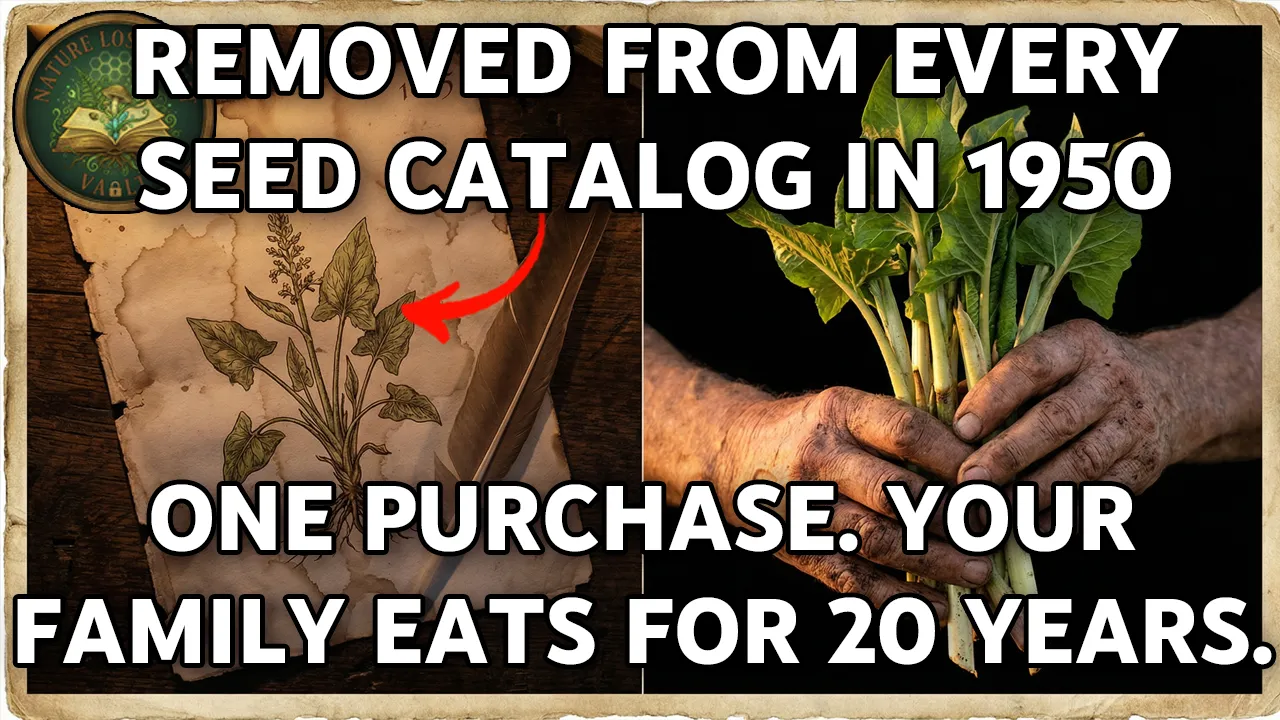
Table of Contents
Recommended Product: Good King Henry seeds
View Good King Henry SeedsAffiliate link - supports our channel
What is Good King Henry?
In 1593, King Henry IV of France made a promise that became legendary. He said he wanted no peasant in his kingdom so poor that he could not have a chicken in his pot every Sunday. It was a beautiful idea, a political promise of abundance. But while the king was making speeches, the peasants were already eating.
They did not need a chicken and they did not need the king because for 500 years their pots had been filled by a different Henry. This one was not a monarch. It was a weed. They called it Good King Henry (*Chenopodium bonus-henricus*).
From the 12th century until the industrial revolution, this plant was the engine of European survival. It grew in every cottage garden from England to Germany. It was not something you bought.
It was not even something you planted every year. It was perennial. You put it in the ground once and it fed you for the rest of your life. Welcome to Nature's Lost Vault.
Today we are opening the file on the peasants asparagus and why modern agriculture had to destroy it. Not because it failed, but because it worked too well. To understand why this plant disappeared, you first have to understand what we lost. If you walked into a Tudor garden in 1550, Good King Henry was the anchor.
In March, it shot up thick stalks that tasted like sweet asparagus. In May, it produced leaves that tasted like spinach, and it kept producing until frost. For centuries, it was the backbone of medieval vegetable soups combined with leeks, chard, and bread in a vitamin-rich broth that sustained peasant farmers through brutal winters. The Romans knew it.
Pliny the Elder wrote about a plant that Emperor Tiberius demanded as tribute from Germanic tribes. Most historians believe he was talking about Good King Henry. The emperor wanted it that badly. And nutritionally it makes modern spinach look like cardboard.
In 1989 a study published in HortScience measured the nutritional content of Good King Henry. Then in 2022 Backyard Larder ranked perennial vegetables for nutritional density. Good King Henry outperformed spinach, kale, and chard across multiple micronutrient categories. Iron higher than spinach.
| Metric | Value |
|---|---|
| Botanical name | Chenopodium bonus-henricus (now reclassified as Blitum bonus-henricus) |
| Family | Amaranthaceae (formerly Chenopodiaceae) |
| Common names | Good King Henry, peasant's asparagus, perennial spinach, Lincolnshire spinach, mercury goosefoot, fat hen |
| Life cycle | Perennial (productive 20+ years from a single planting) |
| Mature height | 1.5–2.5 feet (45–75 cm); root depth ~3 feet |
| Earliest written reference | 1st century AD (Pliny, Naturalis Historia) for the Chenopodium genus |
| Cottage-garden staple from | 12th century onward across England, France, Germany, the Alps |
| Edible parts | Spring shoots (asparagus-like) + summer leaves (spinach-like) + flower buds (broccoli-like) |
| Iron | Higher than cultivated spinach |
| Calcium | Higher per gram than cow's milk |
| Other nutrients | High vitamin C, B vitamins; oxalates present (cook before eating) |
| Nutritional benchmark | 2022 Backyard Larder ranking: above spinach, kale, and chard |
| Killed off by | 1701 Jethro Tull seed drill, 1837 John Deere plow, 1920s commercial seed industry |
| Dropped from US seed catalogs | By ~1950 |
| Soil benefits | 3-foot taproot prevents erosion, sequesters carbon, accesses deep nutrients |
| Modern revival signal | 2009 Land Institute Kernza release; 2022 USDA CSP includes perennials |
| Annual vs perennial cropland share | Annuals 70% / perennials 13% (despite 94% of plant species being perennial) |
Historical Context & Discovery
Calcium higher than milk. Vitamin C off the charts. It has more B vitamins than most leafy greens. Complete nutrition from a plant that required zero annual labor.
No tilling, no replanting, no seeds to buy every spring. It just showed up every year like a loyal friend. So where is it? Why are we spending billions genetically modifying climate resilient crops when the perfect droughtproof vegetable already exists?
The answer is not a conspiracy. It is a geometry problem. The murder of Good King Henry began in 1701 with an English farmer named Jethro Tull. Tull invented the seed drill.
It was a brilliant machine that mechanized planting, but it had one specific requirement, uniformity. The drill favored annuals, crops you plant from scratch every year in perfect straight rows. Wheat, corn, turnips. But Good King Henry, it was chaotic.
It grew in clumps. It spread by roots. It did not stay in the line. You could not plant it with a drill in perfect rows.
You could not mechanize the harvest. In the language of emerging industrial agriculture, it was inefficient. When the industrial revolution arrived, farmers stopped looking at food and started looking at efficiency. In 1837, John Deere invented the steel plow.
For the first time, farmers could break virgin prairie soil and turn it into farmland. But perennial root systems, the kind Good King Henry developed over decades, were the enemy of the plow. They held soil together. They resisted breaking.
Annual crops with their shallow, weak roots were easy. You plowed, you planted, you harvested, you plowed again. The system selected for annuals not because they were better for soil, better for nutrition, or better for farmers, but because they were better for machines. In 1900, the tractor replaced the horse.
Every single machine we built was designed to do one thing. Wipe the earth clean and start fresh every spring. Perennials like Good King Henry fought back. Their roots went down 3 ft.
They held the soil. They broke the plows. In the eyes of the machine, this plant's greatest strength, its resilience, became its fatal flaw. It was labeled inefficient.
Not because it did not feed people, but because it slowed down the tractor. But machines are only half the story. If the tractor was the weapon, the business model was the motive. In the 1920s, the modern commercial seed industry exploded.
Companies like Burpee, Ferry-Morse, and Northrup King realized a fundamental truth of capitalism. Perennials are a terrible product. Think about it. If I sell you a packet of spinach seeds, you have to come back and buy more next year and the year after that and the year after that.
It is recurring revenue. If I sell you Good King Henry seeds, I never see you again. You plant it once and your children are still eating from it 20 years later. It is self-sufficiency, and self-sufficiency is the enemy of profit.
By 1950, seed cataloges had quietly dropped perennial vegetables. Good King Henry disappeared from commercial offerings, not because it stopped working, but because it worked too well. And then came the final nail, the green revolution. In 1960, Norman Borlaug introduced high-yielding dwarf wheat varieties.
The promise was simple, more calories per acre. The cost was hidden. Total dependence on synthetic fertilizer, mechanization, and annual replanting. The green revolution saved a billion people from starvation.
That is true. But it also locked global agriculture into a system where perennial vegetables had no place. Government subsidized annual grain crops. Universities focused research budgets on corn, wheat, and soybeans.
Agricultural extension services taught farmers to think in planting seasons, not in perennial plots. We bet the entire farm on annuals. We chose wheat, corn, and soy. We accepted a system where 70% of our crop land requires violent tillage every single year, destroying the soil, releasing carbon and demanding synthetic fertilizers just to keep growing.
Scientific Research & Nutritional Benefits
We traded a plant that takes care of itself for plants that are on life support. Today, annual crops occupy 70% of global crop land. Perennial crops occupy 13%. Think about that.
94% of all plant species on Earth are perennial, but only 13% of our farmland grows them. We chose the exception and made it the rule. And what did we lose? Start with the soil.
Annual agriculture requires tillage. Every year you break the earth open, plant seeds, then leave the soil bare for months. wind erosion, water runoff, carbon release. The American dust bowl of the 1930s was caused by exactly this, plowing up perennial prairie grasses and replacing them with annual wheat.
Perennials like Good King Henry have root systems that go down 3 ft or more. They hold soil together year round. They prevent erosion. They sequester carbon.
Research from the land institute shows that perennial crops reduce soil erosion by up to 50% compared to annuals. Then there is the water. Annual crops lose up to five times more water than perennials because their shallow roots cannot access deep moisture. In a world facing water scarcity, we built our entire food system around the most water inefficient plants possible.
And the chemicals, annual monocultures require synthetic fertilizers because tilling destroys soil biology. They require pesticides because bare fields are vulnerable to weeds and pests. Perennials like Good King Henry needed none of this. Their deep roots accessed nutrients other plants could not reach.
Their year round coverage suppressed weeds naturally. We are now living with the bill for that decision. Soil erosion, water scarcity, nutrient collapse. The annual experiment is failing.
But nature plays the long game. While the tractors were conquering the fields, Good King Henry did not actually die. It retreated. It survived in the margins, in the gardens of stubborn grandmothers in Yorkshire, in wild patches near old monasteries, in the mountains of Switzerland.
And now the vault is opening again because the rules are changing. We are finally realizing that efficiency is not efficient if it destroys the soil. In 2009, The Land Institute released Kernza, the first commercially viable perennial grain. It has taken two decades of breeding, but perennial wheat is finally becoming real.
Climate change is forcing us to reconsider annuals. Soil degradation is accelerating. Water is becoming scarce. And suddenly the characteristics we bred out of our food system, deep roots, permanent coverage, self-sufficiency, look less like inefficiency and more like survival.
In 2022, USDA updated the conservation stewardship program to include perennials for the first time. It is a small change, but it signals something larger. recognition that the annual monoculture system is not sustainable long term. And Good King Henry, it never actually disappeared.
You can buy seeds online today. You can plant them this spring. And unlike every other vegetable you grow, you will not have to plant them again. They will return every year for the next 20 years.
How to Identify, Grow & Use Good King Henry
The shoots will come up in March. The leaves will follow in April and you will taste something most people have not tasted in a century. Food that does not depend on a system. Food that opts out of the machine.
Food that grows on its own timeline by its own rules without asking permission. When those shoots come up next March and the march after that and the march after that, you will participate in a quiet rebellion. You will be eating food that exists outside the industrial timeline. Food that does not need a tractor.
Food that does not need a seed company. Food that does not need a king's permission. King Henry IV's promise of a chicken in every pot depended on wealth, on commerce, on a functioning economy. When economies collapsed, the promise failed.
The other, King Henry, the plant that lived in gardens for 500 years, asked for nothing. It just grew. One made a promise that required the world to cooperate. The other kept a promise the world had forgotten how to hear.
And now maybe we are starting to listen again. If this story changed how you see the weeds in your garden, subscribe to nature's lost vault. We are digging up the history they tried to plow over. Some promises are made with words.
Some are kept in roots that refuse to die. Plant the future. The next vault opens soon.
Good King Henry FAQ
What is the nutritional value of Good King Henry?
Good King Henry (Chenopodium bonus-henricus) contains more iron than spinach, more calcium than milk, high vitamin C, and more B vitamins than most leafy greens. A 2022 Backyard Larder study ranked it above spinach, kale, and chard across multiple micronutrient categories. Both shoots and leaves are edible, making it one of the most nutrient-dense perennial vegetables available.
What are the health benefits of Good King Henry?
Good King Henry provides exceptional iron, calcium, vitamin C, and B vitamins from a single plant. Its high mineral density supports bone health, immune function, and energy metabolism. As a perennial, it provides fresh nutritious greens from early spring (March shoots) through autumn (leaves), filling the "hungry gap" when few other fresh vegetables are available.
Why is Good King Henry called peasant's asparagus?
Good King Henry earned the name "peasant's asparagus" because its thick spring shoots taste similar to asparagus but required zero annual labor. From the 12th century through the industrial revolution, European peasants grew it as a staple perennial vegetable. Unlike asparagus, it also produces spinach-like leaves throughout summer, providing two crops from one planting that lasts 20+ years.
How do you grow Good King Henry?
Plant Good King Henry seeds or divisions in spring in partial shade to full sun. It thrives in most soils, tolerates drought, and needs no fertilizer once established. Harvest asparagus-like shoots in March, then pick spinach-like leaves from April through autumn. The plant is fully perennial: one planting produces food for 20+ years with zero replanting. Seeds are available online from specialty herb suppliers.
Why did Good King Henry disappear from commercial seed catalogs?
Good King Henry disappeared from commercial seed catalogs by 1950 because perennial vegetables are a poor business model: customers only buy seeds once, then harvest from the same plants for 20+ years. The 1701 Jethro Tull seed drill required uniform annual rows, John Deere's 1837 steel plow could not work around deep perennial roots, and the 1920s commercial seed industry (Burpee, Ferry-Morse, Northrup King) needed recurring revenue. The plant was labeled "inefficient" not because it failed to feed people but because it slowed down tractors and produced no repeat sales.
Explore More Perennial Foods
Plant once, harvest for decades. Discover the perennial crops that fed cottage gardens long before the seed catalog existed.
Browse Perennial Foods Collection →