
More Vitamin C Than Oranges: Why $11 Billion Is Spent Killing It
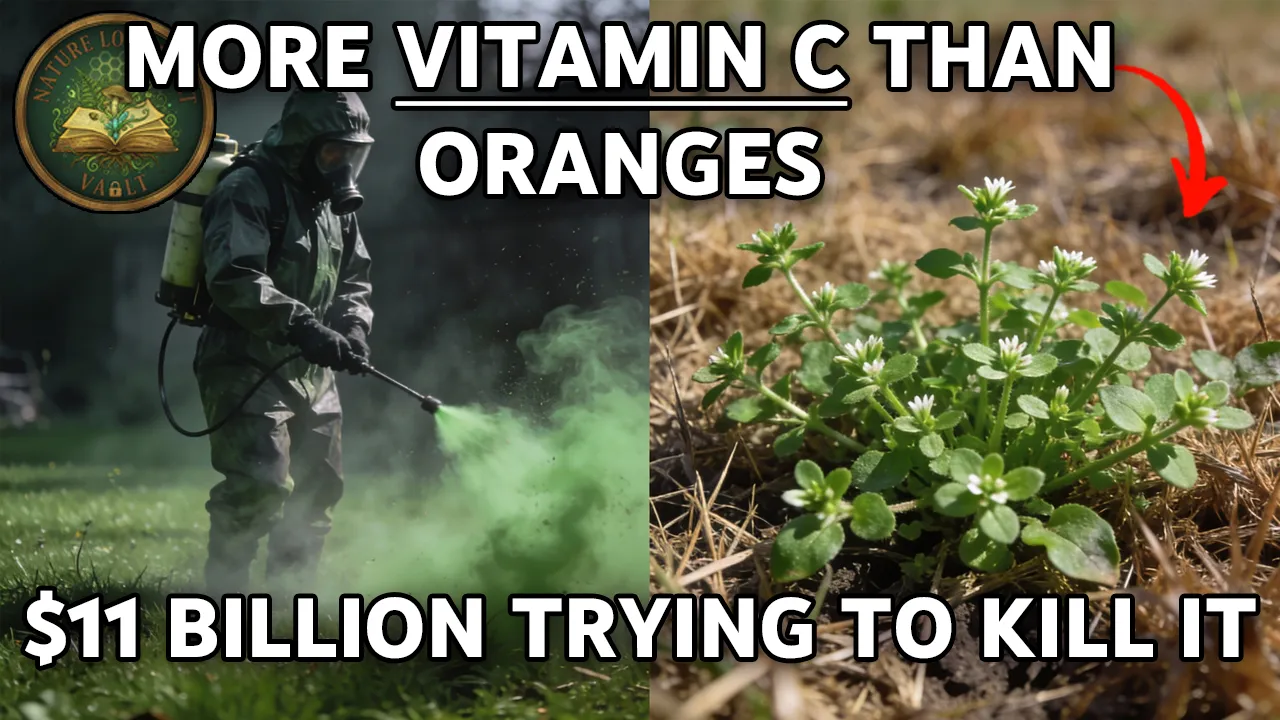
Table of Contents
Recommended Product: Chickweed seeds and growing supplies
View Chickweed OptionsAffiliate link - supports our channel
What is Chickweed?
In 2012, archaeologists excavating medieval ruins in Europe tested seeds buried for 600 years under collapsed stone walls. 22% germinated within 2 weeks. The plant that survived 6 centuries underground is the same plant photosynthesizing in your yard right now at 26° F while every other green thing lies dormant. Victorian England couldn't get enough of it.
The 1863 edition of the kitchen garden called it the most productive winter vegetable per square foot in the British Isles. London restaurant served it to wealthy Cleontel. By 1947, everything changed. The plant that fed Europe for 2,000 years became public enemy number one.
Today, Americans spend $1 billion annually on lawn care products, specifically targeting this plant by name. The global broadleaf herbicide market sits at 11.7 billion. This is chickweed (*Stellaria media*), and the war against it is a masterclass in agricultural manipulation. Welcome to Nature's Lost Vault.
In the year 90 AD, the Greek physician Dioscorides compiled Demateria Medica, a five volume encyclopedia that remained the primary medical text in Europe for 1,500 years. Among 600 plants, he gave precise instructions for one winter growing herb. He advised mixing it with cornmeal for eye inflammation, introducing juice into the ear for earachches, and consuming leaves to treat malnutrition. Archaeological investigations across Viking age sites from 775 AD to 1,50 AD consistently identify chickweed in settlement deposits.
A 2021 study in philosophical transactions of the Royal Society confirmed medicinal chickweed use throughout medieval Scandinavia. Medieval Europeans understood what modern agriculture has tried to erase. Chickweed is insurance against starvation. Historical records document families in rural Ireland, Scotland, and England surviving failed wheat harvests by walking outside in February, brushing snow aside, and harvesting chickweed growing green beneath the white.
It was not a delicacy. It was survival. The plant appeared on its own, grew through winter, and asked nothing in return. By the 1580s, the English herbalist John Gered documented families giving chickweed to caged birds as a tonic.
Farmers hatched chicks in early spring and raised them on a primary diet of chickweed until they could forage. The plant's name isn't metaphorical. Chickweed literally means the weed that chickens devour. By the 1600s, physician Nicholas Culper prescribed it systematically for inflammation, skin conditions, and weight loss.
Then, Victorian England elevated it from medicine to cuisine. By the 1850s, seed cataloges marketed chickweed alongside lettuce and spinach. The plant that kept peasants alive during famine became fashionable dining for the upper class. This wasn't misguided tradition.
Historical Context & Discovery
Nutritionists documented malnourished children recovering from ricketetts, sailors avoiding scurvy with chickweed vinegar during six-month voyages, and pregnant women experiencing fewer complications. Modern testing confirms why chickweed contains 375 mg of vitamin C per 100 g. Spinach contains 63. That is six times more vitamin C, delivering over 400% of your daily requirement in a single serving.
The calcium measurement is even more dramatic. Chickweed contains 187 mg of calcium compared to spinach's 15. That is 12 times more calcium than spinach. And it even surpasses milk, which contains 120 mg.
But the iron measurement is where chickweed becomes extraordinary. Testing confirms up to 83 times more iron than spinach. Chickweed delivers concentrations so high that medical texts prescribed it for anemia and pregnancy complications. The complete profile includes vitamins A, D, and the entire B complex.
and it functions as a dynamic accumulator, concentrating phosphorus, potassium, and manganesees from deep soil. A 1953 Massachusetts study measured chickweed tissue against onions growing beside it. The chickweed contained nearly double the nitrogen, double the phosphorus, and triple the potassium. Chickweed was extracting and storing nutrients at levels crop plants couldn't match.
Victorian physicians watched children recover from ricketetts within weeks. The empirical evidence was undeniable. Then World War II ended. American chemical companies had perfected herbicides for warfare.
Agent Orange and 24D destroyed enemy crops and vegetation. When peace arrived in 1945, these companies had chemical weapons and no war. The solution was brilliant. Declare war on American lawns.
In 1947, Scots began marketing 24D to homeowners under the brand Weed Be Gone. Their campaign introduced a revolutionary concept. The perfect lawn contains nothing but grass. Clover, intentionally included in seed mixes since the 1800s to fix nitrogen, was suddenly the enemy.
Dandelions required elimination. Chickweed became target number one. The timing reveals the manipulation. Between 1947 and 1952, Scots removed white clover from lawn seed mixes specifically because they had developed herbicides that killed clover.
They could not sell the poison if lawns were supposed to contain the target. So, they changed the definition of a lawn. Today BASF manufactures barricade with prodamine. Sententa produces tenacity with meotri.
Bayer markets weed begone max combining 2 4D MCPPP and dicama. Corteva sells speed zone. FMC offers dismiss. Every major herbicide manufacturer lists chickweed by name as a primary target.
The market size reveals the stakes. US lawn care hit 11.06 billion in 2023 and is projected to reach 15.09 billion by 2030. The global broadleaf herbicide market sits at 11.7 billion, forecast for 16.3 billion by 2031. The agrochemical giants are spending billions to eradicate what medieval peasants relied on for survival.
Here is what makes this absurd. After 77 years of chemical assault, chickweed populations have not declined. They have exploded. Each plant produces between 800 and 25,000 seeds.
Those seeds remain viable for 60 years. Cornell confirmed 22% still germinated after 9 years of burial. Medieval ruins proved viability after 600 years. This means every chickweed plant destroyed today deposits thousands of seeds germinating across six decades.
Spraying herbicides does not eliminate chickweed. It creates seed banks, ensuring chickweed dominance for generations. You are fertilizing future infestations while poisoning soil. Chickweed completes its life cycle in 5 weeks.
From seed to flowering plant, producing thousands of new seeds takes less time than tomatoes go from transplant to first fruit. And chickweed produces five generations per year. The math is devastating. One plant producing 5,000 seeds with five generations means 25,000 seeds annually.
If 10% germinate next year, that is 2,500 new plants producing 12. 5 million seeds within 2 years. Every stem node touching moist soil develops roots independently. Pull a plant and miss one fragment and it regenerates within 2 weeks.
Scientific Research & Nutritional Benefits
The plant does not die when disturbed. It clones itself, but its greatest weapon is winter. Cornell confirmed chickweed photosynthesizes at temperatures below freezing. Base growth temperature is 26° F.
It tolerates 7° F before damage. While grass lies dormant from November through March, chickweed is actively growing, flowering, spreading, and producing seeds. It grows under snow. Historical records document it flowering while covered by snowpack.
By the time spring arrives and you spray your lawn, chickweed has already produced two generations and deposited hundreds of thousands of seeds. This biological strategy makes chemical control irrelevant. The seeds are banked in soil, waiting for fall. And now chickweed is fighting back.
Studies between 2020 and 2024 confirmed populations in Delaware, Pennsylvania, Canada, and Europe that no longer respond to ALS inhibitor herbicides. The same evolutionary pressure creating antibioticresistant bacteria is creating herbicide resistant chickweed. The industry responds with stronger chemicals, combination products mixing multiple herbicides, and pre-emergence sterilizing soil for months. But none of this addresses the fundamental problem.
Chickweed is not a weed. It is a winter vegetable with six times more vitamin C than spinach, and American homeowners pay billions to destroy it. Here is the economic reality. Chickweed cannot be patented, genetically modified, or sold at premium prices.
And most critically, it cannot be controlled. Every other winter vegetable requires green houses, heating, or long-d distanceance shipping from California or Mexico. The infrastructure investment is enormous. Transportation costs are substantial.
Energy consumption is massive. Chickweed requires nothing. It germinates naturally in fall, grows without irrigation or fertilizer, tolerates frost and snow, and produces continuously through winter. No heating, shipping, packaging, or corporate control.
Just walk outside in January, brush snow aside, and harvest. That economic model threatens every company profiting from winter produce supply chains. If Americans understood that their lawns naturally produce a vegetable nutritionally superior to spinach and available fresh for 6 months each year, the lawn care industry collapses. You cannot sell herbicides to destroy the most nutritious plant in someone's yard once they recognize what they are destroying.
This is why the cultural programming runs so deep. Suburban bylaws prohibit chickweed by name. Lawn care companies train crews to identify and spray it as priority one. Garden centers display aisles of chickweed killers while shoppers buy spinach shipped 2,000 m.
Meanwhile, across cultures that never abandoned it, the plant remains essential. In Japan, chickweed is celebrated during Nanakusa Noku, the spring festival dating to the Hyan period between 794 AD and 1185 AD, over 800 years of continuous cultural practice. Traditional Chinese medicine calls it the dermatologist of the field. European herbalists never stopped cultivating it.
Rural Appalache passes it down through generations. The plant's winter growth makes it irreplaceable as climate becomes unpredictable. While spring crops suffer late frosts and fall crops struggle with early freezes, chickweed thrives through temperature extremes. It provides guaranteed fresh greens from December through March, regardless of weather.
Look for it November through April. While everything else stays brown, small oval leaves in opposite pairs, a single line of fine hairs switching sides at each stem junction, and five white star-shaped petals. It tastes mild and slightly sweet. That bright green mat around your building edges, under trees, anywhere grass struggles is your winter vegetable.
How to Identify, Grow & Use Chickweed
Chickweed has survived 77 years of chemical warfare funded by billions of dollars, not because it's lucky, but because it's biologically superior. It grows when nothing else can, produces more nutrition per square foot than any domesticated crop, and reproduces faster than herbicides can kill it. The global herbicide industry invests billions annually attempting to eradicate a plant providing six times more vitamin C, 12 times more calcium, and 83 times more iron than spinach. That level of investment in destruction reveals exactly how economically valuable chickweed is and how threatened corporate agriculture feels.
Walk outside. Look at the edges of your yard where grass struggles and something green is growing despite the cold. That is your winter vegetable garden producing the most nutritious greens available in North America. It has been there all along providing free food while you paid to destroy it.
The question is whether you will keep killing it or start eating it. Chickweed is waiting. It has been waiting for 2,000 years, and it will keep waiting, growing through winter, surviving every chemical you spray until you recognize what your ancestors knew. It's food.
If this vault opens something for you, subscribe to Nature's Lost Vault and hit the bell. Every like and share preserves what they tried to erase. The next vault opens soon.
Frequently Asked Questions
Is chickweed more nutritious than spinach?
Yes. Chickweed (Stellaria media) contains 6x more vitamin C than spinach, 12x more calcium than milk, and significant protein. It is one of the few wild edibles that grows through winter snow, producing fresh greens when garden vegetables cannot.
Can you eat chickweed?
Yes, chickweed is entirely edible. Young stems, leaves, and flowers are eaten raw in salads or cooked like spinach. It has a mild, pleasant flavor. It grows abundantly in gardens, lawns, and disturbed soil across most temperate regions.
When does chickweed grow?
Chickweed grows primarily in cool weather, thriving from autumn through spring. It is one of the few plants that continues growing through winter snow. Seeds can survive buried underground for up to 600 years and still germinate.
Explore More Medicinal Plants
Discover ancient healing plants backed by centuries of traditional use and modern science.
Browse Medicinal Plants Collection →