
They Chose the Potato Over This. The Crop Spain Deliberately Erased
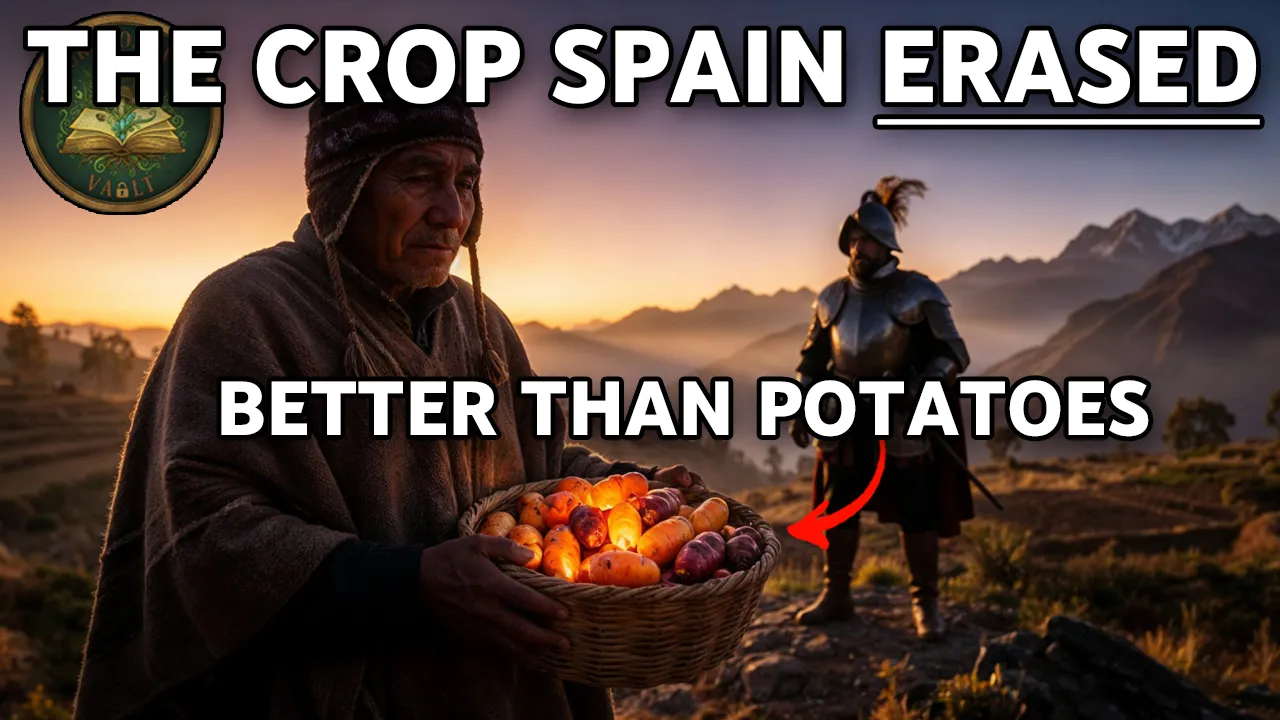
Table of Contents
What is Oca?
There is a tuber that matches the potato in yield, thrives on marginal soils where nothing else will grow, comes in every color of the rainbow and tastes like sweet fruit after a frost. It was feeding civilizations 8,000 years before Europeans arrived. Then the conquistadors decided it looked too much like survival without their permission. They chose the potato for their empire and left this one to fade.
This is oca (Oxalis tuberosa), the second most important tuber of the Andes. The archive opens in the Peruvian coastal desert near modern Lima, where researchers digging in the dry sands discovered preserved tubers: small, colorful, cylindrical, with a distinctive bumpy texture. Carbon dating placed them at 4,250 years old. Higher in the Andes, at a site called Tres Ventanas at 4,000 metres elevation, researchers found evidence suggesting oca may have been cultivated for 10,000 years: ten millennia of human partnership with a single plant, before the pyramids, before written language, before the first brick was laid in Rome.
What makes these finds significant is that they were not found alongside potato remains. They were found at sites where potatoes could not reliably grow. Oca was not a backup crop. It was the primary food source for people farming the edges of what was possible: the plant they turned to when altitude, cold and poor soil made other crops fail.
For 8,000 years, Quechua and Aymara farmers cultivated oca in rotation with potatoes, planting it on marginal land, on high slopes, on poor soils that even potatoes struggled with. They engineered it into a masterpiece of food security, developing two distinct categories based on chemistry. The bitter varieties (called luki) contained high levels of oxalic acid. Farmers would soak these tubers in water for a month, then freeze-dry them in the harsh Andean nights to create khaya, a preserved food that could be stored for years as a hedge against famine. The sweet varieties (called miski) were exposed to sunlight for several days after harvest. The sun reduced the acid and increased the glucose, turning a root vegetable into something that could be eaten raw like a fruit, or boiled, baked and fried like a sweet potato.
The diversity was astounding. Tubers ranged from white and cream to neon pink, deep red and purple. Farmers named varieties with poetry, such as "black ash" and "red cosmos flower." This was botanical artistry developed over millennia.
| Metric | Value |
|---|---|
| Botanical name | Oxalis tuberosa |
| Family | Oxalidaceae (wood sorrel family) |
| Years of cultivation | 8,000–10,000 (Andes) |
| Oldest preserved tubers | ~4,250 years (Peruvian coast, near Lima) |
| Vitamin C vs potato | +42% |
| Iron vs potato | +45% |
| Fiber vs potato | ~4× |
| Yield (modern, virus-free stock) | Up to 55 tons / hectare |
| Maximum cultivation altitude | ~4,100 m (13,450 ft) |
| Two traditional types | Luki (bitter, freeze-dried into khaya) · Miski (sweet, sun-cured) |
| Tuberization trigger | Short days (<12 h), autumn |
| Hardiness zones | USDA 7–10 |
| Pest pressure outside the Andes | Virtually none |
| CIP gene bank holdings | 800+ varieties (Lima, Peru) |
| Major commercial market today | New Zealand (sold as "New Zealand yam" since c. 1860) |
Historical Context & Discovery
The nutritional profile explains why oca became so critical to Andean survival. Fresh oca contains 42% more vitamin C than potatoes, 45% more iron, and nearly four times the fiber. It is high in protein with a balanced amino acid profile, all while being lower in calories and carbohydrates than the potato.
But the real genius of oca was its agricultural role. Traditional Andean farmers planted it at altitudes up to 4,100 metres (13,450 feet). It grew on slopes too steep for tractors. It grew in soils depleted by other crops. It required no fertilizers, no pesticides, just occasional weeding. Under traditional methods, the yields matched the potato. With modern virus-free seed stock, oca can produce up to 55 tons per hectare, higher than many commercial potato varieties, on land where the potato would fail.
This was not subsistence farming. This was sophisticated agricultural engineering designed to extract maximum nutrition from difficult terrain. Ceramic urns from a thousand years ago depict oca alongside other revered crops. It was a staple, a pillar of the empire. Spanish conquest chronicles describe it as highly valued. But those same chronicles document what happened next.
On November 16, 1532, Francisco Pizarro captured the Inca emperor Atahualpa. Despite receiving a room filled with gold as ransom, Pizarro executed him. The Spanish crown and church demanded that European crops replace indigenous ones: wheat, barley, broad beans. These were the crops of "civilization." In Spanish eyes, the foods of the Inca were deliberately erased, forced into obscurity. But the Spanish did make one exception. They selected the potato.
Why the potato and not oca? The answer reveals everything about the logic of colonial control. Potatoes were convenient food for slaves in the silver mines. Potatoes fit the European agricultural model of large monoculture fields. And crucially, potatoes had less farmer-maintained diversity. The Spanish could standardize potato cultivation more easily than the hundreds of localized oca varieties.
Oca represented something dangerous to colonial power. It represented agricultural knowledge that existed outside European understanding. It represented food security that did not depend on European seeds or methods. It represented the ability of indigenous peoples to survive independently on marginal lands the Spanish could not easily control or tax. So oca was systematically marginalized, stigmatized as a "poor man's tuber" associated with backwardness and poverty. That stigma persisted for nearly five centuries. Even today in urban Peru and Bolivia, oca is often seen as rural peasant food. The crop that fed the Andes for 8,000 years was reduced to a garden vegetable.
Modern Science & Rediscovery
What the Spanish could not erase was the biological reality of what oca represents. You cannot patent an 8,000-year-old crop. You cannot force farmers to buy new oca seeds every year because oca propagates vegetatively from tubers. Any farmer who grows oca can save their own planting material forever. You cannot require fertilizers, because oca thrives on poor soils. You cannot create dependency, because oca is adapted to harsh conditions where corporate agriculture struggles. Oca is agricultural sovereignty in physical form. That has always been the threat. It is not that oca is inferior to potatoes. It is that oca allows people to feed themselves without participating in the industrial system.
But knowledge is harder to kill than plants. The modern rediscovery of oca began quietly in the gene banks. The International Potato Center (CIP) in Lima, Peru now maintains more than 800 oca varieties, preserved as insurance against loss. Researchers like Dr. Eve M. Emshwiller (Instagram) have spent decades using DNA sequencing to trace oca back to its wild ancestors, proving its complexity and ancient lineage. Emshwiller found that what farmers call a single variety is often a mix of multiple genotypes. That complexity is exactly what makes oca impossible to commodify. You cannot patent a crop with this much farmer-maintained diversity.
The most successful modern adoption of oca happened far from the Andes. In 1860, oca was introduced to New Zealand, likely on whaling ships. New Zealanders recognized what the Spanish had deliberately ignored: oca was hardy, nutritious and tasted good. They called it "New Zealand yam", even though it is not a yam, and they have cultivated it commercially ever since. Today, you can buy oca in New Zealand supermarkets. It is eaten raw in salads, roasted like potatoes and added to stews. New Zealand farmers proved that oca does not need industrial agriculture to succeed. It just needs respect for what it is: a perennial tuber that produces abundant food on marginal lands with minimal inputs, exactly what the world needs as climate becomes less predictable and industrial agriculture becomes less sustainable.
And here is the remarkable part. Outside the Andes, oca has virtually no pests or diseases. In Europe and North America, it grows with almost zero pressure. This is agricultural gold: a nutritious, productive crop that requires minimal inputs and faces almost no threats. Yet it remains virtually unknown to the rest of the world.
How to Identify, Grow & Use Oca
Identification
The oca plant is small and beautiful. It grows low and bushy, 20 to 40 cm tall, with thick succulent stems and clover-like leaves of three heart-shaped leaflets that close at night and in heavy rain (a characteristic of all Oxalis species). Five-petaled yellow flowers appear in late summer, but they rarely set seed outside the Andes. The real value lies underground: cylindrical, bumpy tubers 4 to 12 cm long, in colors ranging from white and cream to vivid pink, scarlet, magenta and deep purple. Each tuber has shallow eyes from which sprouts emerge, similar to a small potato.
Growing Oca
Oca is a short-day plant. It only forms tubers when daylight drops below roughly 12 hours, which means tuberization happens in autumn (September onwards in the Northern Hemisphere). This is a major advantage and a key constraint:
- Climate: hardiness zones 7 to 10. Frost-tolerant down to about −5 °C. Best in cool maritime climates (UK, Pacific Northwest, New Zealand).
- Plant: tubers in spring after last frost, 8 to 10 cm deep, 30 cm apart, in rich well-drained soil. Hill the soil up around the stems as they grow, like potatoes.
- Water: regular but not waterlogged. More drought-tolerant than potatoes once established.
- Tubers form: mid-October to mid-December as days shorten. The longer the tubers stay in the ground in autumn, the bigger they get.
- Harvest: after the first hard frost kills the tops, around late November or early December. Dig like potatoes.
- Pests: almost none outside South America. No blight, no Colorado potato beetle, no eelworm.
Sweetening & Storage
Freshly dug oca tubers contain oxalic acid (the same compound in spinach and rhubarb), which gives them a tangy, lemony bite. The Andean traditional method to convert this is sun exposure: spread tubers in direct sunlight for 5 to 14 days. The UV light breaks down oxalic acid and converts starches to sugars, making the tubers sweet enough to eat raw like fruit. After sweetening, store in a cool dark place at 4 to 10 °C. Properly cured oca keeps for several months without refrigeration.
Kitchen Uses
- Raw: sun-cured tubers can be sliced into salads or eaten as a snack, with a sweet-tangy taste between an apple and a sweet potato.
- Roasted: toss whole or halved tubers in olive oil, salt and herbs. Roast at 200 °C for 25 to 35 minutes until edges crisp.
- Boiled: 10 to 15 minutes in salted water. Skin is thin enough to leave on.
- Stews and soups: add in the last 20 minutes of cooking.
- Leaves and flowers: the leaves taste tart like sorrel and can be added in small quantities to salads. The flowers are also edible.
- Khaya (traditional preservation): bitter luki oca is soaked in cold water for 3 to 4 weeks, then alternately frozen and sun-dried over 3 to 5 days. The result is a shelf-stable, sweet, lightweight food that keeps for years.
Where to Find Seed Tubers
Oca is sold as seed tubers, not seed. In the UK and Europe, search heritage seed companies and permaculture nurseries. In North America, look for "New Zealand yam" or oca tubers from heritage tuber specialists and seed exchanges. Once you have a starter set, you never need to buy them again, just save tubers from each harvest for the next planting.
Finding Seeds: Oca seeds can be found through specialty seed companies and heritage seed banks.
Check local native plant societies and seed exchange programs for authentic varieties.
Frequently Asked Questions
How does oca compare to potatoes nutritionally?
Oca (Oxalis tuberosa) contains 42% more vitamin C than potatoes, 45% more iron and roughly four times the fiber. It is high in protein with a balanced amino acid profile, and lower in calories and carbohydrates than the potato. It matches potato yields on marginal soils where potatoes fail, and with modern virus-free seed stock can produce up to 55 tons per hectare. It has been cultivated in the Andes for at least 8,000 years.
What does oca taste like?
Freshly dug oca tubers have a tangy, lemony bite from oxalic acid. After 5 to 14 days in direct sunlight (the traditional Andean curing method), the UV breaks down the acid and converts starches to sugars, making the tubers sweet enough to eat raw like a snack, somewhere between an apple and a sweet potato. When cooked, oca becomes mild and creamy, similar to a waxy potato but slightly sweeter and more aromatic.
How do you grow oca at home?
Oca is a short-day plant grown like a small potato, suited to USDA hardiness zones 7 to 10 (best in cool maritime climates such as the UK, Pacific Northwest and New Zealand). Plant seed tubers 8 to 10 cm deep and 30 cm apart in spring after the last frost, in rich well-drained soil. Hill the soil up around the stems as they grow. Tubers form in autumn as days shorten below 12 hours, from about mid-October to mid-December. Harvest after the first hard frost kills the foliage. Tubers propagate vegetatively, save some from each harvest to replant the following year.
Is oca the same as New Zealand yam?
Yes. Oca was introduced to New Zealand around 1860, likely by whaling ships, and has been cultivated commercially there ever since. New Zealanders renamed it "New Zealand yam," although it is botanically not a yam (true yams belong to the genus Dioscorea, while oca is in genus Oxalis). It is the same plant, Oxalis tuberosa, sold today in New Zealand supermarkets.
Why is oca not widely grown outside the Andes and New Zealand?
Spanish conquistadors deliberately suppressed oca after 1532 in favor of potatoes, which were easier to standardize and control under colonial agriculture. Oca was stigmatized for centuries as a "poor man's tuber." It also propagates vegetatively from tubers (not seed) and is a short-day plant tied to autumn tuberization, which limited commercial scaling under industrial agriculture. Today the International Potato Center in Lima maintains over 800 oca varieties, and researchers like Dr. Eve M. Emshwiller have used DNA sequencing to document its complexity and ancient lineage.
Explore More Survival Foods
Discover ancient plants that sustained civilizations through drought, famine, and extreme conditions.
Browse Survival Foods Collection →