
It Produces More Food Than Corn So They Called It a Problem
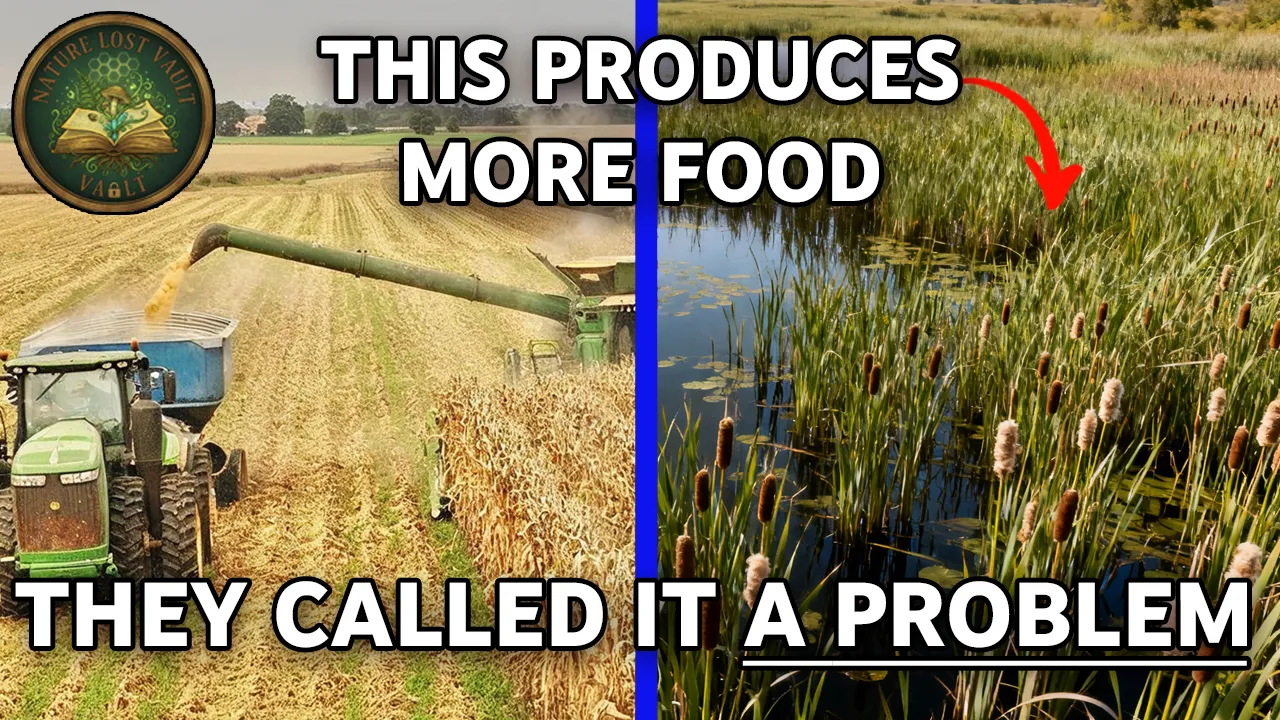
Table of Contents
Recommended Product: Cattail seeds and growing supplies
View Cattail OptionsAffiliate link - supports our channel
What is Cattail?
There is a plant that destroys the concept of famine. It produces food 12 months a year. Root, chute, pollen, seed. Every single part is edible.
It grows in every climate where water touches land. It produces 10 times the starch of potatoes per acre. And it does it without a single drop of fertilizer, without tilling, and without planting. For 30,000 years, this was humanity's grocery store.
Then we drained the grocery store. We replaced a perennial system of abundance with annual farms that poison our water. And we called the most useful plant in history, a weed. This is the story of the supermarket of the swamp that we threw away just before we needed it most.
The archive opens 30,000 years ago along the banks of the Yangtsi River in China. An archaeological site dated to the Paleolithic era. Researchers analyzing ancient tools found something that should not be there. Starch grains.
Not from wheat, not from rice, but from the roots of a wild wetland plant. They found human residues, proving that long before the invention of agriculture, before anyone thought to plow a field, people were processing this plant into flour. Jump forward to a site in Italy 30,000 years old. Grinding stones covered in the same residue.
This was not a backup food. This was a staple in a world where survival meant knowing what to harvest first. Our ancestors chose this not for sentiment, for survival. This is the cattail (*Typha latifolia*), engineered by evolution for one purpose: to feed continuously.
Most crops give you one harvest a year. The cattail gives you four. In early spring, the young shoots emerge from the mud.
Historical Context & Discovery
You peel away the outer leaves to reveal a crisp white core. It tastes like cucumber. When Europeans first tasted it in Russia, they called it cosac asparagus. It was a delicacy that saved thousands from scurvy after long winters.
In early summer, the green flowerheads appear. Before they pollinate, you harvest them and boil them. They taste like corn on the cob, but with a rich earthy depth. In midsummer, the male flowers release their pollen.
This is not dust. It is gold. It is high protein flour ready to harvest. You can shake a single stalk and collect tablespoons of it.
Indigenous peoples mixed it with water to make bright yellow cakes and breads. In winter, when the rest of the world is dead and frozen, the real treasure is waiting underground. You dig the roots, the ryomes. They are packed with 30 to 46% starch by weight.
1 acre of cattails can produce 6,400 lb of flour. That is more than wheat, more than corn, more than rye. And you never planted a seed. The Pyute people had a clan called the cattail eaters.
The Kahila called themselves the cattail people. Daniel Moman's massive ethnobbotanical database catalogs Native American plant use. The entry on cattales is one of the longest in the book. Virtually every tribe that lived near water understood the assignment.
They dried the roots for winter storage. They pounded them into flour for porridge. But it was not just food. It was technology.
Scientific Research & Nutritional Benefits
They wo the leaves into waterproof mats for wigwams. They twisted the fibers into cordage stronger than hemp. They used the fluff from the seed heads to insulate moccasins against the freezing snow and to line the diapers of infants. The jelly found between the young leaves is a potent antiseptic and numbing agent used to treat wounds and toothaches.
One plant provided food, medicine, shelter, and clothing. A natural stand can have 86,000 stems per acre. A single root system can spread to cover 3 acres. This was not a weed.
This was infrastructure. And it required nothing. For 30,000 years, this was the definition of wealth. So, how did a food system this abundant vanish?
It was not nature that killed it. It was policy. The erasia began in 1849. The United States Congress passed the first swamp land act.
It gave millions of acres of federal wetlands to the states on one condition. Drain them. The prevailing economic theory of the 19th century was simple. Water standing on land is waste.
A geological dictionary from 1822 defined a swamp as a piece of land with wet miry soil. Such land is unprofitable or even a nuisance until it be drained. Nuisance, that was the word they used for the ecosystem that fed the continent. By 1850, the act expanded.
Arkansas, Alabama, California, Florida, Illinois, Indiana, Iowa, Michigan, Missouri, Ohio, Wisconsin. 50 million acres were transferred with the mandate to destroy the hydraology. The government published guides on how to do it. Titles like draining for profit became best sellers.
In 1902, the invention of the Buckeye steam traction ditcher mechanized the destruction. It could lay drainage tiles faster than a 100 men. The great black swamp in Ohio, once a massive carbon sink and food forest, was drained dry. The Florida Everglades, 20 million acres were channeled and diverted.
The Sacramento Sanwaqin Delta was drained. Between the 1950s and the 1970s, agricultural drainage alone destroyed 12 million acres of wetlands. Of the 221 million acres of wetlands that once existed in the lower 48 states, only 103 million remain. More than half gone.
And with them, the cattails. What grew in their place? The cornbt, the richest agricultural region in the world. We traded a perennial self- sustaining food system for annual crops that require billions of dollars in fertilizer, pesticides, and diesel fuel.
But wetlands were not just drained for farmland. They were drained because cattails had a fatal flaw. They could not be controlled. You cannot sell someone cattail seeds.
Every year they replant themselves. You cannot patent a plant that spreads across 3 acres from a single root. You cannot tax someone for walking into a marsh and gathering pollen. A perennial food system that regenerates itself is a threat to an economy built on scarcity.
So the wetlands were drained, the cattails were killed, and the knowledge was labeled primitive. But knowledge is harder to kill than plants. And nature has a way of offering solutions to the problems we create. Modern research on cattails began in the 1980s, not for food, but for energy.
Scientists in Minnesota discovered that cattails produce 22 tons of biomass per acre. That is a staggering amount of energy. Then researchers found something even more important. Cattails are the kidneys of the earth.
They absorb nitrogen and phosphorus from polluted water. The fertilizers we spread on our corn fields run off into the water, causing toxic algae blooms. Planting cattails soaks up that pollution. Harvesting 250 acres of cattails removes 5 tons of phosphorus from the ecosystem.
When you burn that biomass for fuel, the ash that remains is pure fertilizer, phosphorus captured and ready to go back on the fields. It is a closed loop. The International Institute for Sustainable Development in Manitoba has been harvesting cattails commercially since 2012. They harvest 15 to 20 tons per acre.
Each ton sequesters over a ton of carbon dioxide. And because cattails are perennial, you harvest them like a lawn. You cut them and they grow back next year. No plowing, no planting, no erosion.
Compare that to corn. Annual planting tilled soil, eroded top soil, polluted water. Cattails heal the water, build the soil, sequester carbon, and produce food for 12 months a year. But almost nobody knows this.
How to Identify, Grow & Use Cattail
We still call them weeds. Landowners across North America spend millions of dollars every year spraying herbicides to kill the most productive food plant on the continent. We are poisoning the solution to protect the problem. The story of the cattail is not about rediscovery.
It is about recognition. The knowledge was never lost, only ignored. And now, while the world spends billions engineering droughtresistant crops and carbon capture machines, the answer has been waiting in the ditch by the side of the road. The plant that fed humanity 12 months a year.
The plant that survived the drainage of 65 million acres. It never stopped offering its gifts. It simply waited for us to remember. This knowledge is not lost.
It grows in every marsh, every riverbank, every pond edge. The plant we called a weed may be the future of survival. All it asks is that we look past the profit of the plow and see what was always there. The supermarket of the swamp.
If this vault opened something for you, subscribe to Naturelost Vault and hit the bell. Every like and every share helps preserve this wisdom together. The next vault opens soon.
Frequently Asked Questions
Is cattail edible?
Yes, every part of the cattail (Typha latifolia) is edible: roots, shoots, pollen, and seed heads. It produces food 12 months a year and has been eaten for over 30,000 years. The roots contain dense starch, shoots taste like cucumber, and pollen is a protein-rich flour substitute.
How much food does cattail produce per acre?
Cattail produces 10x more starch per acre than potatoes with zero planting, tilling, or fertilizer. It grows in any climate where water meets land and regenerates itself indefinitely.
Can you make flour from cattail?
Yes. Both cattail roots and pollen can be made into flour. The roots are dried and ground into a starchy flour for bread and porridge. The pollen is collected in summer and used as a high-protein flour supplement or added to pancake and bread recipes.
Explore More Survival Foods
Discover ancient plants that sustained civilizations through drought, famine, and extreme conditions.
Browse Survival Foods Collection →