
Plant Once, Harvest Forever: Why Don't You Know About It?
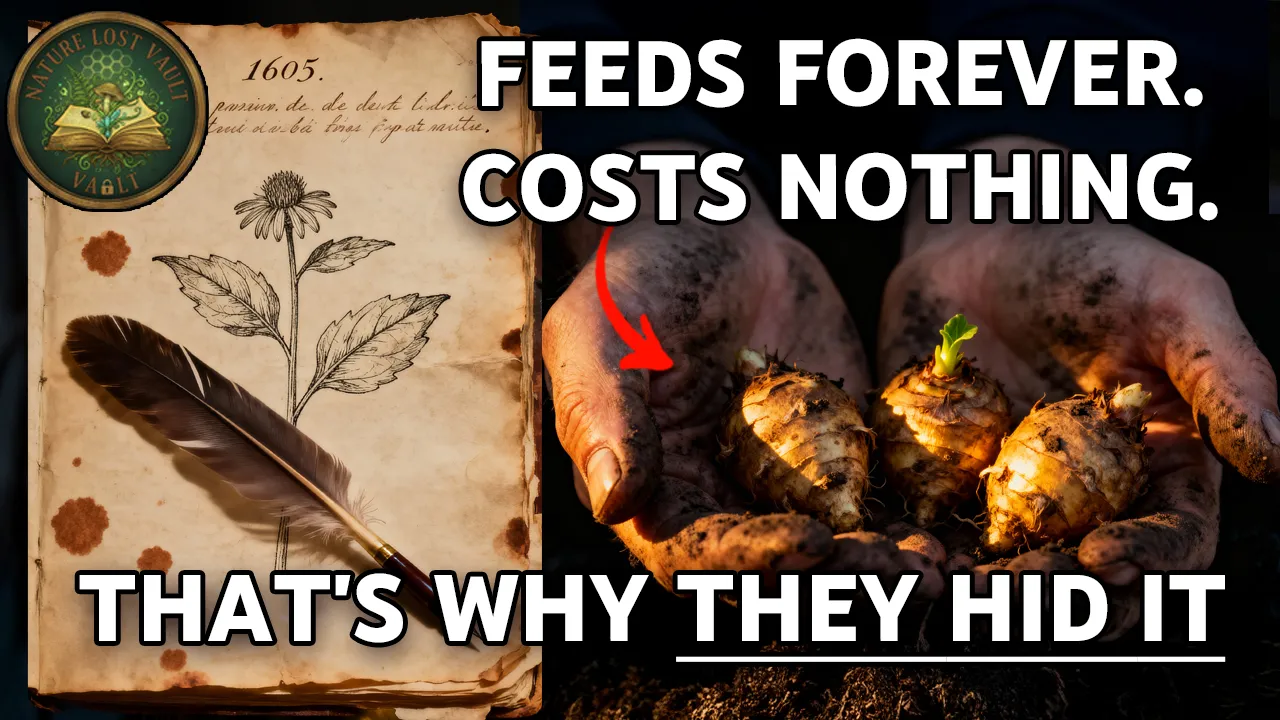
Table of Contents
Recommended Product: Sunchoke seeds and growing supplies
View Sunchoke OptionsAffiliate link - supports our channel
What is Jerusalem Artichoke (Sunchoke)?
There is a crop that breaks every rule of modern farming. It yields double the harvest of potatoes. It survives the cold that kills wheat. And once you plant it, you never have to buy seed again.
It replants itself forever. For thousands of years, it was the ultimate insurance against famine. Then we erased it. We did not stop growing it because it failed.
We stopped growing it because it was too successful. A crop that grows without permission, that feeds without cost, and spreads like wildfire, cannot be owned. And what cannot be owned cannot be sold. This is the story of the perennial that outlasted empires, survived two world wars, and still waits beneath your feet.
Welcome to Nature Lost Vault. Before we open this vault, if these stories matter to you, the best way to preserve this wisdom is simple. Unlock, hit the bell, and share these vaults with those who need to remember what we forgot. The archive opens along the eastern shores of North America in 1605.
A French explorer named Samuel de Champlain lands on the coast of what would become Massachusetts. The Algonquin people welcome him with a feast. Among the dishes is a knobby root they call kaishuk panak, the sun root. Champlain tastes it.
He writes in his journal that it rivals the artichoke of Europe. He fills the hold of his ship with tubers and sails back to France. This is the sunchoke (*Helianthus tuberosus*), the perennial sunflower root native to the Great Lakes and eastern woodlands.
Long before champagne arrived, Native American tribes knew its secret. The Irakquoy told a story. When Earthwoman died giving birth to twin sons, Sapling and Flint, the first sun chokes grew from her feet, a crop born from sacrifice. The plant towers over a man 8 to 10 ft tall, crowned with yellow sunflowers that follow the sun.
But the treasure is invisible, buried beneath the soil. Knobby tubers, white, purple, gold, storing sweetness as inulin, not starch. Tribes from the Atlantic to the Great Plains planted it once and harvested forever. It spread through underground riomes like a network of veins beneath the earth.
One patch fed a village for generations. In 1805, Lewis and Clark nearly starved crossing the Dakotas. Saka Jawia saved them. She found mouse caches, thousands of sun chokes gathered underground for winter.
She dug them up, roasted them over fire, and fed the expedition. The tubers could be eaten raw, crisp like water chestnuts, or boiled until soft. They could be dried into flour that lasted through winter. They survived freezing, waiting in the ground, ready whenever hunger came.
The yield was staggering. A single plant produces 3 to six lb. An acre yields more food than wheat and more food than corn in cold climates. Studies centuries later would prove it.
64,000 per acre without a single drop of irrigation. Potatoes, even in perfect conditions, yielded 53,000 with irrigation. This was survival itself, not luxury. It was the foundation.
Historical Context & Discovery
When Champlain carried sun chokes to France in605, Europe was starving. Soils were exhausted and famines struck every few years. The potato was feared. People believed it caused leprosy.
But the sun choke spread like salvation. The French called it topinamore. The Italians called it giraasola, sunflower. It fed peasants, livestock, even kings.
No fertilizer, no care. Plant a tuber in spring and harvest in fall. Leave fragments in the ground and next year a full crop appears on its own. University trials centuries later confirmed what farmers knew.
Sunchoke produced 30,000 per acre. Potato produced 20,000 in calories. Sun chokes rivaled corn, the world's most important grain. But cracks appeared.
The tubers were small, knobbyby, and irregular, difficult to clean, and difficult to harvest by machine. They spoiled faster than potatoes and could not sit in warehouses for months, and the inulin caused gas in people unused to it. By the mid700s, the potato won. larger, smoother, easier to store.
It fit the systems Europe had built. Warehouses, markets, tax collectors. The sun choke fell, reduced to food for the poor and animal feed, a crop for those with nothing better. In North America, settlers called it a weed.
They preferred European crops, wheat and potatoes. Crops that required buying seed every year. Crops that could be controlled, taxed, and sold. The sun choke survived in ditches, roadsides, forgotten corners.
But it was no longer cultivated, no longer valued, just waiting. Then war came. World War I. Germany was strangled by an Allied blockade.
The winter of 1916 became known as the turnip winter. People ate rutagers meant for livestock because potatoes had failed. Thousands died. Sunchokes saved some growing wild in forgotten fields.
They could not be blockaded. They could not be seized. They were just waiting underground for desperate hands. But World War II was worse.
In France in 1940, Nazi forces seized 80% of all food. Potatoes were sent to German soldiers. What was left for French families was scraps, sun chokes, rutbagers, vegetables once fed to pigs. For 9 years, millions survived on top.
People despised it. The tubers were small and hard to clean. Eaten everyday, they caused terrible gas. Still, they kept children alive when everything else was gone.
Scientific Research & Nutritional Benefits
The Nazi hunger plan seized food from occupied lands while millions starved. But sun chokes could not be controlled. They were too hardy, too wild. They just grew.
In the Netherlands, the winter of 1944 became the hunger winter. 22,000 people died of starvation. The government published emergency cookbooks that listed wild plants, tulip bulbs, and sun chokes. Families dug frozen ground with their bare hands looking for tubers.
After liberation, survivors refused to eat them. An entire generation associated top with death, with occupation, with the worst years humanity had seen. In France, grandparents who survived would not allow it on their tables. Never again.
The vegetable that saved millions became a symbol of suffering. It disappeared from markets, from cookbooks, from memory. But war could not change what sun chokes were. 73 calories per 100 g, 2 g of protein, potassium at 429 mg, more than bananas.
iron, copper, magnesium, B vitamins flooding every cell. The real power is inulin, 50 to 60% by weight. One of Earth's richest sources. Inulin passes through your stomach undigested and reaches your colon intact.
Beneficial bacteria, especially bifidoacterium, feast on it. They multiply and produce short-chain fatty acids. These lower pH, block pathogens, and help absorb calcium and magnesium that would otherwise pass through. Studies showed it reduces constipation and boosts immune function.
It may stop certain cancers before they start. Potatoes spike blood sugar. Sun chokes do not. The inulin converts to fructose slowly.
Diabetics in the 1980s wrote letters saying they ate sun chokes daily and their insulin needs dropped by half. Folk medicine validated by science. And the plant heals land. It is perennial, requiring no tilling and causing no erosion.
Its deep roots crack compacted soil. It tolerates drought, poor dirt, and cold to minus30° C. Where annual crops die, sun chokes thrive. They were designed for chaos.
In the 1960s in California, a produce wholesaler named Freda Kaplan stared at knobbyby tubers gathering dust. The name was killing it. Jerusalem artichoke. Confusing.
Wrong. It was not from Jerusalem and it was not an artichoke. The Italian word girasole, meaning sunflower, had been corrupted by English tongues. She renamed it sonoke and trademarked the name in 1980.
She packaged it in one lb bags with recipes. Sales jumped 600%. Chefs discovered it. Nutty, sweet, crisp when raw, and creamy when cooked.
High-end restaurants in San Francisco served sun choke soup, roasted sides, and purees. But something bigger was happening. In the 1980s, the farm crisis hit, and Midwest farmers were collapsing. An experiment began.
Grow sun chokes for food, feed, fuel, and independence from corporate supply chains. High yields, perennial, ethanol from inulin fermentation. Perfect. It failed economically.
No market, no processing infrastructure. Farmers lost money. But the idea survived. A crop for self-sufficiency for communities that refuse corporate control.
In France, decades after the war, chefs reclaimed topinamore. Leum Zubli, the forgotten vegetables, not symbols of suffering anymore. Heritage. By the 2000s, sun chokes appeared in farmers markets across North America and Europe.
Permaculture called them the holy grail. One planting forever harvests. Today, scientists study them for marginal lands. Where climate change kills wheat and corn, the sun choke waits, born in chaos, built for extremes, resilience.
So why don't we see it everywhere? Industrial agriculture demands uniformity. Crops that ripen on schedule, harvest by machine, ship without bruising, store for months, look perfect under fluorescent lights. Sun chokes refuse, they mature at different times.
Spoil quickly, potato harvesters lose half the tubers. Too small, too attached to roots. Efficient harvest requires specialized equipment or hand labor. Neither scales, neither profits.
and the inulin problem. What makes them nutritionally superior also causes gas. The gut bacteria need time to adapt. But modern food does not tolerate adaptation periods.
It demands instant satisfaction. The nickname spread far to choke. A joke. Even Julia Child wrote asking, "Can you fix the flatulence problem?" Yes, cook longer.
Heat converts inulin to fructose. Or eat small amounts. Let your body adjust. But that requires patience.
Industrial food has none. So sun chokes stay nichch. Farmers markets, specialty crops, and home gardens where they spread uncontrollably. That uncontrollable spread is the point.
You cannot kill sun chokes without poison. Any fragment sprouts. In Europe, they are called invasive when they escape. Invasive, the word we use for things that succeed without permission, things that do not need us.
Things that remind us control is an illusion. The sun choke teaches what empires want buried. Abundance does not require control. Perennials return without permission.
They do not need seed purchases, chemical inputs, corporate approval. They adapt, persist, outlast. But crops that persist without profit are dangerous. The sun choke out yields potatoes, heals dead soil, feeds communities without middlemen.
It cannot be patented, cannot be owned, cannot generate perpetual revenue. So it is called primitive, difficult, unsuitable. The pattern repeats. Amaranth was banned by concistadors for being too sacred.
Temporary beans were erased by machines that could not handle their freedom. Mosquite was cleared for cattle that destroyed what the tree protected. Father beans were replaced by pills that charge $500 for what grows free in gardens. Indigenous crops that enable sovereignty are systematically erased.
Not because they fail, because they succeed without chains. The sun choke survived by being unkillable. But most people alive today have never tasted one. They have never watched it grow.
They have never learned that planting three tubers in autumn yields 30 by spring. That knowledge waits underground. Climate change is coming. Droughts, floods, heat.
How to Identify, Grow & Use Jerusalem Artichoke (Sunchoke)
The crops feeding 8 billion people were bred for stability. That stability is ending. The sun choke was born in chaos. It stores energy where drought cannot reach.
It survives cold that kills potatoes. It outproduces corn using 1/3 of the water. When industrial systems fail, the sun choke will be ready. It has been ready for four centuries.
French families survived occupation eating topam boore they hated. Dutch mothers dug frozen ground for tubers to feed starving children. Native Americans called it kaishuk panarch sunroot. A gift from earthwoman's sacrifice.
Names change. Memory fades. It resurfaces. But the plant never left.
perennial underground waiting for hands willing to dig. We did not lose the sun choke. We just forgot it. But forgetting is not final.
The knowledge lives in the soil. In every wild patch, in every escaped tuber, in every gardener who plants three and harvests 30. This crop teaches through persistence, through a refusal to die. Abundance was always here, growing in the dirt, free.
If this vault opened something for you, subscribe to Nature Lost Vault and hit the bell. Every like and every share preserves what they tried to erase. The next vault opens soon.
Frequently Asked Questions
How much food does Jerusalem artichoke produce?
Jerusalem artichoke yields double the harvest of potatoes per acre. It is a perennial tuber that replants itself every year, survives frost to -40F, and produces food for decades with zero replanting or maintenance.
Is Jerusalem artichoke a perennial?
Yes. Jerusalem artichoke (Helianthus tuberosus) is a true perennial. You plant it once and it regrows every year, spreading through underground tubers. One planting can produce food indefinitely with no replanting needed.
What does Jerusalem artichoke taste like?
Jerusalem artichoke has a sweet, nutty flavor similar to a cross between artichoke and sunflower seeds. It can be eaten raw, roasted, mashed, or made into soup. It contains inulin, a prebiotic fiber that feeds beneficial gut bacteria.
Explore More Perennial Foods
Discover ancient plants that sustained civilizations through drought, famine, and extreme conditions.
Browse Perennial Foods Collection →